Chapter 1: The Strange Hotel Check That Experienced Travelers Never Forget
Imagine arriving at a hotel after a long journey.
You have spent hours at the airport, waited for your luggage, traveled through an unfamiliar city, and finally reached the room where you hope to relax.
The bed looks comfortable, the curtains are closed, the bathroom is clean, and everything appears ready for a peaceful evening.
Most guests would immediately put down their luggage, take a shower, and begin unpacking.
But some experienced travelers follow a slightly different routine.
Before settling down, they take an ordinary water bottle, crouch near the bed, and roll it underneath.
It might seem like an unusual habit. Why would anyone throw a perfectly good bottle of water under a hotel bed?
The answer is surprisingly simple: it is a quick way to check whether something is blocking the space underneath the bed.
The idea became widely discussed after Dutch flight attendant Esther Sturrus shared the technique on social media.
Because her job requires frequent travel and hotel stays, she has developed a collection of practical habits for checking unfamiliar accommodation.
Her water bottle trick attracted particular attention because it requires almost no preparation.
Travelers do not need special equipment, expensive security devices, or technical knowledge. They simply use something they may already have in their luggage.
The technique works on a straightforward principle.
If a hotel bed has enough clearance underneath, a bottle rolled from one side should generally travel beneath it and emerge on the opposite side, provided the space is unobstructed.
If the bottle stops unexpectedly, something may be blocking its path.
That object could be a suitcase, a storage box, discarded bedding, or another ordinary item.
However, in the context of hotel safety, the possibility that someone could be hiding underneath the bed is what makes the technique particularly interesting.
A person hiding in a dark space beneath a bed may not be immediately visible when a guest first enters the room.
Rather than immediately bending down and putting their face close to the floor, a traveler can use the bottle as a preliminary check.
If it does not emerge, the traveler has a reason to investigate further.
It is important to understand that this is only a precaution, not a guaranteed security test. A bottle may become trapped because of the bed's design, carpet, furniture supports, or objects stored underneath.
Likewise, a bottle passing through does not prove that every part of the room is safe.
Nevertheless, the idea offers an inexpensive way to notice an obstruction that might otherwise go unnoticed.
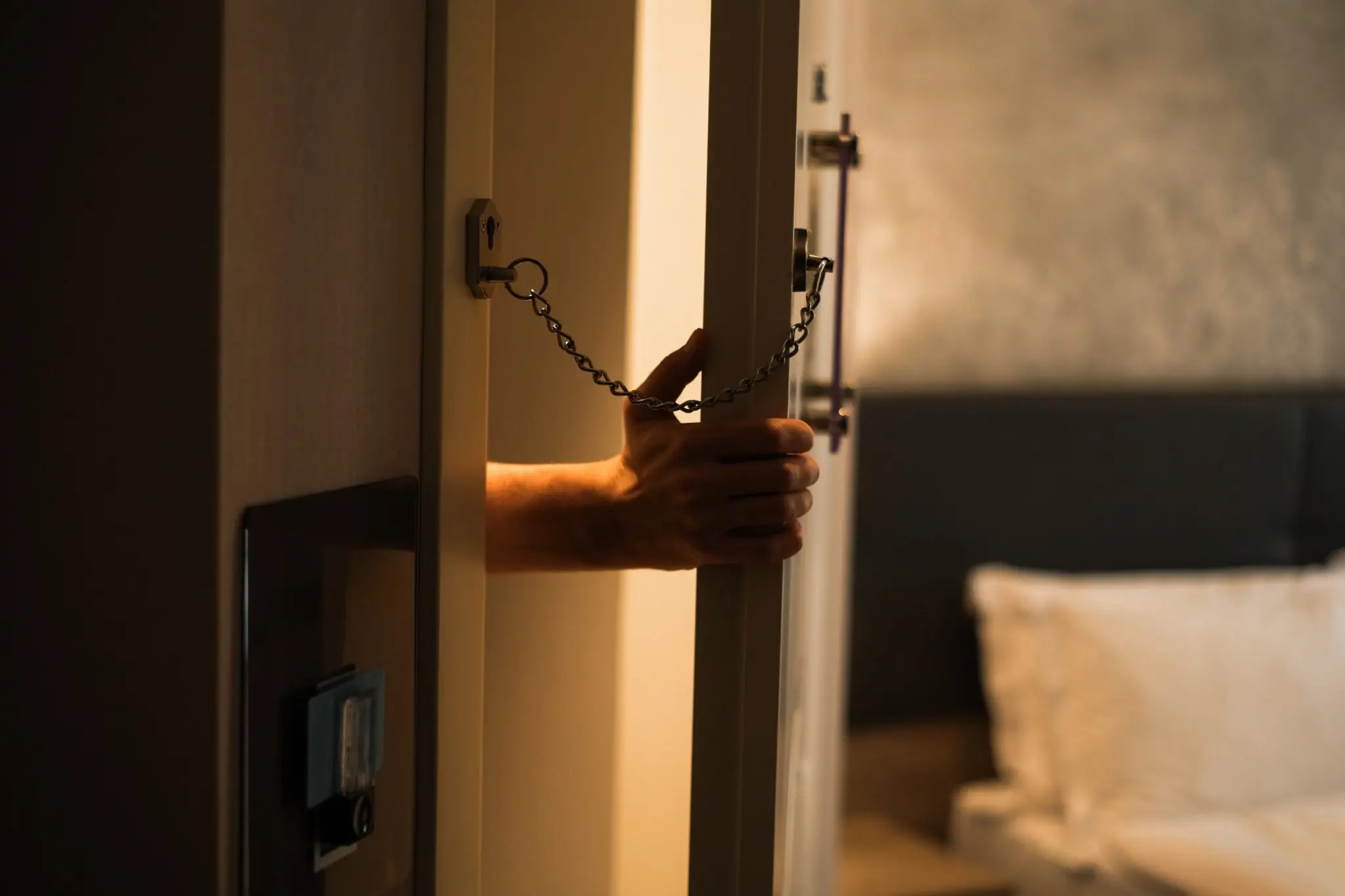
What makes the trick particularly appealing is its simplicity.
Many hotel rooms have beds with a gap between the mattress frame and the floor. This creates a space that can be difficult to inspect without getting down on one's hands and knees.
For travelers with limited mobility, back discomfort, or heavy luggage, physically inspecting every corner may be inconvenient.
A rolling bottle can provide a first indication of whether the space is clear.
The technique is also useful as a reminder that hotel rooms are unfamiliar environments.
Even in reputable hotels, guests should not automatically assume that everything is arranged exactly as expected.
Housekeeping staff may have moved furniture, maintenance workers may have left equipment behind, and previous guests may have forgotten belongings.
A quick inspection can reveal ordinary problems before they become inconvenient.
For solo travelers, the idea can provide an additional sense of reassurance.
Traveling alone often means making decisions without the immediate support of another person. Guests may arrive late at night, stay in unfamiliar neighborhoods, or check into accommodation where they have never stayed before.
Small habits can help them feel more prepared.
However, the goal should not be to make people afraid of every hotel room.
Hotels are designed to accommodate travelers, and most stays are uneventful.
The bottle technique is simply one small precaution among many.
Its popularity demonstrates something interesting about modern travel: sometimes the most useful advice is not complicated.
It is often a simple habit that takes only a few seconds but encourages people to pay attention to their surroundings.
And once travelers understand the reason behind the trick, many begin wondering what other parts of a hotel room they should inspect before going to sleep.
Chapter 2: What Happens If the Water Bottle Does Not Come Out?
The most important part of the water bottle technique is understanding what happens when the bottle fails to emerge from the opposite side of the bed.
Imagine standing near the foot of a hotel bed. You have a plastic bottle in your hand, and there appears to be enough space underneath the furniture for it to pass through.
You gently roll the bottle toward the other side.
If it travels smoothly and appears on the opposite side, the space is probably clear along that particular path.
But what if it suddenly stops?
This is when travelers should pay attention.
An unexpected obstruction may have several explanations, and it is important not to jump to conclusions.
The first possibility is ordinary hotel furniture.
Some beds have support legs, wooden crossbars, storage compartments, or decorative panels that prevent objects from passing underneath. A bottle may hit one of these structures and stop even when nothing unusual is present.
The second possibility is luggage or housekeeping equipment.
Hotels sometimes have extra pillows, blankets, storage boxes, or cleaning supplies placed underneath beds. Previous guests may also have pushed personal belongings into the space without realizing they were leaving something behind.
A bottle could become trapped against any of these objects.
The third possibility is something that requires closer attention: an unidentified object or an unusual obstruction that should not be there.
Although it is uncommon, the possibility of someone hiding in an accessible space underneath a bed is the reason the technique became popular.