When people think about nighttime home security, they often focus on alarms, cameras, motion sensors, or stronger locks.
But there is another simple habit that sometimes gets discussed: leaving a key in the inside of a door at night.
The idea sounds straightforward. If the key is already in the lock, you don't have to search for it during an emergency, and depending on the type of door lock, the key may also affect how the lock can be manipulated from outside.
However, there is an important catch.
Leaving a key in a door is not automatically safer. The effect depends entirely on the lock design, the type of door, and how the home is configured. In some situations, an interior key can actually create a safety problem—particularly if it interferes with emergency escape.
So before adopting the habit, it's worth understanding what it can and cannot do.
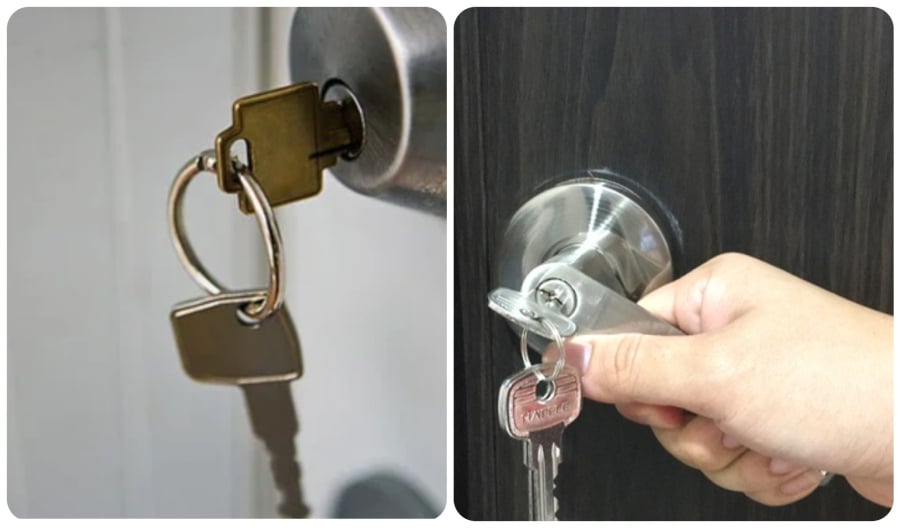
Why Do Some People Leave a Key in the Door at Night?
The most obvious reason is convenience.
Imagine waking up to:
-
A fire alarm
-
Smoke in the house
-
A medical emergency
-
A suspicious noise
-
A power outage
-
Another situation requiring you to leave quickly
If your door requires a key from the inside, having the key already in the lock means you don't have to search for it in the dark.
That can be useful when you're disoriented or under stress.
But there is an important distinction between having a key immediately available and leaving a key permanently inserted in the lock.
Those aren't necessarily the same thing.
1. The Type of Lock Makes a Huge Difference
Not all locks work the same way.
Some doors have:
-
A key cylinder on both sides
-
A thumb-turn on the inside
-
A deadbolt
-
A multipoint locking system
-
A smart lock
-
A night latch
-
An emergency-function cylinder
Because of these differences, advice that works for one lock may be completely inappropriate for another.
Before following any "key in the door" tip, understand how your particular lock operates.
2. Some Locks Require a Key to Exit
Older or certain types of double-cylinder locks may require a key on the inside as well as outside.
This can create a serious concern.
Imagine a fire starts at night.
Smoke fills the hallway.
You need to leave immediately.
If the key isn't where you expect it to be, finding it under pressure can cost valuable time.
For this reason, emergency egress should always be considered before prioritizing burglary resistance.
3. Fire Safety Comes First
A door lock is supposed to protect your home.
It should never make it difficult for occupants to escape during an emergency.
If leaving a key in the lock makes it easier for everyone in the household to unlock the door quickly, that may be useful.
But if the key can be removed, misplaced, turned incorrectly, or interfere with the lock's operation, the arrangement may not be ideal.
Every household should know exactly how to unlock its exterior doors in darkness.
4. Children and Older Adults Need Special Consideration
A locking system that seems simple to an adult may be confusing to a child or older person.
In an emergency, people may panic.
They may:
-
Forget where the key is
-
Turn it the wrong direction
-
Struggle with a stiff lock
-
Drop the key
-
Become disoriented
The safest setup is one that everyone who may need to escape can operate quickly.
Practice matters more than a viral security trick.
5. The Key May Not Actually Improve Security
One common misconception is that putting a key in the interior side of a lock automatically makes the door more resistant to break-ins.
That's not necessarily true.
Security depends on the entire locking system.
Factors include:
-
Lock quality
-
Door construction
-
Door frame
-
Strike plate
-
Hinge protection
-
Cylinder design
-
Installation
-
Window placement
-
Overall property security
Simply inserting a key doesn't transform an ordinary lock into a high-security lock.
6. Some Cylinders Have Special Security Features
Modern locks may include features designed specifically for situations involving keys on both sides.
One example is an emergency or double-clutch function.
Depending on the lock, this can allow an exterior key to operate the lock even when a key is already inserted on the inside.
Other cylinders may behave differently.
That's why it's important to check the manufacturer's specifications rather than assuming every lock works the same way.
7. Test Your Lock Before Relying on It
If you're considering leaving a key in the door, test the lock during the daytime.
Don't experiment during an emergency.
Check:
Can the door be opened quickly from inside?
Can everyone in the household operate it?
Does an interior key prevent another authorized key from working outside?
Does the lock require a particular position before the key can be removed?
Does the door still lock correctly?
If you're unsure, ask a qualified locksmith.
8. Don't Leave a Key Where It Can Be Seen Through Glass
There's another security issue that is often overlooked.
If your door contains glass panels or there is a nearby window, leaving a key visibly hanging in the lock may potentially give someone outside information about the locking mechanism or provide an opportunity to manipulate it, depending on the door design.
Avoid assuming that "key in the lock" is automatically secure.
Consider the entire door configuration.
9. Avoid Hiding Spare Keys in Obvious Places
A common habit is leaving a spare key:
-
Under a doormat
-
Under a flowerpot
-
On top of the door frame
-
Inside a nearby mailbox
These locations are widely known.
If you need an emergency spare key, consider a more secure arrangement such as a properly installed key safe or leaving a spare with a trusted person.
10. Smart Locks Change the Situation
If your home uses a smart lock, there may be no reason to leave a traditional key inserted at night.
Depending on the model, you may have:
-
A keypad
-
Fingerprint access
-
Smartphone control
-
Physical backup key
-
Interior thumb-turn
-
Automatic locking
But smart locks also require planning.
What happens if:
-
The battery dies?
-
The phone isn't available?
-
The Wi-Fi goes down?
-
The keypad malfunctions?
A reliable backup method is important.
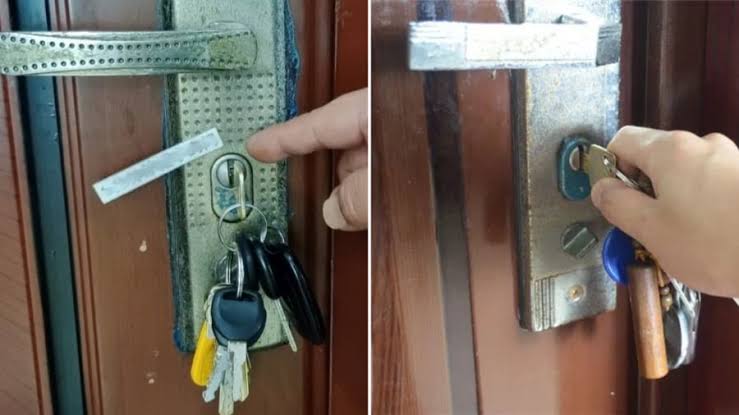
11. Automatic Locking Can Be Convenient
Some smart locks automatically lock after a certain period.
This can help people who frequently forget to lock the door.
But automatic locking should be balanced against emergency access.
Everyone in the household should know how to unlock the door manually if necessary.
12. Your Door Frame May Matter More Than Your Key
People often focus heavily on the lock cylinder.
But a strong lock installed into a weak door frame may not provide much protection.
The security of an entry door depends on the entire system.
A good lock can be undermined by:
-
A weak strike plate
-
Short screws
-
A damaged frame
-
Poor installation
-
A lightweight door
For meaningful security improvements, evaluate the entire entry point.
13. Check the Strike Plate
The strike plate is the metal component attached to the door frame that receives the bolt.
A properly installed, reinforced strike plate can improve resistance against certain forms of forced entry.
If your door is older, it may be worth having a locksmith or security professional inspect the installation.
14. Long Screws Can Improve Certain Door Installations
Depending on the construction of the door and frame, longer screws may allow hardware to be anchored more securely into the structural framing.
However, this isn't something to change blindly.
The appropriate hardware depends on the door and frame.
A professional can determine whether reinforcement is appropriate.
15. Don't Forget the Hinges
If a door opens outward, the hinge configuration may deserve attention.
Some doors have hinge pins or hardware that may be accessible from outside.
Security hardware can be used in some situations to address this.
Again, the exact solution depends on the door.
16. Windows Can Be a Bigger Weak Point
A highly secure front-door lock doesn't help much if an easily accessible window is left unlocked.
Home security is strongest when you consider:
-
Doors
-
Windows
-
Garage entrances
-
Basement doors
-
Patio doors
-
Sliding doors
A thief generally looks for the easiest opportunity rather than necessarily attacking the strongest part of the house.
17. Don't Forget the Garage
Garage doors can provide another route into a home.
At night:
-
Keep the garage door closed
-
Don't leave the remote visible in an unsecured vehicle
-
Lock the interior door between the garage and house
-
Check that the interior door has an appropriate lock
A garage should be treated as part of the home's security perimeter.
18. Outdoor Lighting Can Help
Good exterior lighting can make a property less attractive for someone who wants to remain unnoticed.
Consider lighting around:
-
Front entrances
-
Side doors
-
Garage entrances
-
Pathways
-
Dark areas near windows
Motion-activated lighting can be useful in appropriate locations.
But avoid creating excessive glare that actually makes it harder to see what's happening outside.
19. Cameras Can Provide Another Layer
Security cameras don't physically stop someone from entering.
But they can provide:
-
Alerts
-
Recorded evidence
-
Remote monitoring
-
Visibility around entrances
A camera works best as part of a broader security strategy rather than as the only protective measure.
20. Don't Rely on a Single Security Trick
There is no magic household habit that guarantees safety.
Good home security usually involves multiple layers:
Strong doors
Good locks
Secure windows
Lighting
Alarms
Cameras
Awareness
Good emergency planning
The goal is to make unauthorized entry more difficult while making emergency escape easy.
21. Emergency Escape Should Be Practiced
One of the best nighttime safety habits has nothing to do with keys.
Practice how everyone will leave the house during:
-
A fire
-
Heavy smoke
-
A power outage
-
Another emergency
Know:
Which door is the primary exit?
What is the backup exit?
Where should everyone meet outside?
Who helps children?
Who helps elderly family members or people with disabilities?
A plan is much more useful when everyone knows it before an emergency happens.
22. Keep Exit Routes Clear
A perfectly functioning lock doesn't help if the path to the door is blocked.
Don't place:
-
Furniture
-
Boxes
-
Shoes
-
Bicycles
-
Storage containers
in areas that could obstruct an emergency exit.
At night, darkness makes obstacles even more dangerous.
23. Keep a Flashlight Accessible
A small flashlight beside the bed can be surprisingly useful.
Power outages can make it difficult to locate:
-
Keys
-
Phones
-
Shoes
-
Emergency exits
A flashlight can help you navigate safely.
Many smartphones also have built-in lights, but a dedicated flashlight with charged batteries can be useful if your phone battery is low.
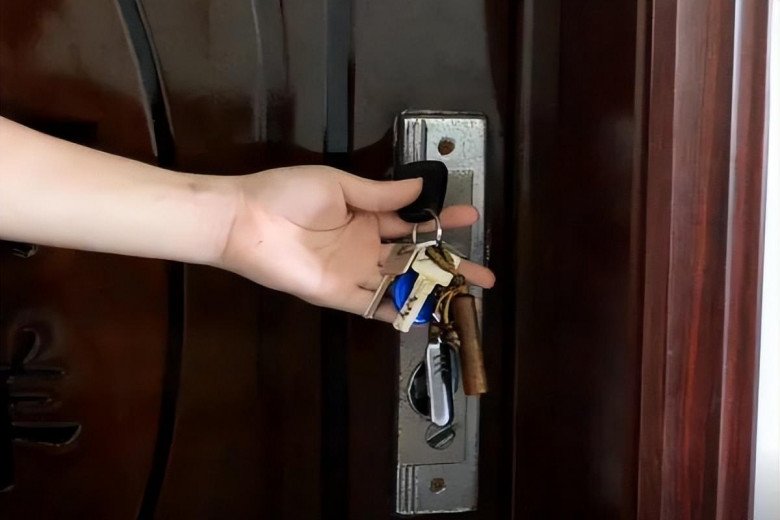
24. Keep Your Phone Nearby
A phone can be important during emergencies.
Keep it somewhere accessible rather than across the house.
If something happens during the night, you may need to:
-
Call emergency services
-
Contact family members
-
Activate an alarm
-
Use a flashlight
-
Receive emergency alerts
25. Don't Lock Yourself Into a Dangerous Situation
Security measures should never make it impossible to leave.
This is particularly important with:
-
Double-keyed deadbolts
-
Security bars
-
Improvised locks
-
Chains
-
Additional interior barriers
If a fire occurs, you need to be able to escape quickly.
Always balance security with emergency egress.
26. What About Leaving a Key in the Lock While Sleeping?
Whether this is a good idea depends on the lock.
For some locks, it may simply provide convenient access.
For others, it may interfere with the ability to unlock the door from outside.
For certain doors, it may also create a safety issue if the key can be removed or manipulated.
So there isn't one universal answer.
Check your specific lock.
27. A Locksmith Can Give You a Definitive Answer
If you're unsure whether leaving a key in your lock is safe, a qualified locksmith can inspect the mechanism.
They can tell you:
-
How the cylinder operates
-
Whether it has an emergency function
-
Whether an interior key affects exterior operation
-
Whether the lock meets current security needs
-
Whether a replacement cylinder would be beneficial
This is much more reliable than following a generic social-media tip.
28. Consider an Interior Thumb-Turn
For some homes, a lock with a thumb-turn on the inside can make emergency exit simpler.
You don't need to search for a key.
However, whether a thumb-turn is appropriate depends on the specific door, building requirements, and security needs.
A locksmith can recommend an appropriate configuration.
29. Fire Safety Should Always Take Priority
A useful rule is:
The best security system is one that keeps unwanted people out without preventing people inside from getting out.
This is especially important at night, when occupants may be asleep and less aware of what's happening.
A door should be secure but still easy for authorized occupants to open from the inside.
30. Don't Assume More Locks Always Mean More Safety
Adding multiple locks can sometimes make a door more secure.
But too many locking mechanisms can also create confusion during an emergency.
Every additional device should have a clear purpose.
If a family member cannot quickly understand how to unlock the door, reconsider the setup.
31. Teach Everyone How the Door Works
Don't assume children or guests know how your locks operate.
Show household members:
-
Where the key is
-
How the lock turns
-
Which direction it operates
-
How to unlock the door quickly
-
What to do if the power goes out
-
What to do during a fire
This is especially important for older adults and anyone with limited mobility.
32. Don't Advertise Your Security Routine
You don't need to publicly share details about:
-
Where you keep spare keys
-
Which locks you use
-
When the house is empty
-
Your alarm schedule
-
Your security weaknesses
Avoid posting highly specific security information publicly.
33. Think About Security During Vacations Too
When traveling, simple precautions can make a difference.
Before leaving:
-
Lock doors and windows
-
Secure garage entrances
-
Avoid leaving spare keys in obvious places
-
Use appropriate lighting
-
Ask a trusted person to check the property if necessary
-
Avoid publicly announcing that your home is empty
34. The "Key in the Door" Habit Isn't a Universal Security Hack
This is perhaps the most important takeaway.
You may see online posts claiming:
"Put your key in the door every night and burglars won't be able to get in."
That's far too broad.
Different locks behave differently.
Some locks may actually be easier or harder to manipulate depending on the key position and cylinder design.
There is no universal rule that an inserted key automatically prevents burglary.
35. What Should You Do Instead?
Rather than relying on one trick, focus on proven fundamentals.
At night:
-
Lock exterior doors
-
Lock accessible windows
-
Close the garage
-
Keep keys accessible but secure
-
Keep emergency exits clear
-
Turn on appropriate exterior lighting
-
Activate your alarm if you have one
-
Keep your phone nearby
For long-term security:
-
Upgrade weak locks
-
Reinforce vulnerable doors
-
Secure windows
-
Improve lighting
-
Consider cameras
-
Maintain your alarm system
-
Address structural weaknesses
36. A Simple Nighttime Security Routine
You can create a routine that takes only a few minutes.
Step 1: Check the doors
Confirm that exterior doors are locked.
Step 2: Check accessible windows
Especially ground-floor windows.
Step 3: Check the garage
Make sure the garage door is closed.
Step 4: Check the emergency exit
Make sure it remains easy to open from inside.
Step 5: Check your alarm
Activate it if appropriate.
Step 6: Keep your phone nearby
Make sure it has enough battery.
Step 7: Keep a flashlight accessible
Especially if power outages are possible.
This routine is more useful than relying on a single viral trick.
37. What If You Hear Something Outside at Night?
Don't immediately open the door.
If you hear an unusual noise:
-
Check through a secure window or camera
-
Turn on exterior lights
-
Keep doors locked
-
Avoid confronting strangers
-
Contact authorities if you believe there is an immediate threat
Home security is about reducing unnecessary exposure to danger.
38. Don't Open the Door Just Because Someone Knocks
If someone arrives unexpectedly at night, you don't have to open the door.
Use:
-
A peephole
-
Doorbell camera
-
Intercom
-
Window from a safe location
to determine who is there.
If you don't recognize the person and have concerns, keep the door locked.
39. The Best Security Habit May Be Simple Awareness
Technology is useful, but awareness still matters.
Knowing:
-
Who has keys
-
Which doors are vulnerable
-
Where emergency exits are
-
How locks work
-
What to do during a power outage
can make your home safer.
40. The Bottom Line
Keeping a key in the door at night may be convenient in some homes, particularly when the key is needed to unlock the door from inside.
But it isn't a universal security trick.
Whether it improves or reduces safety depends on the specific lock and door.
The most important question isn't:
"Should everyone leave a key in the door?"
It's:
"Can everyone in the home unlock the door quickly during an emergency, while the door remains appropriately secured against unauthorized entry?"
If the answer is yes, your setup is probably serving its purpose.
If you're unsure, have the lock inspected by a qualified locksmith.
And remember that home security isn't only about preventing someone from getting in. It's also about making sure everyone inside can get out quickly when something goes wrong.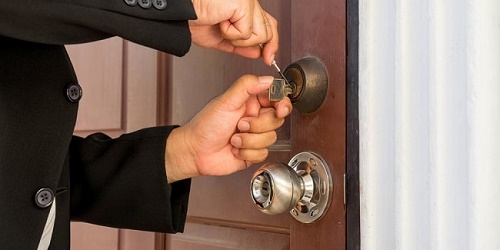
Final Thoughts
The idea of leaving a key in the door at night sounds like a tiny household trick, but it raises a much bigger issue: good security has to balance protection with accessibility.
A locked door can provide an important barrier against unauthorized entry. But during a fire, medical emergency, or other crisis, every second can matter.
That's why your nighttime routine should focus on the whole system:
Secure your doors.
Check your windows.
Keep emergency exits clear.
Make sure everyone knows how the locks work.
Keep your phone and a flashlight accessible.
Consider alarms, lighting, and cameras where appropriate.
And if you're thinking about leaving a key permanently in a lock, check how your particular lock is designed before making it a habit.
Sometimes the simplest safety improvement isn't a secret trick at all—it's understanding how your home's existing security system actually works.