Most people do not give much thought to the position they choose when going to bed. After a long day, they simply climb under the covers, close their eyes, and settle into whatever position feels comfortable. Some stretch out across the mattress, others curl into a tight ball, while many instinctively hug a pillow or place their arms above their heads.
Yet the way people sleep has become a subject of considerable curiosity. Images showing different sleeping positions often claim that a person's posture reveals whether they are lazy, energetic, confident, anxious, or emotionally sensitive. These claims can be entertaining, but they should not be confused with scientific conclusions.
There is no reliable evidence that sleeping in a particular position determines someone's personality or work ethic. A person who sleeps with their arms stretched above their head is not necessarily more relaxed than someone who curls up on their side. Likewise, sleeping in a compact position does not mean someone is timid, insecure, or unwilling to take on responsibilities.
What sleeping positions can reveal more reliably is how people arrange their bodies for comfort, how certain postures affect breathing and pressure on the joints, and whether their nighttime habits may be contributing to discomfort.
The body does not remain completely still throughout the night. Most people change positions several times while sleeping, sometimes without remembering it in the morning. These movements are part of the body's natural response to pressure, temperature, discomfort, and different stages of sleep.
A position that feels comfortable when someone first gets into bed may become uncomfortable after an hour. The shoulder may begin to ache, the lower back may feel strained, or the arm may become numb because of pressure. The sleeper then moves, often automatically, until a more comfortable position is found.
This explains why a person's favorite sleeping position may not be the only position they use.
The eight illustrations commonly seen in sleeping-position charts represent several familiar patterns: sleeping on the back with the arms raised, lying straight with the arms beside the body, spreading the arms and legs outward, curling into a fetal position, sleeping on the side with the hands near the face, raising the arms overhead, hugging a pillow, and lying in a twisted or partially curled posture.
Each position has different physical characteristics.
Some may be comfortable for people who experience back discomfort. Others may help reduce snoring or improve comfort during pregnancy. Certain positions, however, can place pressure on the neck, shoulders, hips, or lower back when maintained for long periods.
The most important question is not whether a particular sleeping position makes someone lazy. It is whether that position allows the body to rest without unnecessary strain.
Sleep is essential for nearly every system in the human body. During adequate sleep, the brain processes information, the immune system performs important functions, and the body regulates hormones involved in appetite, metabolism, and stress. Poor-quality sleep can affect concentration, mood, memory, and physical performance.
That is why understanding sleeping habits can be useful.
A person who wakes up refreshed may have found a comfortable routine that supports their needs. Someone who repeatedly wakes with headaches, shoulder pain, numbness, or extreme fatigue may need to examine their sleep environment and habits more carefully.
The position itself is only one part of the picture. Mattress quality, pillow height, room temperature, stress, medical conditions, and sleep duration can all influence how someone feels in the morning.
The eight positions in the image offer a useful starting point for understanding these differences. But before examining them individually, it is important to recognize one basic principle: the best sleeping position is generally the one that supports comfortable breathing, keeps the spine reasonably aligned, and allows uninterrupted rest.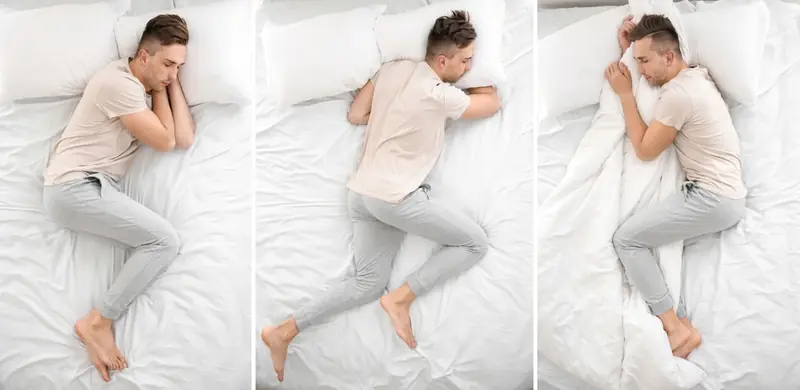
Chapter 2: Positions 1–4 — From Sleeping on Your Back to Curling Up
Position 1: Sleeping on Your Back With Your Arms Raised
The first position shows a person lying on their back with both arms raised near the head.
Some people naturally fall asleep this way because it allows their shoulders and upper body to relax. Others find that raising their arms reduces the feeling of pressure across the chest or makes the upper body feel more comfortable.
Sleeping on the back can have several advantages.
For some individuals, it distributes body weight relatively evenly across the mattress. This may reduce pressure on the hips and shoulders compared with certain side-sleeping positions. It can also make it easier to maintain a neutral spinal position when the mattress and pillow provide appropriate support.
However, raising the arms overhead is not comfortable for everyone.
Keeping the arms elevated for extended periods may place strain on the shoulders, particularly in people who already have shoulder injuries, stiffness, or limited mobility. Some individuals may wake with tingling or numbness if their arm position compresses nerves or restricts circulation.