The Attorney General's Office opened its investigation because the death of Cisneros followed an encounter with NYPD officers. That review is not a substitute for examining the stabbings themselves. It is a separate process focused on the circumstances in which police force caused a death.
The distinction is important because one tragic event can involve several people whose actions and experiences must be assessed individually.
The surviving stabbing victim deserves attention and care. The family of the woman who died deserves accurate information about the attack. The officers involved are entitled to a fair examination of their actions. The family of Cisneros may also seek answers about the circumstances surrounding her death.
A serious investigation should not treat any of these interests as unimportant.
It should also avoid reducing the incident to a debate in which every detail is used to support a predetermined position. Public safety and accountability are not opposing goals. A community can recognize the danger officers faced while also expecting a transparent review of a fatal use of force.
That is why evidence matters more than speculation.
What Is Known, What Remains Unclear, and What Should Not Be Assumed
The most reliable way to understand the incident is to separate the confirmed official account from details that remain subject to investigation.
The New York Attorney General's Office confirmed that Pamela Cisneros died on August 31, 2026, after an encounter with NYPD officers in Manhattan. Its preliminary statement said she had stabbed two people in Times Square, was holding a knife in each hand when officers encountered her on Seventh Avenue, did not comply with commands to drop the weapons, and was not stopped by three Taser deployments. Two officers then fired their service weapons, and she died after being taken to hospital.
New York State Attorney General
News reports identified one stabbing victim as 32-year-old Erin Piacenti, who died, and the other as a 68-year-old man who survived the attack and was reported to be in stable condition.
The NYPD later released body-camera footage, according to NBC New York, offering additional material about the minutes before the shooting.
What remains important is the final independent assessment of the police shooting. The Attorney General's preliminary announcement did not provide a final determination about whether the use of force was lawful. It explicitly cautioned that the facts could change as the investigation progressed.
New York State Attorney General
It would also be wrong to connect the wrecked car shown in the supplied screenshot to the Times Square incident without evidence. The image appears to show a vehicle that has suffered severe crash damage, with emergency vehicles and responders nearby. The written report, however, describes a knife attack and police shooting. No supplied information establishes that the damaged vehicle was involved in either event.
That distinction matters for readers. A dramatic photograph can attract attention, but the image must not be allowed to create a false account of what happened.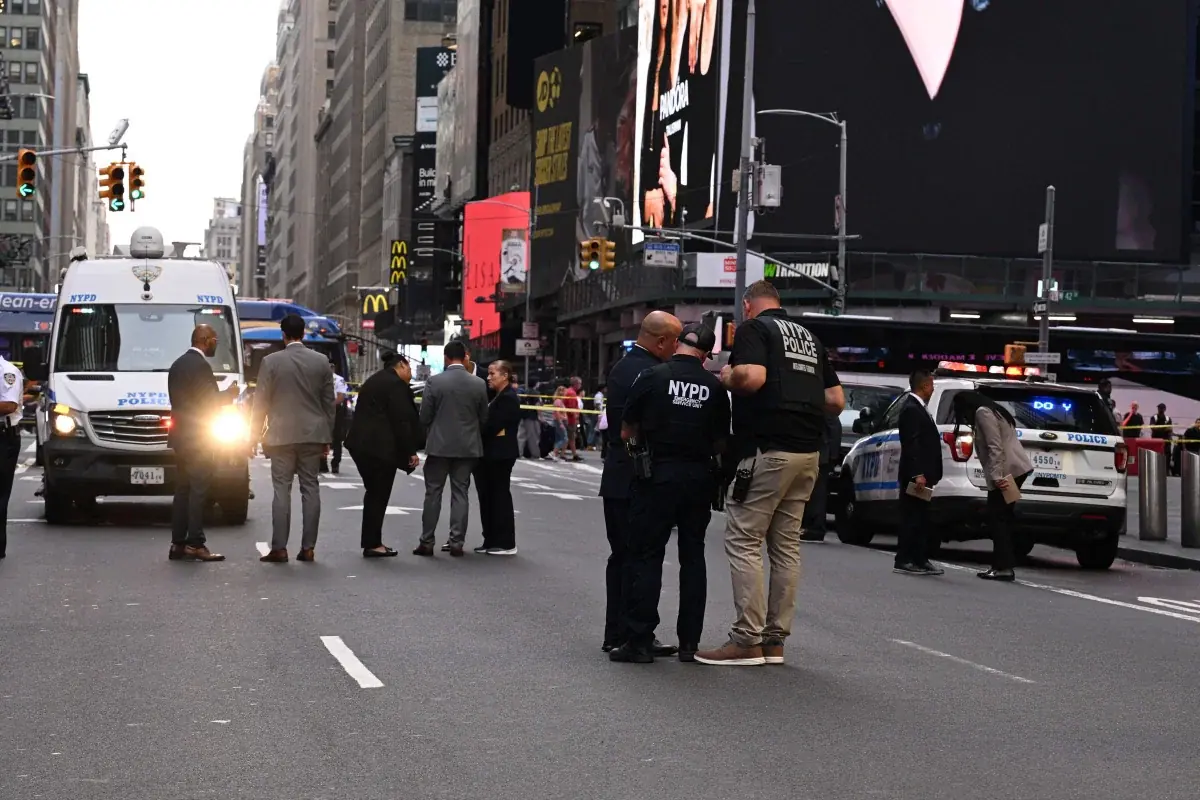
The Human Cost Behind the Headlines
Breaking-news reports often summarize a tragedy in a few lines: two people stabbed, one victim dead, another hospitalized, and a suspect fatally shot by police.
But those numbers do not capture the full consequences.
For the family of Erin Piacenti, the incident meant losing someone whose life extended far beyond the location where she was attacked. Her colleagues, friends, and loved ones were left to process a sudden death that occurred during an ordinary day in Manhattan.
For the 68-year-old man who survived, recovery may involve more than the immediate treatment of physical injuries. A violent attack can leave emotional consequences that continue after hospital treatment has ended.
For people who witnessed the incident, the memory of the emergency response may remain vivid. The sound of sirens, the sight of police weapons, and the sudden closure of a familiar public space can be difficult to forget.
The officers involved also experienced a serious and potentially traumatic event. Police shootings are subject to review, but the people involved may also need medical and psychological support after an encounter in which firearms were used.
And for the family of Cisneros, her death raises questions that may never be fully answered by a short official statement.
These human consequences are easy to overlook when attention is focused entirely on the dramatic sequence of events. Yet they are part of the reason why accurate reporting and careful investigation matter.
A Tragedy That Requires More Than a Quick Conclusion
The August 31 incident in Times Square was a serious act of public violence. Two pedestrians were stabbed, one of them died, and the woman identified by authorities as the attacker was fatally shot by police after officers attempted to stop her.
The location, the number of people affected, and the use of deadly force made the event particularly significant. It also triggered an independent investigation under New York law.
The available information provides a broad outline of what happened, but an official preliminary timeline should not be mistaken for the final word. Investigators must examine the recordings, witness accounts, physical evidence, and circumstances surrounding the shooting before a definitive conclusion can be reached.
The photograph supplied with the original report shows a badly damaged car at an emergency scene. It is visually dramatic, but it should not be presented as proof of a vehicle crash connected to the Times Square stabbing. The confirmed written account concerns the attacks on pedestrians and the subsequent police confrontation.
Ultimately, the story is about more than an alarming scene in one of the world's busiest tourist districts. It is about the people who were attacked, the officers who responded, the family members left grieving, and the responsibility of public authorities to establish what happened.
One victim lost her life, another was injured, and the woman at the center of the attack also died. The investigation that followed is essential to understanding the final moments of the encounter—and to ensuring that the public receives answers grounded in evidence rather than speculation.