Deadly Times Square Stabbing: One Victim Dies After Police Shoot Armed Woman in Manhattan
A violent encounter near Times Square left one person dead and another injured, prompting a major police response and a review of the fatal shooting.
The flashing lights of emergency vehicles, the sight of a badly damaged car, and the presence of police officers can make any New York street feel suddenly unfamiliar. But the incident described in the supplied report is even more disturbing than the photograph might first suggest: it concerns a reported knife attack in the heart of Manhattan, a police confrontation that ended with a woman being fatally shot, and a victim who later died from their injuries.
The incident also raises difficult questions. What happened before officers opened fire? Why were two people attacked? Could the confrontation have ended differently? And what happens after a police shooting in New York, when investigators must examine not only the original violence but also the actions taken by officers?
There is an important distinction to make at the outset: the photograph shows a severely wrecked vehicle at an emergency scene, but the written account describes a knife attack and a fatal police shooting near Times Square. The image alone does not establish that the vehicle was involved in the reported stabbing. The account below follows the details supplied in the text and separates those claims from facts that would require independent confirmation.
The story is not simply about a frightening moment on a busy Manhattan street. It is also about the people caught in the violence, the police response, the investigation that follows an officer-involved death, and the questions that remain when a public incident ends but the search for answers continues.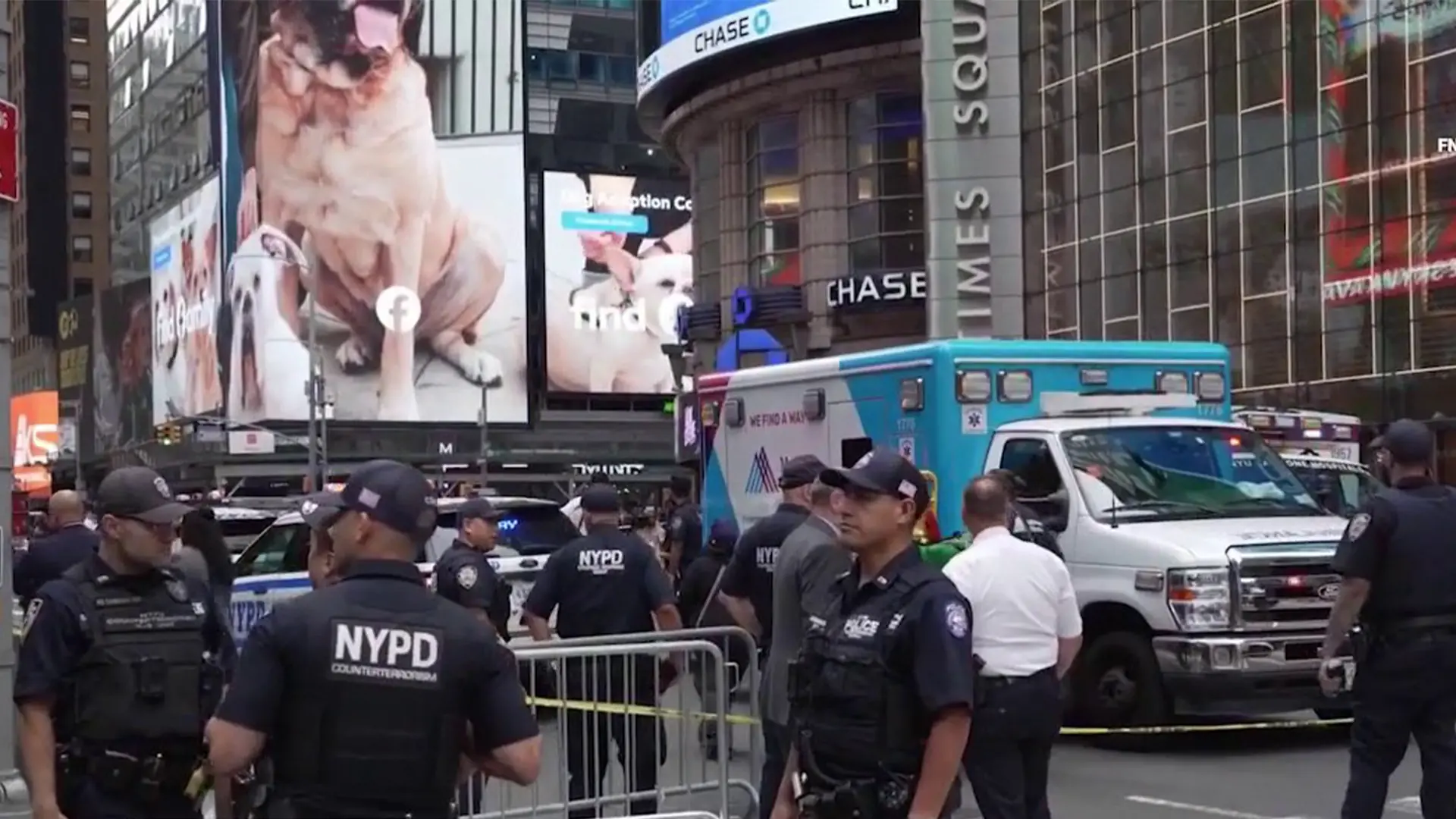
What Happened in Times Square on August 31, 2026?
According to the New York Attorney General's Office, the incident began on the afternoon of August 31, 2026, when two people were stabbed in Times Square. The woman later identified as Pamela Cisneros, 49, was reported to have attacked both victims before officers encountered her on Seventh Avenue, between West 42nd and West 43rd Streets.
The location matters. Times Square is not an isolated stretch of road where an emergency might go unnoticed. It is one of Manhattan's best-known public spaces, surrounded by theaters, shops, hotels, subway entrances, restaurants, and busy pedestrian routes. At almost any hour, visitors and New Yorkers move through the area in large numbers.
An incident involving knives in such a crowded setting can create danger far beyond the people directly attacked. Pedestrians may run in different directions, drivers may be unable to move through the street, and witnesses may struggle to understand what is happening. People who are nearby can suddenly find themselves trying to escape, call emergency services, or help someone who has been injured.
The official account places the police encounter at approximately 4:26 p.m. Officers found Cisneros holding a knife in each hand. They ordered her to drop the weapons, but she did not comply. Three officers then deployed Tasers, which had no apparent effect. The Attorney General's Office says Cisneros allegedly moved toward officers while still holding the knives. Two officers discharged their service weapons, striking her. She was taken to a hospital, where she was pronounced dead.
That sequence is central to understanding why the case received attention beyond the original stabbings. There were two separate forms of violence to investigate: the attacks on civilians and the fatal use of police force.
The supplied screenshot describes the two victims as one person who died and another who was hospitalized. Later reporting identified the deceased victim as 32-year-old Erin Piacenti and the surviving victim as a 68-year-old man. The Associated Press reported that the man was in stable condition after being taken to hospital.
The tragedy therefore involved three deaths or injuries that cannot be treated as a single statistic: the death of the woman who was stabbed, the injuries sustained by the older man, and the death of the woman shot by police.
For the families and people close to those involved, the consequences were far more personal than the brief descriptions that appeared in breaking-news alerts.
Two Victims, Two Lives Interrupted
The first reports focused on the number of people attacked and the rapid police response. But behind those details were two people who had been going about an ordinary day in New York.
According to reporting by NBC New York, the first victim was a 68-year-old man who had recently exited the subway and was waiting to cross the street with his wife. He was stabbed in the abdomen. The second victim, identified in later coverage as 32-year-old Erin Piacenti, was also stabbed and later died in hospital.
The fact that the attacks were described by police as apparently random and unprovoked made the incident especially frightening. People often think of public violence as something connected to a personal dispute, a robbery, or a confrontation between people who know one another. An apparently random attack challenges that expectation.
For someone walking through a crowded shopping district, waiting to cross a street, or leaving a subway station, there may be no obvious warning that danger is approaching. The ordinary routine of a city can change in seconds.
It is important, however, not to turn the victims into anonymous figures in a dramatic headline. The older man was a person with a family and a life beyond the brief description of his injuries. Piacenti's death also meant that relatives, friends, and colleagues faced a sudden loss.
The public details of an incident rarely capture the full impact on those closest to the victims. Families may have to deal with hospital visits, difficult conversations, funeral arrangements, and the challenge of understanding how an ordinary afternoon became a life-changing tragedy.