A Sudden, Painful Spot on Your Child’s Foot: A Gentle Guide for Worried Parents (And When to Seek Immediate Care)
Your child wakes up, takes the first step out of bed, and suddenly cries because something on the bottom of their foot hurts. You look closer and notice a dark, raised spot near the toes. It may look purple, almost black, or like a small bubble filled with blood. Yesterday, the foot seemed perfectly normal. Now your child is reluctant to stand, walk, or even let you touch the area.
For a parent, that sudden change can be frightening. Is it a blood blister caused by rubbing? Could it be an insect bite, a splinter, a wart, or an infection? And, most importantly, how can you tell whether it is safe to watch at home or whether your child needs medical attention straight away?
The photograph accompanying this article shows a rounded, dark, raised spot on the sole near the toes. Its appearance may be consistent with a blood blister, but a photograph cannot confirm the cause. Several conditions can produce a similar-looking mark, and a painful lesion on a child's foot deserves attention to its appearance, tenderness, size, and the child's ability to walk.
This guide explains the possibilities in calm, practical language. First, we will look at what a blood blister is and why it can appear so suddenly. Then we will explore other possible causes, what parents can safely do at home, and the warning signs that mean it is time to seek medical care. The aim is not to make you diagnose your child from a picture, but to help you make a safer, more confident decision.
What Is a Blood Blister, and Why Does It Look So Dark?
A blood blister is a small pocket of blood trapped beneath the surface of the skin. It forms when pressure, pinching, or friction damages tiny blood vessels while the outer layer of skin remains partly intact.
An ordinary blister usually contains clear fluid. A blood blister contains blood, which is why its color may range from red or deep purple to brownish-black. Depending on the depth of the trapped blood and the thickness of the skin, it can look surprisingly dark.
The skin covering the blister acts like a natural protective layer. Beneath it, the damaged tissue gradually repairs itself while the trapped blood is reabsorbed or dries out. This is why a small, uncomplicated blood blister often becomes flatter and changes color as it heals.
Why Can a Blood Blister Develop on the Sole?
The bottom of a child's foot experiences repeated pressure throughout the day. Every step places weight on the heel, the ball of the foot, and the area beneath the toes. Running, jumping, climbing, dancing, and playing sports can increase the amount of friction and pressure.
A blood blister may develop when:
-
Shoes are too tight and repeatedly press against one part of the foot.
-
Shoes are too loose, allowing the foot to slide and rub.
-
A seam, rough lining, or small object inside a shoe repeatedly irritates the skin.
-
A child runs or plays for longer than usual in unfamiliar footwear.
-
A foot is pinched, squeezed, or struck during play.
-
A child walks barefoot over a rough surface and experiences repeated friction.
The area shown in the photograph is close to the ball of the foot, just beneath the toes. This region carries considerable pressure during walking and running. A blister in that location can therefore be uncomfortable even when it is relatively small.
Children do not always notice the first signs of rubbing. They may continue playing until the skin becomes sore. By the time a parent sees the foot, a blister may already have formed.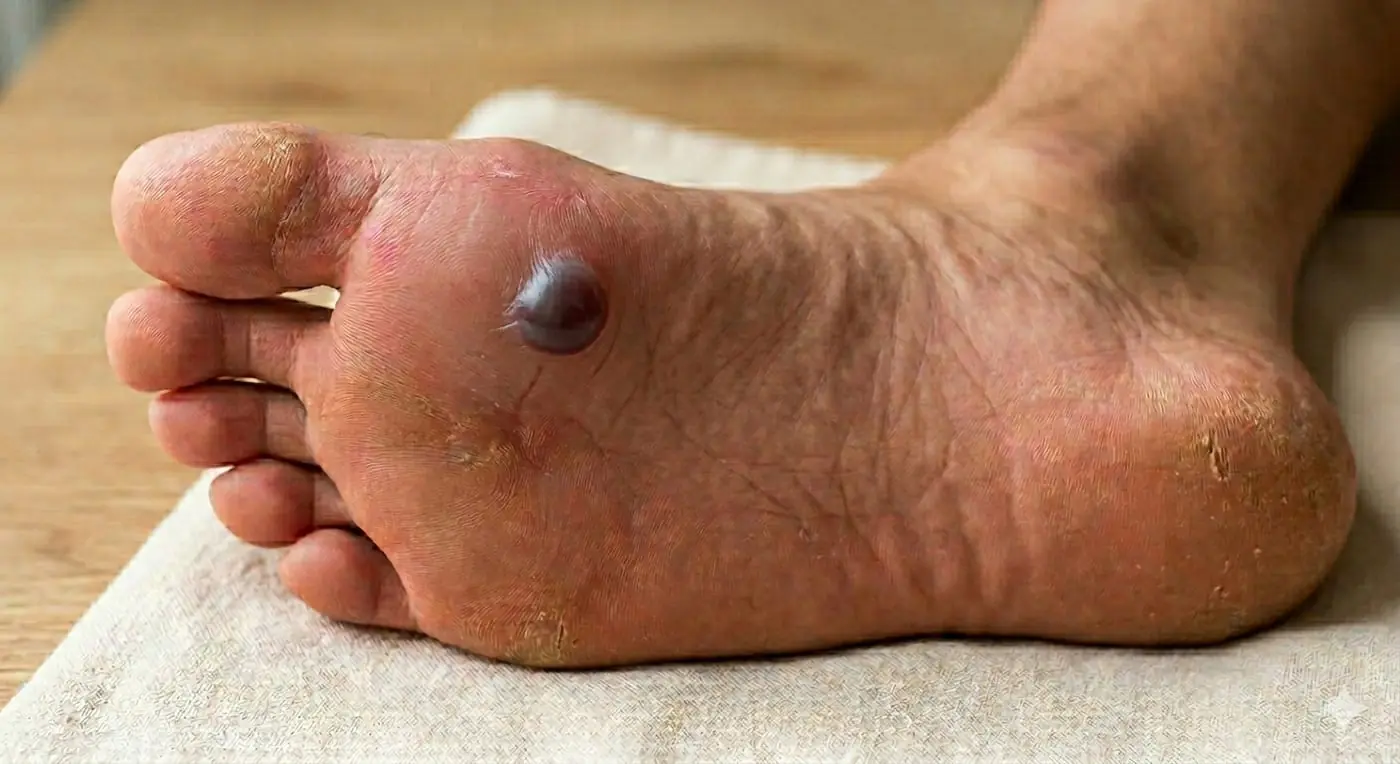
Why Does It Look Like a Dark Bubble?
The dark color can be alarming, especially when the spot appears almost black. However, a blood blister can naturally look dark because the blood is trapped under the outer layer of skin.
The appearance can change over time. A newer blister may look red or purple, while an older one may become darker as the blood settles and dries. The surface may be smooth, shiny, rounded, or slightly raised.
The important point is that color alone cannot establish the diagnosis. A dark spot on the sole could also be caused by bruising, a small foreign object, a wart with tiny blood vessels, or another skin condition. If the cause is uncertain, the lesion is growing, or the child is having significant pain, a healthcare professional should examine it.
Does a Blood Blister Mean Something Dangerous?
Usually, a small blood blister caused by ordinary friction or a minor pinch is not dangerous. It often heals without special treatment.
However, not every dark or painful spot is a simple blood blister. A blister can become infected, and a painful spot may have another cause that needs attention. Parents should therefore consider the whole picture rather than focusing only on the color.
Ask yourself:
-
Did the child recently wear new shoes?
-
Has the child been running, dancing, or playing more than usual?
-
Is the spot exactly where the shoe presses against the foot?
-
Does the child have pain only when the area is touched or when standing?
-
Is the surrounding skin becoming red, hot, or swollen?
-
Is the child otherwise well, or are there symptoms such as fever or unusual tiredness?
These details can help a clinician understand what may have happened. They are not a substitute for an examination, but they can make the consultation more useful.
How to Tell Whether It Might Be a Blood Blister
Parents do not need to become skin specialists to notice useful clues. The following features may help describe what they see, although none can confirm the diagnosis on its own.
Appearance
A blood blister often looks like a rounded, raised bubble beneath an intact layer of skin. It may be dark red, purple, burgundy, brown, or nearly black.
The surface is usually smooth rather than rough or grainy. The color may appear concentrated in the center, and the edges may blend into the surrounding skin.
Feel
The spot may feel tender when touched or pressed. A blister on the sole can be particularly uncomfortable because the pressure of standing pushes against it.
Some children describe the feeling as a sharp sting, while others say it feels like stepping on a small stone. Younger children may simply refuse to walk or become upset when their shoes are put on.
Location
Blood blisters can occur on the toes, heels, soles, fingers, and hands. On the foot, they may appear in places where pressure or rubbing is repeated.
A lesion beneath the toes or on the ball of the foot may be associated with footwear or physical activity. A spot that appears after a finger or toe has been pinched may have a different mechanical cause.
Duration
An uncomplicated blood blister generally improves gradually. It may become flatter, darker, or drier before the surface skin eventually sheds.
Some uncomplicated blisters heal over approximately one to two weeks, although the exact time varies with size, location, and repeated pressure. A lesion that does not improve, keeps returning, or becomes more painful should be assessed.
Other Possible Causes of a Painful Spot on a Child's Foot
The screenshot's article begins to discuss other possible causes, including insect bites. This is important because a dark, raised spot on the foot is not automatically a blood blister.
The same general area can be affected by bites, splinters, warts, infections, bruises, and other skin conditions. Their treatment can be quite different, so parents should avoid trying to remove or treat an uncertain lesion as though its cause were already known.
1. Insect Bites and Stings
Insect bites are common during childhood, particularly when children play outside, walk through grass, visit parks, or spend time near gardens.
A bite may cause a small raised bump, redness, swelling, itching, or tenderness. Some children develop a larger local reaction than others. In certain cases, a bite can form a small blister.
The location may offer a clue. If the child has several itchy spots on exposed skin, an insect bite may be more likely than a single pressure-related blister. However, bites can occur on the soles too, particularly when children walk barefoot.
What might an insect bite look or feel like?
-
A raised bump, sometimes with a small central puncture mark.
-
Itching that may be more noticeable than pain.
-
Local swelling or redness.
-
Warmth around the affected area.
-
Occasionally, a small fluid-filled blister.
A bite that is mainly itchy and appears soon after outdoor exposure may fit this pattern. But a painful dark bubble is not enough to identify an insect bite with certainty.
What can parents do?
Gently wash the area with soap and water. A cool compress may help reduce discomfort and swelling. Discourage scratching because broken skin can become infected.