Chapter 1: The Viral Eagle Story That Captured the World's Attention
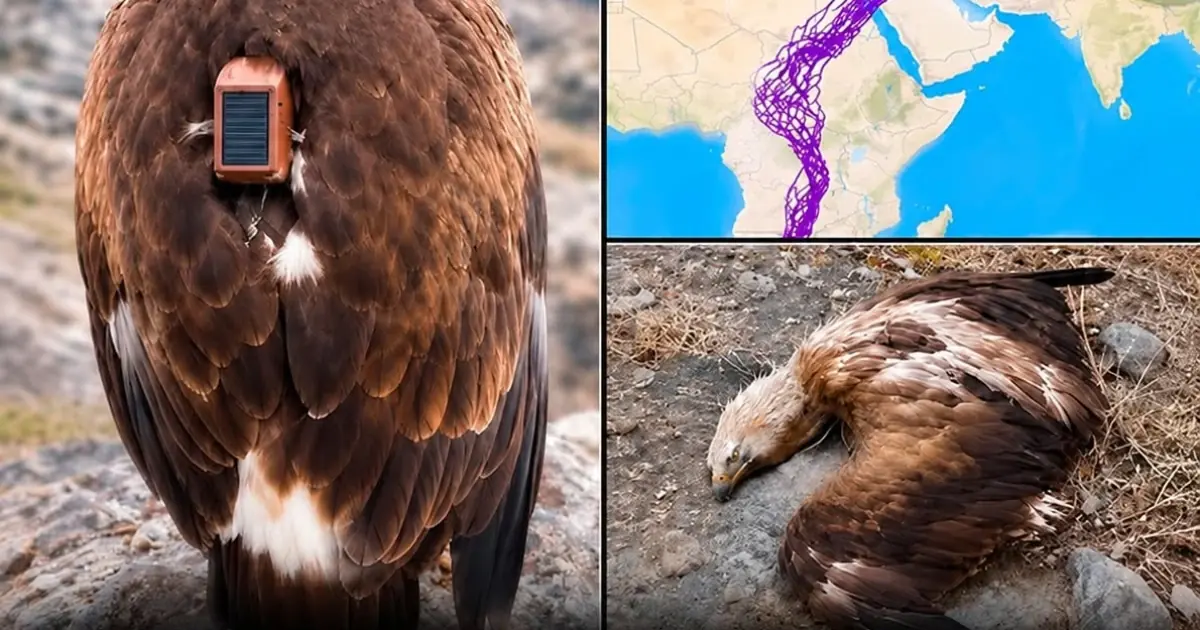
For years, a dramatic image circulated across social media, showing a large eagle carrying a tracking device, a map covered with purple flight paths, and a photograph of a bird that appeared to have died far from where it began its journey.
The accompanying story was astonishing. According to the viral claim, a scientist had attached a GPS tracker to an eagle in Russia, and the bird had continued flying across several countries for twenty years. Eventually, it supposedly died in Saudi Arabia, leaving behind a remarkable record of its travels.
The map appeared to support the story. Its countless lines stretched across enormous distances, crossing deserts, mountains, and unfamiliar landscapes. Some routes seemed to follow the edges of continents, while others passed through regions that would be difficult for many animals to reach.
For readers, the image seemed to offer a rare glimpse into the life of a wild creature whose movements would otherwise remain invisible.
But the real story was different.
According to fact-checking investigations, the map did not represent one eagle's twenty-year journey. Instead, it showed the movements of approximately twenty juvenile steppe eagles tracked during a study conducted in 2018. The birds were monitored for around ten months, and each line represented the movements of an individual eagle rather than the lifetime route of a single animal.
The misunderstanding appears to have developed after a photograph of a dead eagle with a tracking device was shared alongside the migration map. Information about the bird and the research was reportedly mistranslated, eventually creating the dramatic claim that one eagle had been followed for two decades.
Although the original story was inaccurate, the scientific findings remain fascinating.
Steppe eagles are migratory birds of prey that travel between breeding areas and warmer regions during different seasons. Their journeys can involve crossing several countries, navigating changing weather conditions, and searching for suitable places to rest and feed.
The birds tracked during the study provided researchers with valuable information about how young eagles move through unfamiliar landscapes.
A juvenile eagle does not necessarily follow the same route as an experienced adult. It may explore different areas, respond to changing environmental conditions, and gradually develop patterns that help it survive.
GPS tracking allows researchers to observe these movements in a way that was previously impossible.
Instead of relying on occasional sightings or reports from distant locations, scientists can collect repeated location data and reconstruct a bird's route across large geographical areas.
The resulting maps may appear confusing at first, but every line represents a real movement recorded by a tracking device.
The important lesson from the viral eagle story is that scientific discoveries can be extraordinary without being exaggerated.
A group of young eagles traveling thousands of kilometers across continents is already an impressive natural phenomenon. Their movements reveal how wildlife responds to geography, weather, food availability, and seasonal changes.
The truth is not a disappointing replacement for the legend. It is a more meaningful story about the lives of real animals and the scientific methods that help us understand them.
Chapter 2: The Steppe Eagle and Its Remarkable Migration
The steppe eagle is a large bird of prey associated with open landscapes, including grasslands, semi-deserts, and broad plains. Its powerful wings and keen eyesight help it search for food across extensive areas.
Unlike birds that remain in one territory throughout the year, many steppe eagles migrate seasonally. They move between breeding regions and wintering areas as temperatures, food supplies, and environmental conditions change.
Migration is not simply a matter of flying from one point to another.
A bird must make countless decisions during its journey. It needs to find suitable air currents, avoid dangerous weather, locate food, and identify places where it can rest safely.
For a young eagle undertaking its first long migration, these challenges may be especially demanding.
The bird may have little experience of the landscapes ahead. It must respond to unfamiliar mountains, wide deserts, rivers, and human-made obstacles.
Researchers studying steppe eagles have therefore become interested in the differences between individual migration routes.
Some birds may travel through particular regions repeatedly, while others may take different paths depending on conditions.
GPS data can help reveal these variations.
When a tracking device records the location of a bird at regular intervals, researchers can identify the general direction of travel, estimate the distance between locations, and determine where the bird spends time.
The information can also reveal whether an eagle appears to be moving steadily or remaining in one area for an extended period.
Such observations are useful because migration is not always continuous.
A bird may stop for several days while searching for food or waiting for favorable weather. It may also spend time in an area that provides shelter from strong winds.
These pauses are an important part of migration rather than evidence that the journey has failed.
The steppe eagle's movements are particularly interesting because the species uses broad geographical corridors that connect different environments.
A route may begin in open grassland, pass through dry regions, and continue toward areas where food is more readily available during winter.