There is no single sensation that means:
“This is bone cancer.”
Some people describe bone-related pain as deep and aching.
Others may describe pressure, tenderness, or a persistent discomfort that becomes more noticeable over time.
The timing may also vary.
Some people notice symptoms more during activity.
Others may notice discomfort at rest.
Nighttime pain is sometimes mentioned in descriptions of bone tumors, but it is not specific to cancer. Many benign and inflammatory conditions can also become more noticeable at night.
So rather than asking:
“Is nighttime pain cancer?”
A better question is:
“Why is this pain persistent, and what other symptoms are occurring with it?”
Primary Bone Cancer vs. Cancer That Spreads to Bone
When people hear “bone cancer,” they sometimes imagine one single disease.
In reality, there are different situations.
Primary bone cancer
This begins in bone or related tissues.
It is uncommon compared with many other cancers.
Different types exist, including osteosarcoma, chondrosarcoma, and Ewing sarcoma, among others.
Bone metastasis
This occurs when a cancer that began somewhere else in the body spreads to the bone.
Common primary cancers that can spread to bone include certain cancers of the breast, prostate, lung, kidney, and thyroid.
These are biologically different from a cancer that starts in bone itself.
The distinction matters because treatment and prognosis can be very different.
Who Can Develop Primary Bone Cancer?
Primary bone cancers can occur at different ages depending on the specific type.
Some forms are more commonly diagnosed in younger people, while others are more common in adults.
That is another reason the phrase “bone cancer” cannot be treated as a single disease.
Age can influence what doctors consider, but it doesn't allow someone to diagnose the condition from symptoms alone.
Why Early Symptoms Can Be Misunderstood
Perhaps the biggest challenge is that many early symptoms look ordinary.
Consider pain.
Pain is common.
Consider swelling.
Swelling is common.
Consider fatigue.
Extremely common.
Consider an injury.
Also common.
That creates a natural tendency to ignore symptoms until they become difficult to live with.
A person might wait because they assume:
“I must have pulled something.”
“I probably slept badly.”
“It will go away.”
“It's just getting older.”
Sometimes that assumption is correct.
But if the problem continues, changing your mind and getting it evaluated is not an overreaction.
A Persistent Symptom Is Different From an Isolated One
One day of pain after exercise is not the same as several weeks of unexplained discomfort.
One episode of fatigue after a sleepless night is not the same as months of worsening exhaustion.
A bruise after a clear injury is not the same as unexplained swelling.
This is why duration and progression matter.
Doctors often want to know:
When did it start?
Has it gotten worse?
Is it always present?
What makes it better?
What makes it worse?
Did anything trigger it?
Are there additional symptoms?
Those details help distinguish everyday injuries from problems that need additional investigation.
What Happens During a Medical Evaluation?
If you present with persistent bone pain, swelling, or an unexplained fracture, a clinician may begin with a physical examination and a detailed history.
They may ask about:
- The exact location of the pain
- How long it has been present
- Whether you've experienced an injury
- Whether you have swelling
- Whether movement is affected
- Your medical history
- Previous cancer diagnoses
- Medications
- Family history
- Other symptoms such as fever, fatigue, or weight loss
Depending on the situation, imaging may be recommended.
An X-ray is often one of the initial tools used for evaluating bone abnormalities.
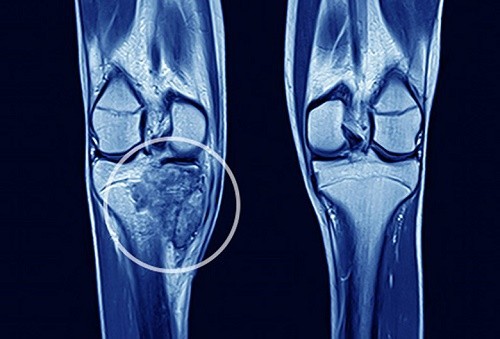
MRI can provide detailed images of bone and surrounding soft tissues.
CT can also be useful in selected situations.
If imaging reveals something that requires further investigation, additional tests may be performed.
A Biopsy May Be Needed to Confirm the Diagnosis
Imaging can identify an abnormal area.
But an image alone usually cannot determine exactly what type of tumor it is.
A biopsy, in which a sample of tissue is examined under a microscope, may be needed to establish a definitive diagnosis.
That means an X-ray showing an unusual lesion does not automatically mean cancer.