The morning of September 9, 2024, began with people travelling across a familiar bridge in northern Vietnam. Within moments, the crossing disappeared into the swollen Red River, vehicles plunged into the powerful current, and families were left desperately waiting for news.
A bridge is more than concrete, steel, and road surface. It is a connection between homes, workplaces, schools, markets, and communities. For residents living on opposite sides of the Red River in Phu Tho Province, Phong Chau Bridge was part of everyday life. People crossed it to earn a living, visit relatives, transport goods, and carry out ordinary responsibilities. Most mornings, there was little reason to imagine that the familiar journey could suddenly become a life-threatening emergency.
But on September 9, 2024, the situation was very different. Typhoon Yagi had brought destructive weather to northern Vietnam, leaving heavy rainfall, flooding, damaged infrastructure, and rivers swollen with water. The Red River was running high and fast. At approximately 10 a.m., a section of Phong Chau Bridge collapsed, sending vehicles into the water below.
The first reports described cars and motorcycles falling with the structure. The exact number of people involved was not immediately clear. Some people were reported missing, and rescuers faced the enormous challenge of searching a powerful river while dealing with the remains of a collapsed bridge.
What happened next became one of the most distressing images of the disaster caused by Typhoon Yagi. Yet the collapse was not an isolated event. It raised urgent questions about extreme weather, river conditions, infrastructure safety, emergency response, and the vulnerability of communities that depend on a small number of essential crossings.
To understand the full tragedy, it is necessary to look beyond the moment the bridge fell: at the storm that preceded it, the people whose journeys were interrupted, the difficult rescue operation, and the lasting consequences for the communities connected by the crossing.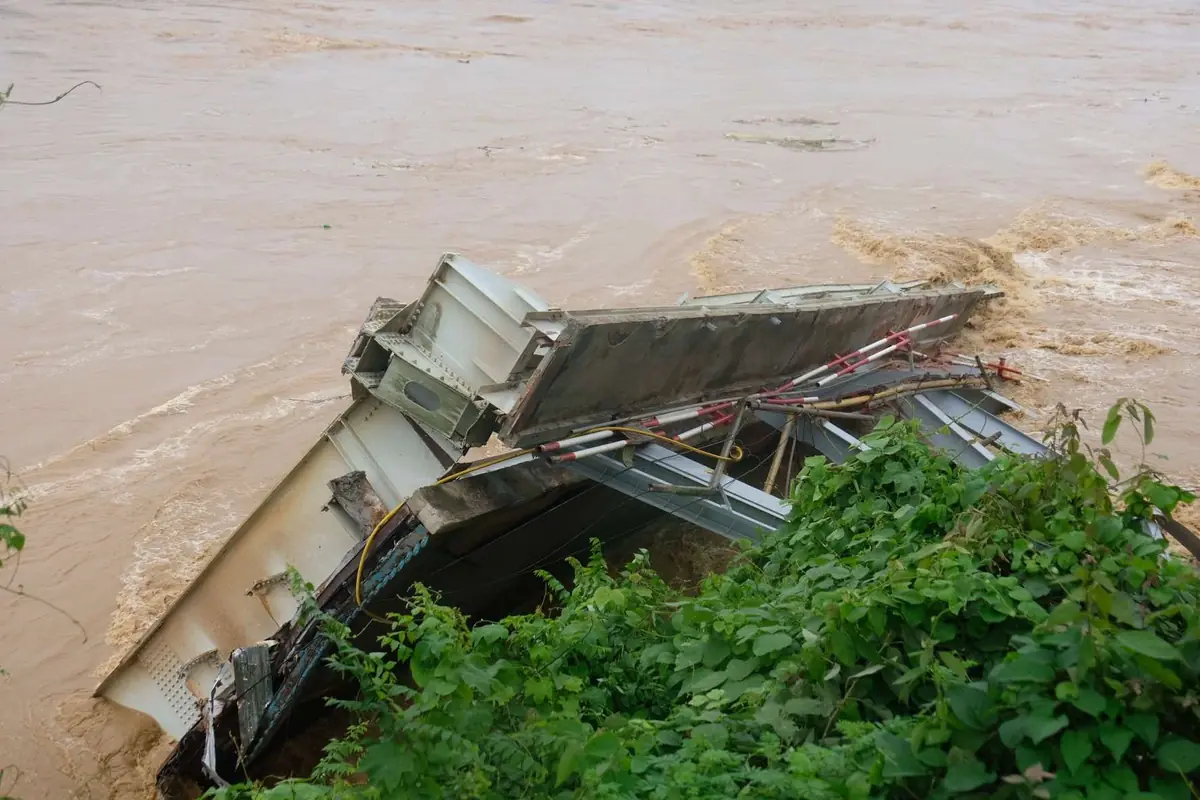
Phong Chau Bridge Collapse: The Disaster That Sent Vehicles Into a Flooding River
The sudden collapse of a major bridge in northern Vietnam sent vehicles plunging into the swollen Red River. As rescuers raced against powerful floodwaters, families waited anxiously for news, and an entire region faced the loss of a vital connection.
Chapter 1: A Routine Journey Turned Into a Disaster
On the morning of September 9, 2024, residents in northern Vietnam woke to another day shaped by the aftermath of Typhoon Yagi. Rain had affected large areas of the region, rivers were rising, and communities were dealing with flooding, damaged roads, fallen trees, and disruptions to everyday life. For people travelling through Phu Tho Province, however, the morning initially appeared to be another opportunity to complete ordinary journeys.
Some were going to work. Others were travelling between neighbouring communities, transporting goods, visiting relatives, or making routine trips that had become familiar over many years. Motorcycles and cars moved along the roads, while larger vehicles continued their journeys across the Red River.
Among the important crossings in the area was Phong Chau Bridge, which connected communities in what were then Tam Nong and Lam Thao districts. The bridge was an essential part of the local transport network. It allowed residents to cross the river without making a much longer journey to another crossing.
For people who used it regularly, the bridge was part of everyday life. Its steel structure and concrete supports had carried countless vehicles since it opened in 1995. Many drivers crossed without giving much thought to the enormous forces acting on the structure beneath them.
But on that September morning, the Red River was not behaving like the river people normally knew.
Heavy rainfall associated with Typhoon Yagi had caused water levels to rise dramatically. The current was powerful, carrying sediment and debris through the river system. The water was moving with a force that created serious challenges for bridges, roads, riverbanks, and other infrastructure.
At approximately 10:02 a.m., Phong Chau Bridge suffered a catastrophic structural failure. Its T7 pier was lost, and two main steel-truss spans, identified as spans 6 and 7, collapsed into the river.
Vehicles travelling across the bridge at the time plunged into the water.
The first official reports described ten vehicles on the bridge: one truck, two tractor-trailers, six motorcycles, and one electric motorcycle. Authorities initially reported eight people missing and three injured people rescued and taken for medical treatment. These were preliminary figures released while the emergency operation was still developing, and the exact number of people and vehicles involved was not immediately certain.
The disaster happened so quickly that people nearby had little time to understand what they were witnessing. One moment, the bridge was carrying traffic. The next, a section of the crossing had disappeared into the muddy water.
The collapse created an immediate emergency. People could have been trapped inside vehicles, injured by falling structural components, or swept downstream by the current. Rescuers had to reach the river while avoiding further danger from the damaged bridge and rapidly moving water.
The destruction also severed an important connection between communities on opposite banks. For local residents, the loss of the bridge meant more than a damaged piece of infrastructure. It meant that a familiar route had vanished at the very moment when the surrounding region was already struggling with the consequences of a powerful storm.
The first hours would bring difficult questions: how many people had fallen into the river, where had the vehicles gone, and could anyone still be found alive?
Those questions became the focus of one of the most challenging rescue operations in the region.
Chapter 2: The Red River Rose as Typhoon Yagi Passed Through Northern Vietnam
To understand why Phong Chau Bridge collapsed, it is necessary to understand the extraordinary conditions affecting northern Vietnam in early September 2024.
Typhoon Yagi was one of the most powerful storms to affect the region in years. It brought destructive winds and heavy rainfall to northern Vietnam, causing widespread flooding, landslides, damaged infrastructure, and major disruption to transport.
Even after the storm's strongest winds had passed, the danger did not disappear. Rainwater continued flowing from mountains and surrounding areas into rivers and streams. Water levels rose, currents strengthened, and flood conditions remained dangerous.
The Red River system was among the waterways affected.
The river is an important part of northern Vietnam's geography, supporting agriculture, transport, communities, and economic activity. Its water levels naturally change with seasonal rainfall, but extreme weather can cause those changes to become much more severe.
When large volumes of rain fall across a wide river basin, water from different areas gradually moves toward the main channels. This means that a river can continue rising even after rainfall becomes less intense in a particular location.
The water can also carry large amounts of sediment, branches, trees, and other debris. These materials can change the conditions around bridge supports and riverbanks.
A river under extreme pressure
According to the initial report from Phu Tho authorities, the water level at Am Thuong reached approximately 27.25 metres, exceeding the third warning level by 1.25 metres.
That figure illustrates the seriousness of the flooding conditions.
The river was not simply higher than normal. It was carrying a powerful current capable of moving heavy debris and changing the shape of the riverbed.
For a bridge, this matters because the structure must resist forces from several directions. Its supports carry the weight of the bridge and traffic, but they must also withstand water pressure, debris impact, changes in the riverbed, and other environmental stresses.
During ordinary conditions, the forces may remain within the range anticipated by the original engineering design. During extreme flooding, however, the situation can change dramatically.
Why floodwater can damage bridge foundations
A phenomenon known as scour is particularly important.
Scour occurs when flowing water removes sediment from around bridge foundations. As the riverbed is eroded, the soil or material supporting a pier may become less stable.
The process can happen gradually over many years or develop much more rapidly during extreme floods.
Strong currents can remove sand and other loose material around a foundation. If enough supporting material disappears, the pier may become vulnerable to movement or failure.
Debris carried by floodwater can create additional pressure. Large branches, trees, and other objects may become trapped around a pier, increasing the force exerted by the current.