An old photograph may be presented as new.
A picture from one country may be incorrectly attributed to another.
A military installation may be identified incorrectly.
Even genuine images may reveal sensitive information about emergency operations.
Residents should avoid circulating unverified footage and follow local restrictions on photographing or publishing military activity.
Keep Essential Travel Information Accessible
For people who live or work in the region, it is sensible to keep important documents and emergency contact information accessible.
This includes identification documents, travel reservations, insurance details, and relevant medical information.
These are ordinary preparedness measures, not a prediction that an evacuation or emergency will occur.
The most important principle is to remain informed without allowing every dramatic headline to create unnecessary panic.
8. The Bigger Geopolitical Question: Can the Gulf Maintain Its Balance?
The current confrontation is not simply a dispute between two governments.
It involves a complicated network of relationships.
The United States maintains military partnerships throughout the Gulf.
Iran views the American military presence in the region as a major security concern.
Israel is directly involved in the broader conflict.
Gulf governments must protect their territories while maintaining relationships with international partners.
At the same time, these countries depend on stable trade routes and energy markets.
This creates a difficult balancing act.
The United States Wants to Preserve Its Regional Position
American military installations provide Washington with the ability to respond to developments across the Middle East.
They support surveillance, air operations, naval activities, logistics, and cooperation with allied governments.
However, the current conflict has exposed the vulnerabilities associated with permanent military facilities.
A large installation may offer substantial operational advantages, but it can also become a recognizable target.
The Associated Press analysis of damage to American military sites across the region has highlighted this problem.
It suggests that future military planning may place greater emphasis on dispersing assets, strengthening defenses, and reducing dependence on vulnerable fixed facilities.
Iran Wants to Demonstrate Its Ability to Respond
Iran's military strategy has included the use of missiles and drones against regional targets.
Tehran has also attempted to use pressure on maritime transportation as a strategic instrument.
The purpose of these actions is not necessarily limited to destroying military equipment.
They can also demonstrate that a conflict involving Iran may carry costs for the United States and its regional partners.
This creates pressure on governments that host American military facilities.
However, Iranian claims about individual attacks must still be examined separately.
A government statement does not automatically establish the extent of damage.
The November 13 Bahrain radar incident is a clear example.
Gulf Governments Want to Avoid Becoming the Main Battlefield
The UAE, Bahrain, Qatar, and Saudi Arabia all have strong reasons to maintain regional stability.
Their economies depend on international trade and investment.
Their populations depend on functioning infrastructure.
Their governments have ambitious long-term economic development plans.
A prolonged regional war could undermine these objectives.
This explains why diplomatic activity remains important even when military tensions are high.
The Gulf countries may have different security policies, but they share a common interest in preventing the conflict from spreading into a wider regional disaster.
The Nuclear Question Remains Unresolved
Another important dimension is Iran's nuclear programme.
The conflict has raised concerns about inspections, monitoring, and the status of nuclear materials.
International efforts to verify Iran's nuclear activities have faced significant difficulties.
A lasting settlement would therefore need to address more than the immediate exchange of missiles and drones.
It would also need to consider sanctions, verification, security guarantees, and the future of regional military relationships.
These questions are complicated, and a quick agreement may be difficult.
Nevertheless, they remain central to the possibility of a longer-term solution.
9. The Most Important Facts to Remember
Before returning to the headline, it is worth separating the main developments into what has been reported and what remains uncertain.
|
Development |
What the available reporting says |
|---|---|
|
Bahrain radar incident |
Iran claimed the radar was destroyed; the United States denied the claim and reported intercepting two drones. |
|
Saudi Arabia |
Drone and missile interceptions were reported; Houthi claims of attacks on oil infrastructure remained unverified. |
|
Qatar |
No attacks were reported during November 10–13 in the regional security update. |
|
UAE |
No new attacks were reported during November 10–13, excluding incidents in Emirati waters. |
|
Gulf airspace |
Regional security reporting listed UAE, Qatar, Bahrain, and Saudi airspace as open on November 13. |
|
Four-country offensive coalition |
No reliable evidence establishes that the four countries formed a joint offensive force to attack Iran. |
|
Maritime security |
Attacks on commercial vessels and disruption around the Strait of Hormuz remained significant concerns. |
These distinctions are essential.
They help readers understand why the situation is serious without exaggerating what has actually happened.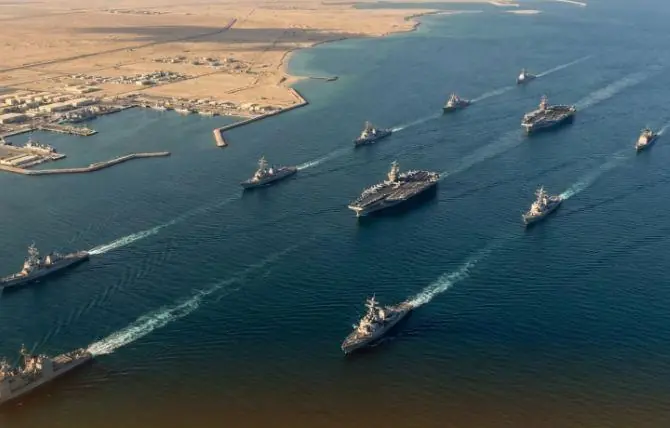
10. Final Analysis: Is the Gulf Heading Toward an Even Bigger Conflict?
The reports emerging from the Gulf show a region facing an unusually complicated security situation.
Iran's military confrontation with the United States and Israel has already affected several neighboring countries.
American military facilities have come under attack during the wider conflict.
Saudi Arabia has faced additional threats involving drones and energy infrastructure.
Bahrain has become the center of a new dispute over an American early-warning radar system.
The UAE and Qatar remain strategically important because of their military facilities, commercial infrastructure, and diplomatic relationships.
The Strait of Hormuz continues to be a major concern because of its importance to international energy transportation.
But there is another side to this story.
Gulf governments have strong reasons to avoid a wider war.
They need functioning airports, secure shipping routes, reliable energy exports, and international confidence.
A prolonged confrontation could undermine years of economic development.
That is why diplomatic efforts remain important even while military threats continue.
The next developments will depend on several factors:
-
Whether military attacks increase or decline.
-
Whether Iran and the United States resume negotiations.
-
Whether regional governments can maintain communication channels.
-
Whether commercial shipping can operate safely.
-
Whether attacks on energy infrastructure continue.
-
Whether military incidents produce casualties that trigger further retaliation.
A single incident does not necessarily determine the future of the entire region.
But repeated incidents, especially when accompanied by inaccurate information and competing claims, can make an already difficult situation even more dangerous.
So, Have Four Countries Really Joined Forces?
The answer, based on the available evidence, is that the headline overstates what has been established.
The four countries shown in the image are facing different aspects of the same regional security crisis.
There is evidence of defensive cooperation, shared security concerns, and diplomatic coordination.
There is also evidence of attacks and attempted attacks affecting American military interests across the region.
However, the available reporting does not establish that Abu Dhabi, Bahrain, Qatar, and Saudi Arabia have formed a four-country offensive alliance to launch a joint attack.
The distinction is important.
The real story is not simply that four countries are preparing to attack. It is that an expanding conflict is putting military bases, energy infrastructure, international shipping, and civilian security under increasing pressure.
And that may be the more significant development to watch.
For millions of people across the Gulf, the most important question is no longer just which country has the strongest military response.
It is whether the region can prevent another cycle of retaliation before the consequences become even more difficult to contain.