That is why engineers must inspect critical infrastructure before it is declared safe.
The lesson from the disaster is clear: earthquake preparedness must include bridges, roads, hospitals, airports, power systems, and communication networks—not only residential buildings.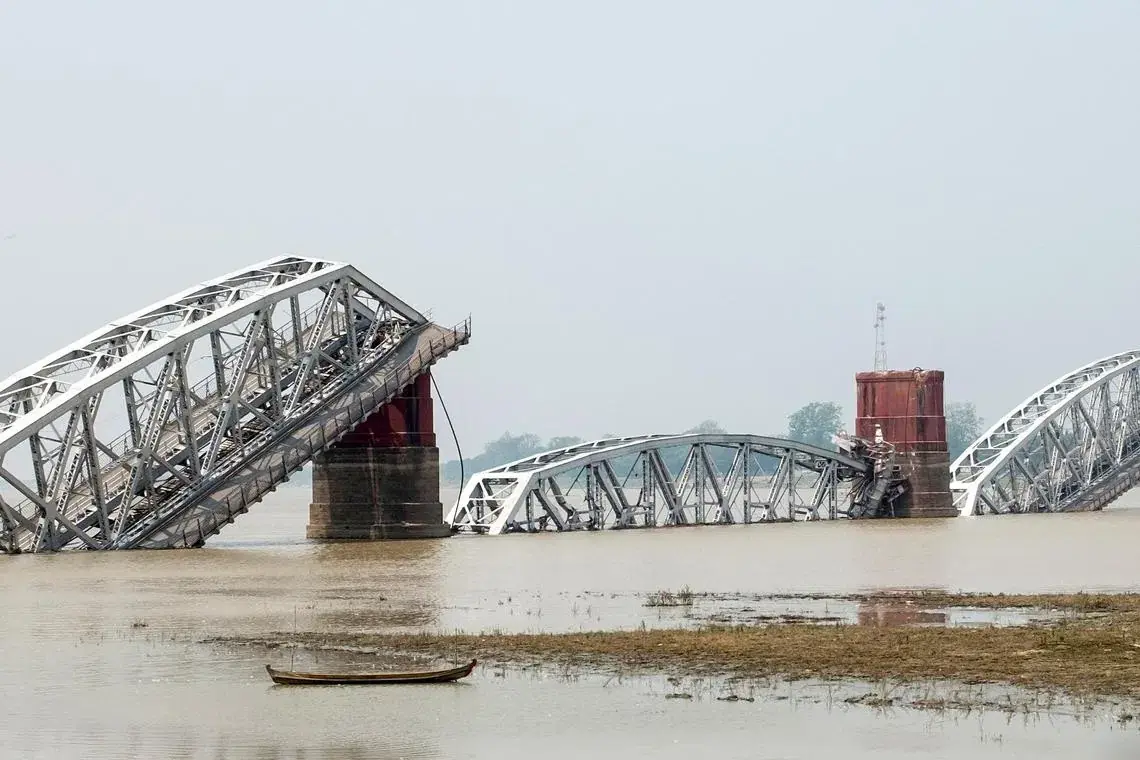
Why the Bridge in the Picture Needs Careful Verification
The bridge image is one of the most attention-grabbing parts of the supplied screenshot. It shows a huge concrete structure apparently breaking apart, dust rising from the damaged section, and workers looking toward the collapse.
It may look like a photograph taken during an earthquake, but several details make it unsafe to identify it as a real scene from the March 2025 disaster.
The composition appears unusually dramatic. The truck is positioned at an implausible angle near the broken structure, while the workers are shown in a way that resembles a staged disaster illustration. Without an identifiable location, photographer, date, or reliable news record, there is no basis for saying that this exact scene occurred.
That does not mean the earthquake caused no bridge damage. It did.
The historic Sagaing Bridge collapsed, and other structures were damaged or required inspection. The Ayeyawady Bridge, also known as Yadanabon Bridge, was inspected after damage was reported around structural connections. Transport authorities also reported damage to roads, railway infrastructure, and airport facilities.
The difference is between describing documented damage and attaching an unverified picture to a specific event.
Readers should be cautious when an article uses a dramatic image without identifying the location. A genuine photograph of a damaged bridge should normally be accompanied by information about where it was taken, when it was captured, and who documented it.
This is especially important during natural disasters, when misleading images can spread quickly.
An old photograph from a different earthquake may be presented as new. A digitally altered image may be shared as evidence. An illustrative scene may be mistaken for a real photograph.
The safest approach is to separate the confirmed event from the visual material used to attract attention.
The Human Cost: Families, Homes, and Communities
The greatest impact of a major earthquake is not measured only in damaged roads or collapsed buildings.
It is measured in lives disrupted, families separated, homes lost, and communities forced to rebuild.
In the hardest-hit parts of Myanmar, people faced the sudden loss of houses, workplaces, schools, religious buildings, and essential services.
Some families had to sleep outdoors because their homes were destroyed or because they feared entering buildings that might have been weakened by the shaking.
Others faced the difficult task of finding relatives, obtaining medicine, and securing clean drinking water.
For older people, children, pregnant women, and people with disabilities, displacement can create additional risks. They may have greater difficulty reaching temporary shelters, accessing healthcare, or protecting themselves from extreme heat and heavy rain.
The humanitarian situation was also complicated by conditions that existed before the earthquake. Some communities were already dealing with displacement, economic hardship, and insecurity. The disaster added another emergency to an already difficult situation.
In June 2025, UNICEF reported that the earthquake had caused thousands of deaths and injuries, damaged or destroyed tens of thousands of homes, and severely affected schools and health facilities.
The agency also described families living in overcrowded shelters and facing problems with sanitation, clean water, and access to essential services.
These problems are not always visible in photographs of collapsed buildings.
A family may lose its home but remain outside the frame of a news image. A child may be unable to attend school because the building is unsafe. A person with a chronic illness may struggle to obtain medication because the local health center is damaged.
Recovery therefore requires more than clearing rubble.
It requires restoring the systems that allow people to live safely and independently.
The First Hours: Why Rescue Operations Are So Difficult
After a major earthquake, the first hours are often critical.
People may be trapped beneath collapsed structures, injured residents may need urgent treatment, and emergency services may be overwhelmed by the number of calls.
Rescue teams must work quickly, but they also face serious risks.
A damaged building can collapse further without warning. Aftershocks may shake unstable structures. Fires, leaking gas, broken electrical lines, and blocked roads can create additional hazards.
In Myanmar, the response was made more difficult by the scale of the disaster and damage to essential infrastructure.
Hospitals in affected areas had to treat large numbers of injured people while some medical facilities were themselves damaged.
Road disruptions complicated the delivery of medical supplies and emergency equipment. Communication problems made it harder to determine which communities needed assistance most urgently.
International rescue teams and humanitarian organizations joined local responders.
Search-and-rescue specialists used equipment and trained techniques to locate people trapped beneath debris. Medical teams treated injuries, while humanitarian agencies worked to provide food, water, shelter, and other essential supplies.
Local residents also played a major role.
Neighbors helped one another find relatives, move injured people, distribute basic supplies, and clear accessible routes. In many disasters, the first people to help survivors are the people who live nearby.
That local response is vital because professional teams cannot reach every location immediately.
However, volunteers must be careful. Entering a severely damaged building without training can put both rescuers and survivors at risk.
The safest response is to follow instructions from emergency authorities and trained rescue personnel.
Why Aftershocks Can Be Dangerous
One of the most frightening aspects of a major earthquake is the possibility of further shaking.
Aftershocks are smaller earthquakes that occur in the same general area after a larger event. They happen as the Earth's crust adjusts to changes in stress caused by the main rupture.
Some aftershocks are minor and may be felt only by people close to the source. Others can be strong enough to cause additional damage.
The danger is not limited to their magnitude.
A building that survived the main earthquake may already have cracks, damaged columns, weakened walls, or unstable foundations. Even a smaller aftershock can cause parts of that structure to collapse.