People who use wheelchairs or walking aids should identify safe evacuation arrangements in advance.
The goal is not to create fear. It is to reduce confusion when an emergency occurs.
A family that has discussed its plan before an earthquake is more likely to respond calmly when one happens.
The Long Road to Recovery in Myanmar
The immediate rescue operation is only the first stage of recovery after a disaster of this scale.
Once trapped survivors have been located and emergency medical care is underway, communities must begin rebuilding homes, schools, hospitals, roads, bridges, and essential services.
The challenge can last for months or even years.
For families whose houses have been destroyed, temporary shelters may become long-term living spaces if reconstruction is delayed.
Children may lose access to education when schools are damaged or converted into emergency facilities. Teachers may also be displaced, and families may struggle to afford transportation to alternative schools.
Hospitals face a particularly difficult task.
They must restore buildings and equipment while continuing to treat patients. Some medical services may have to operate in temporary facilities until repairs are completed.
Clean water and sanitation are equally important.
When water systems are damaged, families may rely on temporary supplies. Poor sanitation in crowded shelters can increase the risk of infectious diseases, especially during hot and rainy seasons.
Farmers and small business owners face additional difficulties.
A damaged market, workshop, farm building, or transport route can interrupt income. Even when people survive the earthquake, they may lose the tools and resources needed to support their families.
The International Committee of the Red Cross reported six months after the earthquake that many displaced communities continued to face serious challenges involving shelter, safe water, sanitation, and livelihoods.
This is why disaster recovery cannot be measured only by the number of buildings repaired.
A successful recovery must also restore people's ability to work, attend school, obtain medical care, and live safely.
What the Earthquake Teaches Other Asian Countries
The March 2025 Myanmar earthquake was a warning for the wider region.
Countries across Asia face different levels of earthquake risk, but many share similar challenges: rapidly growing cities, dense populations, older buildings, complex transport networks, and communities that may not have enough emergency resources.
Thailand, China, India, Nepal, Indonesia, the Philippines, and other countries have areas exposed to significant seismic hazards.
The risk is not identical everywhere.
Some regions are threatened by major plate-boundary earthquakes, while others are affected by faults within continental landmasses. Some cities are built on soft sediment that can amplify shaking, while others are located near steep slopes vulnerable to landslides.
But the basic lessons are widely applicable.
Building regulations must be enforced, not simply written.
Hospitals, schools, bridges, airports, and emergency facilities should receive particular attention because their failure can disrupt the entire response.
Public education should be practical and repeated. People need to know how to protect themselves, where to find reliable information, and how to prepare their homes.
Emergency systems should also be tested before a disaster occurs.
A response plan that exists only on paper may fail when roads are blocked, communication networks are damaged, or multiple communities request help at the same time.
Regional cooperation is important as well. Earthquakes can affect several countries, and neighboring governments may need to coordinate humanitarian assistance, transport, medical support, and technical expertise.
The Myanmar disaster showed how quickly a major earthquake can become an international humanitarian concern.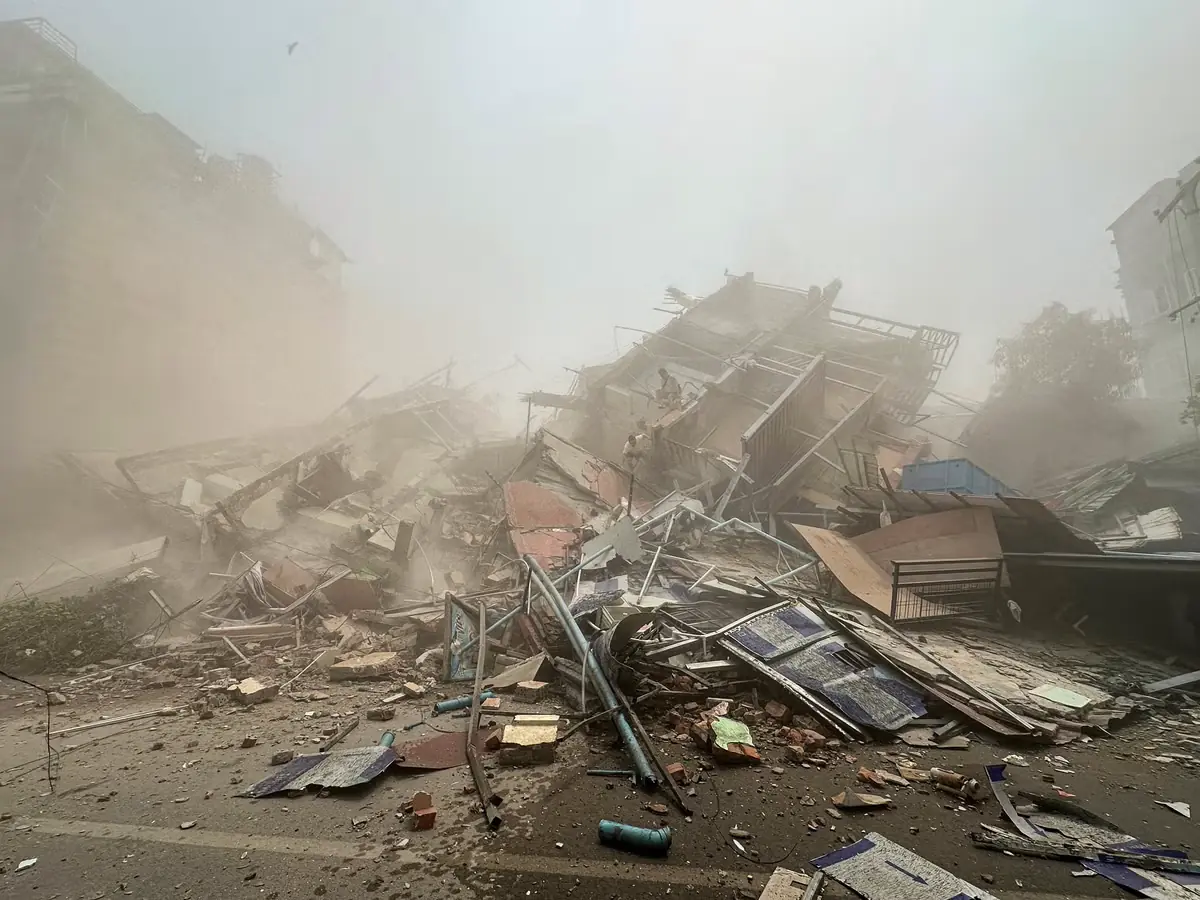
Can Scientists Predict the Next 7.7 Earthquake?
One question often appears after a major earthquake: Can scientists predict when another one will happen?
The short answer is no—not with the precision many people imagine.
Seismologists can identify active faults, estimate the likelihood of future earthquakes over long periods, and monitor small seismic events.
They can also use historical records and geological measurements to assess which regions face greater hazards.
However, they cannot reliably predict the exact date, time, location, and magnitude of an individual earthquake.
Earthquake early-warning systems are different from earthquake prediction.
An early-warning system detects an earthquake after it has begun and sends alerts to locations that may receive strong shaking moments later. Depending on the distance from the source and the system's design, those seconds may allow people to stop machinery, move away from dangerous equipment, or take protective action.
The warning does not arrive before the earthquake begins.
For communities near the epicenter, there may be little or no time to receive an alert. For more distant cities, the warning may arrive earlier.
That is why early-warning systems are useful but cannot replace safe buildings and public preparedness.
The most reliable approach remains a combination of scientific monitoring, strong construction standards, emergency planning, and public education.
The Most Important Message for Residents
The headline about a powerful 7.7 earthquake is based on a real and devastating event, but its date and presentation need correction.
The confirmed disaster struck central Myanmar on March 28, 2025. It caused severe destruction around Mandalay and Sagaing, affected neighboring countries, damaged critical infrastructure, and created a prolonged humanitarian crisis.
It was not a newly confirmed magnitude 7.7 earthquake on a Monday in November 2026.
The image of the collapsing concrete bridge should also not be presented as a verified photograph of the disaster. There were genuine bridge collapses and structural damage during the 2025 earthquake, but that does not authenticate every dramatic image shared alongside the headline.
The real story is already serious enough without exaggeration.
For people living in earthquake-prone regions, the most valuable response is preparation rather than panic. Know where to take cover, secure heavy furniture, keep essential supplies ready, and understand how to receive official emergency information.
After strong shaking, stay away from damaged structures and be prepared for aftershocks.
For affected communities in Myanmar, recovery has involved far more than repairing buildings. It has meant restoring homes, healthcare, schools, livelihoods, clean water, and a sense of security.
A major earthquake lasts only seconds or minutes, but its consequences can continue for years.
And the lesson from Myanmar is one that every earthquake-prone community should remember: the strongest protection begins long before the ground starts moving.