Confirmed Update: The Dubai Runway Disaster That Nearly Became a Catastrophe — What Happened to Emirates Flight EK521?
The aircraft was carrying hundreds of people when it struck the runway at Dubai International Airport. Within moments, smoke and flames surrounded the Boeing 777, passengers were ordered to evacuate, and emergency crews rushed toward the burning plane. For those watching from the terminal, the scene looked like the beginning of an unimaginable tragedy.
Yet the most remarkable part of the incident was also the detail that made the story so difficult to forget: all 300 passengers and crew members survived the crash and evacuation. One life was nevertheless lost — that of a firefighter who was killed while responding to the emergency.
The incident involved Emirates Flight EK521 on August 3, 2016, arriving in Dubai from Thiruvananthapuram, India. It was not a routine landing gone slightly wrong. It became one of the most serious emergencies in the airport’s history, prompting a major investigation into the aircraft’s final approach, the attempted go-around, the crew’s actions, and the evacuation that followed.
To understand why the event was so extraordinary, it is necessary to look beyond the dramatic photographs of the damaged aircraft. The story begins with an ordinary international journey — and then turns, in a matter of seconds, into a race to get everyone out alive.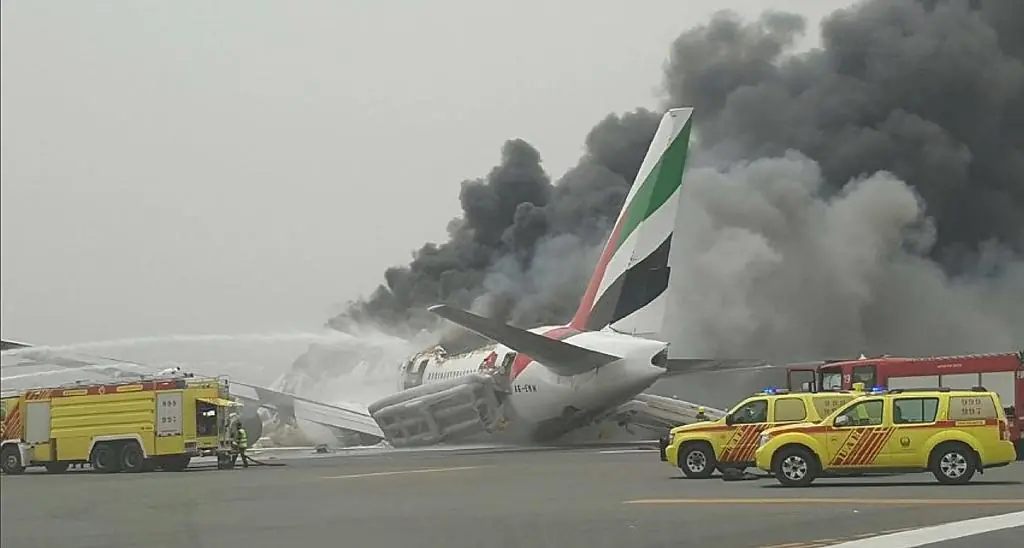
Chapter 1: An Ordinary Flight Turns Into an Emergency
On the morning of August 3, 2016, Emirates Flight EK521 departed from Trivandrum International Airport in the southern Indian state of Kerala, bound for Dubai. The route was familiar to thousands of travelers. People used it to visit relatives, return home after working abroad, begin holidays, and travel for business. For the 282 passengers on board that day, the journey was expected to end with an ordinary arrival at one of the world’s busiest international airports.
The aircraft was a Boeing 777-300, registered as A6-EMW. It had been delivered to Emirates in March 2003 and was powered by Rolls-Royce Trent 800 engines. There were 18 crew members on board: two pilots and 16 cabin crew. Together with the passengers, that brought the total number of people on the aircraft to 300.
The flight lasted approximately three and a half hours. Nothing about the route itself suggested that the aircraft would become the center of an international aviation investigation. Passengers had boarded, cabin crew had prepared the cabin, and the pilots had received the operational information needed for the approach into Dubai.
But the weather and wind conditions around the airport were important. The final investigation later examined changing wind conditions during the aircraft’s approach, including a wind component that affected the aircraft’s performance close to the runway. The crew was attempting a manual landing with a tailwind component that remained within the aircraft’s operating limits, while a windshear warning had been included in the airport’s information.
For most passengers, these technical details would have been invisible. From inside the cabin, an approach may feel like a gradual reduction in altitude, a slight change in engine sound, and the familiar movement of an aircraft preparing to touch down. Few travelers would have known that investigators would later spend years studying the precise sequence of events that unfolded during those final moments.
The aircraft approached Runway 12L at Dubai International Airport. The commander was the pilot flying. As the aircraft descended, the wind conditions changed. The aircraft remained airborne longer than expected during the landing flare, and the landing did not proceed as the crew had intended.
The critical decision came after the aircraft’s main landing gear had already made contact with the runway.
The commander decided to perform a go-around — a maneuver in which a pilot abandons a landing attempt and climbs away to make another approach. Go-arounds are a normal and important part of aviation safety. They are not, by themselves, signs of an accident. Pilots are trained to use them whenever a landing cannot be completed safely.
But on EK521, the timing and technical circumstances made the maneuver exceptionally dangerous.
The aircraft had touched down, and the system behavior associated with that contact affected how the go-around command operated. The flight crew initiated the normal go-around procedure, but the thrust levers remained at idle. The engines therefore did not produce the power required to sustain the climb. The crew did not recognize the problem in time to correct it.
The aircraft briefly climbed to approximately 85 feet above the runway. Then it began to descend again.
For passengers, the change would have been sudden and frightening. An aircraft that had appeared to be completing its landing was now moving in an unexpected way. The runway was no longer simply the surface on which the aircraft would roll to a stop. It was directly ahead as the aircraft lost height.
At 08:37:38 UTC, the Boeing 777 struck Runway 12L. It slid along the runway on its lower fuselage for approximately 32 seconds, traveling around 800 metres before coming to rest near a taxiway. Several aircraft components separated during the slide, including the No. 2 engine and pylon assembly. The aircraft remained sufficiently intact during the movement to protect the occupants from the immediate destruction of the cabin.
The landing had become a runway impact. The aircraft was badly damaged, and a fire began to develop. The emergency response was now a race against time.
Chapter 2: The Evacuation That Saved 300 People
The first priority after the aircraft came to rest was clear: everyone had to get out.
Cabin crew members began directing passengers toward the available exits and escape slides. In an emergency evacuation, seconds matter. Passengers must move quickly, follow instructions, leave belongings behind, and avoid blocking the aisles. A cabin that is crowded during an ordinary flight can become extremely difficult to manage when smoke, noise, fear, and uncertainty are added.
The crew faced an especially demanding situation. The aircraft was damaged, fire was developing, and not every escape route remained usable. Several passenger door slides became unusable, meaning that the evacuation could not proceed through every exit as originally intended. Passengers and crew had to use the operational slides.
The official investigation recorded that most occupants evacuated in approximately six minutes and 40 seconds. The commander and the senior cabin crew member were the exceptions: they left after an explosion involving the aircraft’s center wing tank.
The evacuation was not without injuries. The final report recorded 21 passengers, one flight crew member, and six cabin crew members with minor injuries, while four cabin crew members sustained serious injuries. These figures are important because early public statements and later investigation summaries did not always describe the injury totals in exactly the same way. The final investigation provides the more complete account.