That principle is central to modern aviation. Aircraft systems can automate many tasks, but automation does not remove the need for active monitoring. A pilot must understand not only what a system is supposed to do, but also what its indications show it is actually doing.
The final investigation identified shortcomings in the crew’s monitoring of primary flight instruments during the landing and attempted go-around. It also found that the pilots were unaware that the autothrottle had not moved the engine thrust levers into the expected position after the TO/GA switch was pressed. The report further identified omitted thrust-verification steps in the go-around procedure.
These findings did not mean that the accident could be reduced to a simplistic claim that one person made one mistake. Aviation investigations examine how multiple conditions combine. Weather information, cockpit indications, automation logic, training, procedures, and human performance all matter.
The pilots had substantial experience. Emirates said at the time that both the captain and first officer had more than 7,000 hours of flying experience each. The aircraft had also been operating in commercial service for years. Experience, however, cannot eliminate every possible combination of circumstances, especially when a critical system response differs from what the crew expects during a rapidly developing emergency.
Chapter 4: The Firefighter’s Death and the Human Cost Behind the Headlines
The most widely repeated description of EK521 is that all 300 people aboard survived. That statement is accurate when it refers specifically to the passengers and crew members. But it does not tell the whole story of the accident.
A firefighter died while responding to the burning aircraft.
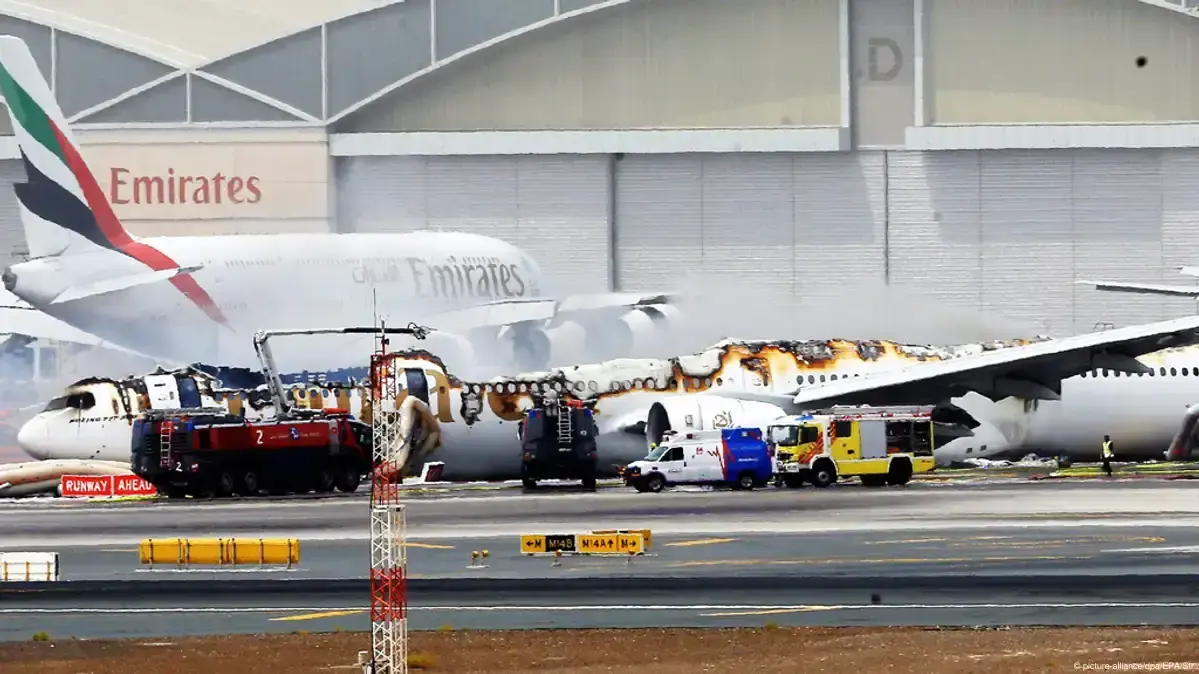
The official investigation explains that the center wing tank exploded approximately nine minutes and 40 seconds after the aircraft came to rest. The explosion caused a large section of the right wing’s upper skin to separate. As the panel fell, it struck a firefighter on the ground and fatally injured him.
The firefighter was identified in contemporary reporting as Jassim Al Baloushi. His death was widely recognized as a sacrifice made during an effort to protect the people aboard the aircraft. The UAE’s civil aviation authorities expressed condolences to his family and emphasized that his actions had helped secure the survival of everyone on the flight.
It is easy to focus on the dramatic images of a passenger aircraft surrounded by smoke and emergency vehicles. But those images also show people working in dangerous conditions. Firefighters approach burning aircraft knowing that fuel, heat, damaged structures, and sudden explosions can create unpredictable hazards.
An aircraft fire is particularly difficult to manage because the fuel load is large and may be distributed across several tanks. The structure can be weakened by heat, and components may detach or collapse. Even when the cabin has been evacuated, the aircraft can remain dangerous to emergency crews.
The center wing tank explosion on EK521 was a reminder that the most serious risks can continue after the initial impact. The aircraft had come to rest. The passengers were leaving. Yet the emergency was far from over for the people fighting the fire.
The crew evacuation also involved difficult decisions. Most passengers and crew had left through the usable slides, but the commander and senior cabin crew member remained aboard until after the explosion. They then evacuated using an operational exit. The final report’s account makes clear that the last people leaving the aircraft faced a different and more dangerous situation from those who had exited earlier.
The accident also raised questions about the safety of evacuation procedures and passenger behavior. Investigators recorded that several escape slides had become unusable. They also noted that many passengers took carry-on baggage with them. Both details are relevant to the broader discussion of how emergency evacuations work in practice.
Passengers may instinctively reach for a phone, wallet, handbag, passport, or laptop when something frightening happens. In an ordinary situation, those belongings are valuable. During an aircraft evacuation, however, retrieving them can cost precious seconds and obstruct other people trying to escape.
Cabin crew are trained to give clear commands and direct passengers toward exits. The instruction to leave baggage behind is not a formality. A bag can catch on a slide, slow a passenger, or block the narrow route through which dozens of people must move.
The EK521 evacuation demonstrated the importance of crew training, passenger cooperation, and the availability of multiple escape routes. It also showed that evacuation systems must be considered as part of a complete emergency plan rather than as isolated pieces of equipment.
For the families of the passengers, the incident was a frightening reminder that the safety of a flight depends on far more than the aircraft reaching its destination. The people on board rely on the pilots, cabin crew, airport personnel, firefighters, air traffic controllers, and emergency planners whose work may become visible only when something goes wrong.
The firefighter’s death should therefore remain part of the story. It is not a minor detail to be placed beneath a headline celebrating the survival of the passengers. It is a central part of the human cost of the disaster.
Chapter 5: What Changed After the Accident — and Why the Report Still Matters
The investigation did not end when the aircraft was removed from the runway. The final report, issued by the UAE’s Air Accident Investigation Sector in January 2020, examined the accident in detail and made safety recommendations to several organizations, including Emirates, the General Civil Aviation Authority, Boeing, the Federal Aviation Administration, Dubai Airports, Dubai Air Navigation Services, and the International Civil Aviation Organization.
The purpose of an aviation accident investigation is not simply to identify an individual to blame. Under international investigation principles, the central objective is to prevent similar accidents from happening again. That requires understanding the conditions that contributed to the event and identifying practical ways to improve safety.
One major area was go-around training.
A go-around is a routine maneuver, but EK521 demonstrated that the circumstances surrounding a go-around can be more complicated when an aircraft has already touched down. Training needs to prepare pilots for situations in which the expected automated response does not occur. It must also reinforce the importance of verifying engine thrust and monitoring flight instruments throughout the maneuver.
The accident showed why pilots cannot rely only on the assumption that a system has performed the action they requested. A control input must be followed by confirmation. If the aircraft does not respond as expected, the crew must recognize the discrepancy and act quickly.