For them, it isn't a disease or disorder.
It's simply a variation.
The same principle applies to many other physical characteristics.
One person's fingers may naturally bend farther backward.
Another person's ankles may be unusually flexible.
Someone else may have extremely mobile shoulders.
Variation is a normal part of human biology.
When Excessive Joint Flexibility May Deserve Attention
There is an important distinction between naturally flexible joints and symptomatic joint hypermobility.
If someone experiences frequent joint pain, repeated dislocations or subluxations, unusual instability, or other persistent symptoms, excessive joint mobility may deserve professional assessment.
Certain connective tissue disorders can also be associated with generalized joint hypermobility.
But it is important not to diagnose a medical condition simply because a thumb bends backward.
A flexible thumb alone is generally not enough to establish a disorder.
The broader medical history and symptoms matter.
Your Hands Change Over Time
Another reason thumb appearance can change is aging.
As people get older, the tissues around joints can change.
Arthritis may affect some of the joints in the hand.
Previous injuries can alter movement.
Repeated use can contribute to stiffness or discomfort.
Muscle and tendon function can also change over time.
So if someone notices that their thumb doesn't move the way it used to, that doesn't necessarily have anything to do with personality.
It may simply reflect normal aging, an old injury, or a musculoskeletal condition.
What If Your Thumb Suddenly Changes Shape?
A sudden change is different from a lifelong anatomical characteristic.
If a thumb suddenly becomes swollen, painful, deformed, red, warm, or difficult to move, that may indicate an injury or another medical problem.
Possible causes can include:
-
Trauma
-
Arthritis
-
Tendon problems
-
Joint inflammation
-
Infection
-
Other musculoskeletal conditions
In such circumstances, the appropriate response isn't to look up a personality chart.
It is to have the physical problem evaluated.
Can Your Hands Reveal Anything About Your Health?
Yes—but again, this is different from personality prediction.
Healthcare professionals examine hands for clues about certain medical conditions.
For example, they may look for:
-
Joint swelling
-
Deformities
-
Skin changes
-
Nail abnormalities
-
Reduced range of motion
-
Muscle wasting
-
Tremor
-
Changes in color or temperature
These observations can sometimes contribute to a medical assessment.
But even here, a single physical characteristic rarely provides a diagnosis.
Doctors consider the complete clinical picture.
Why Thumb-Based Personality Tests Remain Popular
Despite the lack of scientific evidence, thumb personality tests continue to spread online because they are:
Simple.
You only need to look at your hand.
Interactive.
People can immediately compare their thumb with the illustrations.
Personal.
The result appears to tell you something about yourself.
And perhaps most importantly, they're fun.
There's nothing inherently wrong with taking a personality quiz as entertainment, as long as it isn't mistaken for a scientifically validated psychological assessment.
The Five Shapes Can Be Viewed as a Fun Quiz
If you encounter this image online, you can certainly compare your thumb with the illustrations.
You can even read the traditional personality interpretations associated with each category for entertainment.
But it is better to frame the results as:
“According to this viral personality test…”
rather than:
“Your thumb proves that you are…”
That small distinction matters.
It separates entertainment from fact.
Your Thumb Doesn't Define Who You Are
Perhaps the most important point is that personality is far more complicated than physical appearance.
Who you are is shaped by countless factors:
-
Your experiences
-
Your relationships
-
Your environment
-
Your values
-
Your habits
-
Your upbringing
-
Your goals
-
Your decisions
-
Your emotional experiences
-
Your biological characteristics
No single feature of your hand can capture all of that.
Two people can have almost identical thumbs and completely different personalities.
And two people with dramatically different thumb shapes can have remarkably similar values and behavior.
So What Does Your Thumb Really Reveal?
If your thumb is straight, it may simply reflect your particular joint structure.
If it bends backward easily, you may simply have greater thumb mobility.
If one thumb looks slightly different from the other, that can also be normal.
Your thumb can tell you about your anatomy and mobility.
It cannot reliably tell you whether you're an introvert or extrovert, whether you're ambitious or relaxed, or whether you're emotionally sensitive or highly confident.
Those characteristics cannot be read accurately from thumb shape alone.
The Fun Part Is Still Worth Enjoying
There is nothing wrong with looking at a viral image like this and asking friends:
“Which one looks like your thumb?”
It can be a fun conversation starter.
It can even encourage people to notice something about their hands they had never paid attention to before.
Just remember that the personality descriptions attached to these shapes are best treated as entertainment rather than scientific assessment.
If you want to understand your personality more seriously, validated psychological assessments and professional evaluation are far more appropriate than examining the shape of a thumb.
The Bottom Line
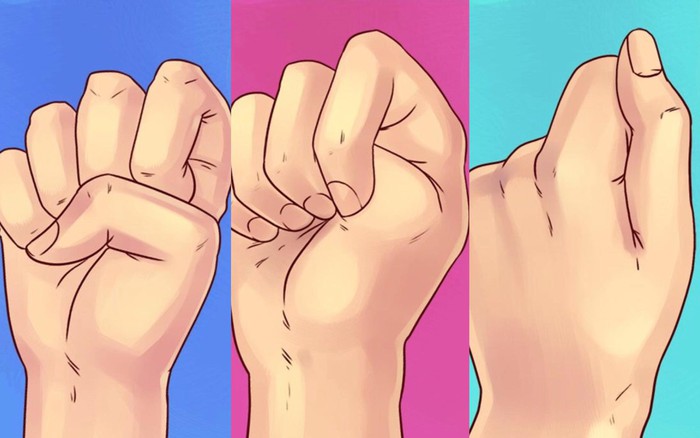
The viral image claims that “the shape of your thumb reveals a lot about your personality.”
It certainly reveals something about you - but not in the way the graphic suggests.
Your thumb's shape and flexibility are influenced largely by anatomy, genetics, connective tissues, and joint structure.
A thumb that bends backward doesn't prove that you're adaptable.
A straight thumb doesn't prove that you're stubborn or disciplined.
And no thumb shape can reliably predict your personality.
Still, the image offers an interesting reminder of just how much natural variation exists in the human body.
So go ahead and compare your thumb with A, B, C, D, or E.
Have fun with the personality test—but don't let a few lines and curves on your hand decide who you are.