Chapter 1: The Cockroach That Produces a Milk-Like Substance
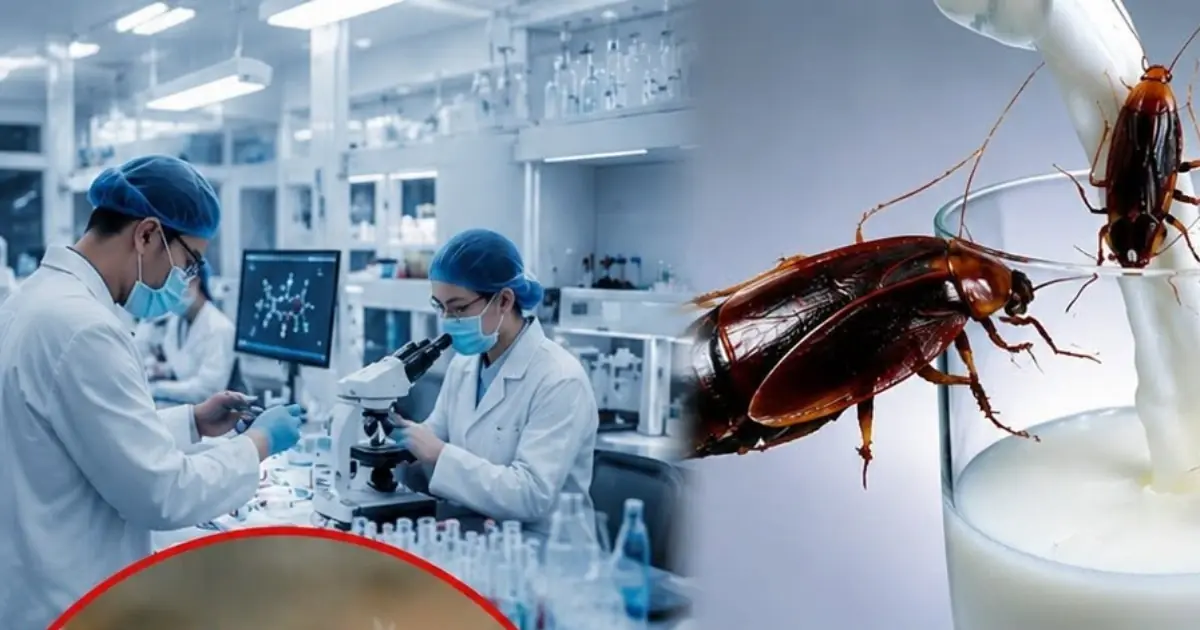
The idea of drinking milk produced by a cockroach may sound like something from a science-fiction story. Yet, in the natural world, one unusual insect has developed a remarkable way to nourish its offspring. The Pacific beetle cockroach, scientifically known as Diploptera punctata, produces a nutrient-rich secretion that has attracted the attention of researchers around the world.
Unlike familiar household cockroaches, this species has a distinctive reproductive strategy. Instead of simply laying eggs and leaving them to develop, the female carries her developing young inside her body. During this period, she provides them with nourishment through a milk-like substance.
Scientists often refer to this secretion as cockroach milk. However, the name can be misleading. It is not milk in the same way that cow, goat, or human milk is. It is a specialized biological secretion produced to support the growth of developing embryos.
The substance contains proteins, fats, carbohydrates, and other nutrients. What makes it especially interesting is that some of these nutrients form tiny crystals inside the digestive system of the developing embryos. These crystals act as a concentrated nutritional reserve, allowing the young insects to receive energy and essential building blocks during development.
The discovery has challenged the familiar idea that milk production is limited to mammals. In fact, nature has evolved several different ways for parents to provide food to their young. Birds produce nutrient-rich crop milk, some fish provide nourishment through specialized tissues, and certain insects use secretions to support their offspring.
The Pacific beetle cockroach represents one of the most unusual examples of this strategy.
Researchers have studied this species for decades because its reproductive biology offers valuable insight into how complex nutritional systems can evolve. The female’s brood sac provides a protected environment, while the secretion supplies nutrients that help embryos grow.
The young are not simply surrounded by a liquid food source. They are able to consume the secretion, and their bodies process it into a highly concentrated form. This process allows them to store nutrients efficiently during a stage when they cannot search for food independently.
The crystals have become the most famous part of the story. Under laboratory examination, they appear as tiny structures containing proteins and associated nutrients. Their unusual organization has made them interesting not only to nutrition researchers but also to scientists studying protein structure and biological storage systems.
The term “cockroach milk” became widely known after research published in 2016 described the structure of these crystals in detail. The study reported that an individual crystal contained more than three times the energy of an equivalent mass of dairy milk.
That finding quickly attracted media attention. Headlines began describing the substance as a possible superfood of the future, and some reports suggested that it could eventually replace conventional milk.
But the original scientific discovery was more specific than many viral headlines suggested. Researchers were investigating how the crystals store energy and nutrients for developing embryos. They were not demonstrating that people could safely drink cockroach milk or that it would improve human health.
The difference is important.
A substance can be extremely useful to an insect without automatically becoming a suitable food for humans. Human nutrition depends on many factors, including digestibility, safety, nutrient balance, preparation, and the amount consumed.
The fascinating biology of Diploptera punctata is therefore best understood as a starting point for scientific investigation rather than proof of a new dietary miracle.
The insect’s unusual secretion has opened a window into a highly specialized natural process. It shows how evolution can produce efficient ways to store and deliver nutrients, even in organisms that people generally associate with kitchens, dark corners, and unwanted pests.
And that is precisely why the discovery deserves attention: not because everyone should begin drinking cockroach milk, but because it reveals a surprising nutritional system that scientists are still learning to understand.
Chapter 2: Why Scientists Are Fascinated by Its Nutritional Crystals
The most remarkable feature of cockroach milk is not simply that it contains nutrients. It is the way those nutrients are organized and stored.
When the developing embryos of Diploptera punctata consume the secretion, proteins can form crystals inside their digestive systems. These structures are not ordinary mineral crystals. They are made from complex biological molecules that bind and store nutrients.
A 2016 structural study examined these crystals using advanced X-ray techniques. The researchers found that the proteins belong to a group related to lipocalins, a family of proteins known for their ability to bind small molecules, including certain fats.
The crystals contain proteins with different amino-acid sequences, attached carbohydrate groups, and associated fatty acids. This diversity gives them a complex structure that is different from the uniform crystals often produced in laboratory experiments.
One important discovery was that the crystals can hold energy-rich molecules in a tightly packed arrangement. This makes them an efficient storage form for developing embryos, which need a steady supply of nutrients during growth.
The study estimated that a single crystal contained more than three times the energy of an equivalent mass of dairy milk. This finding is the scientific foundation behind many of the headlines claiming that cockroach milk is exceptionally nutritious.
However, the word “energy” should not be confused with overall nutritional quality.
Calories measure how much energy a food can provide. They do not tell us whether a food is more beneficial for every person, whether it supplies the right balance of nutrients, or whether it is safe to consume regularly.
For example, oils can provide far more calories per gram than milk because they contain a high proportion of fat. That does not mean oil is a complete replacement for milk or that consuming more calories automatically improves health.
The crystals are especially valuable to the cockroach embryos because they combine several nutritional components in a compact form. Their purpose is to support growth during a very specific stage of life.
The proteins provide amino acids, which are needed to build tissues and support biological processes. The associated lipids supply energy and fatty acids. Carbohydrates also contribute to the overall nutritional composition.
Researchers have reported that the secretion contains a mixture of proteins, amino acids, carbohydrates, and fats. An earlier biochemical study found that dried cockroach milk contained a substantial protein fraction, along with carbohydrates and lipids.
This combination is one reason the substance has attracted interest in food science.
Scientists are interested in whether the principles behind these crystals could inspire new ways to preserve nutrients, develop protein-rich ingredients, or design materials that release nutrients gradually.
The crystals may also help researchers understand how biological systems store energy in small spaces. Such knowledge could have applications beyond food, including the study of protein stability and molecular delivery systems.