Chapter 1: The Cockroach That Produces Milk — A Discovery That Surprised Scientists
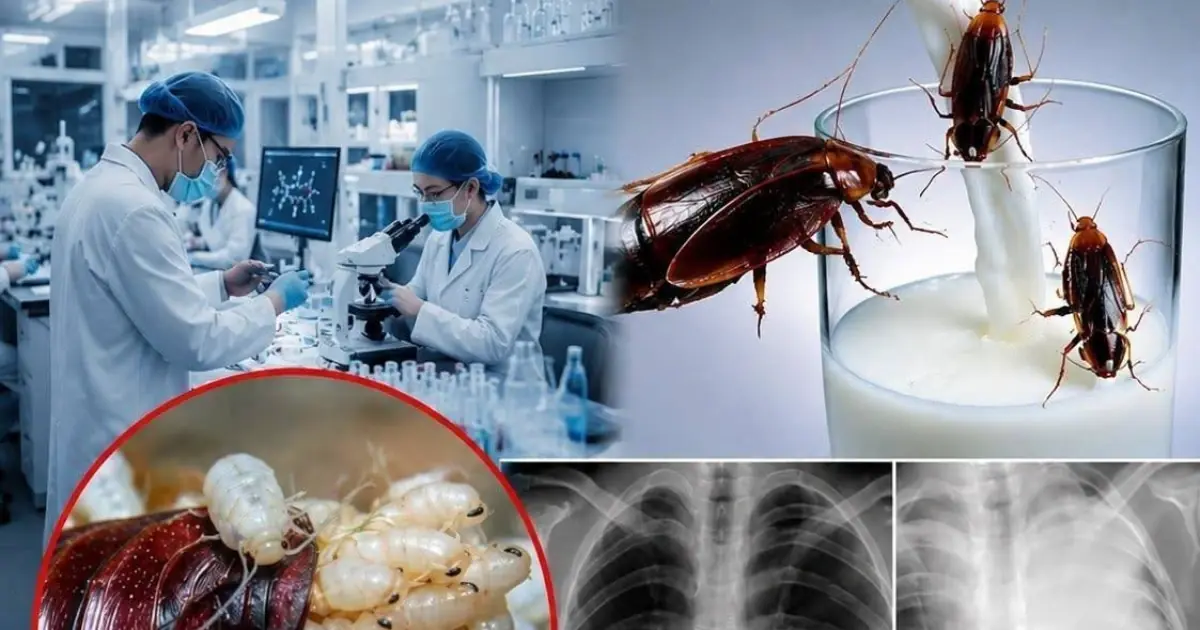
For most people, cockroaches are among the least appealing insects in the world.
They are associated with dirty kitchens, hidden corners, food contamination, and unpleasant infestations. When someone discovers a cockroach inside a refrigerator or near a glass of milk, the natural reaction is usually to remove it immediately.
But scientists have discovered something extraordinary about one particular species.
A cockroach can produce a nutrient-rich secretion that researchers have compared with mammalian milk.
Even more surprising, this secretion contains proteins that form tiny crystals inside developing embryos. These crystals store energy and nutrients that help the young insects grow.
The discovery has attracted international attention and inspired discussions about whether unusual biological resources could contribute to future food technology.
But how can an insect produce something resembling milk?
Meet Diploptera punctata, the Pacific Beetle Cockroach
The species responsible for this discovery is called Diploptera punctata, commonly known as the Pacific beetle cockroach.
Unlike many familiar household cockroaches, this species has an unusual reproductive strategy.
It is viviparous, meaning that it gives birth to live offspring rather than simply laying eggs that develop independently outside the mother's body.
During pregnancy, the female produces a nutrient-rich secretion inside a specialized reproductive structure known as the brood sac.
Developing embryos consume this secretion as their primary source of nourishment.
This is the biological reason scientists use the informal expression "cockroach milk."
It is not milk in the same way that cows, goats, or humans produce milk.
Instead, it is a specialized nutritional secretion that supports embryonic development.
The discovery is particularly interesting because milk production is commonly associated with mammals.
However, nature has evolved several different methods of providing nutrients to developing offspring.
The Pacific beetle cockroach represents an unusual example among insects.
Researchers have studied its reproductive biology for decades, trying to understand how this species produces and delivers nutrients to its embryos.
PubMed+1
A Very Different Way of Feeding Babies
In mammals, milk is generally produced by specialized mammary glands.
The mother supplies nutrients through milk, and the offspring consume it during early development.
The Pacific beetle cockroach uses a different biological system.
The female produces a nutrient-rich liquid inside her brood sac.
The developing embryos consume this secretion directly.
As the embryos digest the liquid, specialized proteins accumulate in their digestive systems and form crystals.
These crystals act as a concentrated nutrient reserve.
This arrangement allows the developing insects to store nutrients for continued growth.
Scientists are particularly interested in this process because it demonstrates how biological systems can package nutrients into highly organized structures.
Why the Discovery Became International News
The scientific community became especially interested in the subject after researchers published a detailed study in 2016.
The study examined the molecular structure of protein crystals found inside developing embryos of Diploptera punctata.
Using advanced crystallographic techniques, the researchers determined the structure of the proteins at atomic resolution.
They discovered that the crystals contained complex milk proteins associated with lipids and carbohydrates.
The research revealed a biological system capable of storing a concentrated supply of nutrients in a crystalline form.
This was scientifically significant because naturally grown protein crystals inside living organisms are unusual.
The researchers also estimated that a single crystal contained more than three times the energy of an equivalent mass of dairy milk.
That finding helped fuel the popular description of cockroach milk as a potential superfood.
However, the scientific discovery was more specific than many headlines suggested.
The study investigated the nutritional storage mechanism used by developing cockroach embryos.
It did not demonstrate that people could drink cockroach milk and experience superior health benefits.
PubMed+1
Not Every Cockroach Produces Milk
Another important distinction is that this discovery does not apply to ordinary household cockroaches.
Most familiar cockroach species do not produce the same type of nutritive secretion.
The Pacific beetle cockroach has a specialized reproductive system that makes this process possible.
Therefore, finding an ordinary cockroach in a kitchen does not mean that it contains a supply of nutritious milk.
The species is biologically different from many common household pests.
This distinction matters because sensational headlines often create the impression that all cockroaches can produce the same substance.
They cannot.
A Biological Discovery, Not Yet a New Breakfast Drink
The idea of obtaining nutrients from an insect has generated considerable curiosity.
Some researchers and commentators have discussed whether the proteins found in cockroach milk crystals could inspire new food technologies.
But producing a useful human food involves far more than identifying an interesting nutrient.
Scientists must determine how the substance can be produced, purified, processed, tested for safety, and manufactured consistently.
They must also establish whether consumers can digest it safely and whether it offers meaningful advantages over existing foods.
For now, cockroach milk remains primarily a subject of biological and biochemical research.
The discovery is fascinating, but it should not be confused with a commercially available or medically proven superfood.
Chapter 2: What Makes Cockroach Milk So Nutritionally Interesting?
The most remarkable part of cockroach milk is not simply where it comes from.
It is what researchers discovered inside it.
The nutrient-rich secretion produced by Diploptera punctata contains a combination of proteins, carbohydrates, fats, and other biological components.
Unlike ordinary liquids that deliver nutrients in a relatively dispersed form, this secretion can produce highly organized protein crystals inside developing embryos.
These crystals are particularly interesting because they allow the embryos to store concentrated nourishment.
1. A Concentrated Source of Protein
Protein is essential for growth and development.
It provides amino acids that organisms use to build tissues, produce enzymes, maintain cells, and support many biological processes.
The cockroach milk proteins belong to a group related to the lipocalin protein family.
Lipocalins are proteins known for their ability to bind and transport small molecules, including certain lipids.
Researchers identified multiple related proteins in the secretion.
The 2016 study examined their molecular structures and demonstrated that they form complex arrangements within the crystals.
An earlier investigation published in 1977 also examined the composition of the secretion.
The researchers reported that dried samples contained approximately:
-
45% protein.
-
25% carbohydrate.
-
16–22% lipids.
-
Additional free amino acids and other components.
These figures describe the composition reported in that particular laboratory study, not a nutritional label for a commercially available beverage.
The findings nevertheless demonstrate that the secretion is a concentrated source of several important biological nutrients.
ScienceDirect+1
2. Essential Amino Acids
Proteins are made from amino acids.
Some amino acids are considered essential because the human body cannot produce sufficient quantities of them and must obtain them through food.
A complete protein provides all nine essential amino acids.
Researchers studying cockroach milk proteins identified a complex amino acid composition associated with the nutritional needs of developing embryos.
This is one reason the discovery attracted attention from scientists interested in alternative sources of protein.
However, there is an important difference between identifying essential amino acids in a laboratory sample and demonstrating that a food is beneficial for humans.
The human body must be able to digest and use the protein safely.
Scientists would also need to evaluate possible allergens, contaminants, and other safety concerns before considering human consumption.
3. Carbohydrates and Energy Storage
Carbohydrates are another important component of the secretion.
They provide energy and can participate in the structural organization of proteins.
The 2016 research identified glycosylated proteins.
Glycosylation is a biological process in which sugar molecules attach to proteins.
This process can influence how proteins fold, interact with other molecules, and function within biological systems.
In the Pacific beetle cockroach, these molecular features contribute to the unusual organization of the nutrient crystals.
The discovery shows that the secretion is not simply a mixture of protein and fat.
It is a sophisticated biological nutrient system.
4. Lipids and Fatty Acids
Fats are essential for many biological processes.
They provide concentrated energy and contribute to cell membranes, hormone production, and other functions.
Researchers found that the cockroach milk proteins bind certain fatty acids.
These include oleic acid and linoleic acid.
Both are important unsaturated fatty acids found in many familiar foods.
Oleic acid is also present in olive oil, while linoleic acid occurs in several vegetable oils, nuts, and seeds.
In the cockroach milk system, these fatty acids interact with the proteins and become part of the organized crystalline structure.
This interaction helps explain why the crystals can store significant amounts of energy.
PubMed Central (PMC)+1
5. Why the Crystals Are Different From Ordinary Milk Proteins
One of the most interesting aspects of the discovery is how the proteins are stored.
In mammalian milk, proteins are commonly organized into structures such as casein micelles.
These structures help maintain the stability of milk while delivering nutrients to the offspring.
In the Pacific beetle cockroach, the process is different.
The proteins are concentrated into crystals inside the developing embryo's digestive system.
The researchers determined that the crystals contain heterogeneous proteins, meaning that the protein molecules are not all identical.
They differ in amino acid sequences, attached sugar groups, and associated fatty acids.
Despite these differences, they organize into a tightly packed crystalline structure.
This creates a nutrient reserve that supports embryo development.
6. The Famous Three-Times Energy Comparison
The most widely repeated claim about cockroach milk comes from the energy content of these crystals.
The 2016 study estimated that a single crystal contained more than three times the energy of an equivalent mass of dairy milk.
Some media reports subsequently described cockroach milk as having approximately four times the energy content of cow's milk.
However, the distinction between energy density and nutritional quality is extremely important.
A food containing more calories per gram is not automatically healthier.