Your first reaction might be to wonder whether the watermelon is spoiled. Is it safe to eat? Could the cracks indicate bacterial contamination? Or is this simply a natural condition that develops while the fruit is growing?
The answer is not always straightforward. Internal cracks in watermelon can develop for several reasons, and not all of them mean the fruit is dangerous. Some are related to growing conditions, while others may be associated with changes in texture or quality. In certain situations, however, unusual cracks can appear alongside signs of spoilage that should never be ignored.
Understanding the difference can help you avoid throwing away perfectly good fruit while also protecting yourself from foodborne illness.
Before taking another bite, examine the watermelon carefully. Its smell, texture, appearance, storage history, and overall condition can tell you much more than the presence of cracks alone.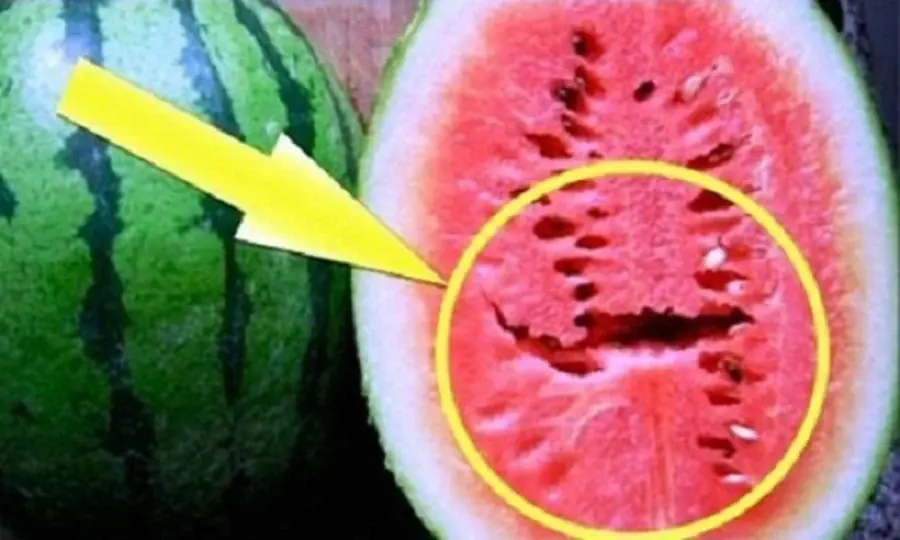
Chapter 1: Why Does a Watermelon Develop Cracks on the Inside?
Watermelons are made up of a large amount of water, which is one reason they are so refreshing. As they grow, their flesh expands and changes as the fruit develops. Under certain conditions, the internal structure may not expand evenly, resulting in gaps, cavities, or cracks.
One possible explanation is a condition commonly known as hollow heart.
Hollow heart is a physiological disorder in which a watermelon develops an internal cavity or split in its flesh. When the fruit is cut open, you may notice a hollow space near the center, sometimes accompanied by cracks extending outward through the surrounding flesh.
The appearance can be surprising, particularly when the outer rind looks completely normal.
What causes hollow heart?
Hollow heart is generally associated with irregularities during fruit development. Environmental conditions, pollination, and the way the fruit grows can all play a role.
Watermelon flowers must be successfully pollinated for the fruit to develop properly. If pollination is uneven or incomplete, the developing fruit may not form a uniform internal structure. This can contribute to gaps or cracks as the watermelon grows.
Temperature fluctuations may also influence development. Watermelons are sensitive to growing conditions, and sudden changes in temperature can affect the rate at which different parts of the fruit develop.
Rapid changes in growth are another possible factor. When a watermelon receives abundant water after a period of relatively dry conditions, it may grow quickly. The internal flesh can expand unevenly, potentially contributing to cracking.
However, it is important to understand that no single factor explains every case. Hollow heart can occur for several reasons, and the precise cause is not always identifiable simply by looking at the cut fruit.
Are internal cracks always a sign of poor quality?
Not necessarily.
A watermelon with hollow heart may still have perfectly edible flesh. In some cases, the fruit tastes sweet and has a pleasant texture despite the visible cavity.
Other watermelons may have a less desirable texture. The flesh around the cracks can sometimes appear grainy, dry, or less firm than the surrounding area.
This means that internal appearance alone cannot determine whether a watermelon is safe to eat. You need to evaluate its condition more broadly.
Why does the outside sometimes look completely normal?
One of the most confusing things about internal cracking is that the rind may show no obvious warning signs.
The watermelon might feel firm, have an intact green exterior, and look fresh at the market. Yet once you cut it open, you discover a large cavity or several irregular cracks.
This happens because hollow heart and other internal developmental problems can occur without producing visible damage to the outer rind.
A normal-looking exterior is therefore not a guarantee that the inside will have a perfect texture. Likewise, an unusual interior does not automatically mean the fruit is spoiled.
The key is learning how to distinguish a natural internal defect from signs of deterioration.
Chapter 2: The Different Types of Cracks and What They May Mean
Not every crack inside a watermelon looks the same. Some appear as narrow lines, while others form large cavities or irregular spaces near the center.
Paying attention to the appearance of the flesh can help you understand what you are seeing.
1. A large hollow space in the center
One of the most recognizable signs of hollow heart is a cavity near the middle of the watermelon.
When you slice the fruit, the center may appear separated, leaving an empty space surrounded by red or pink flesh. Sometimes, several cracks extend from the cavity toward the outer portions of the fruit.
This condition is generally associated with the way the watermelon developed.
If the surrounding flesh is firm, smells fresh, and has no signs of spoilage, the fruit may still be suitable to eat. You can remove any sections with an unpleasant texture and inspect the remaining flesh.
However, do not assume that every hollow space is harmless. If the cavity contains liquid, unusual discoloration, mold, or tissue that appears decomposed, the watermelon should be discarded.