Did You Know Why a Cat Rubs Against You When It Notices You? The Meaning May Surprise You
You walk through the door after a long day, and before you have even put down your bag, a familiar little figure appears beside your feet. Your cat approaches with its tail held high, circles your legs, presses its cheek against your trousers, and slowly slides its body along you as if it has been waiting for this exact moment.
It may look like a simple greeting, but there is more happening than many cat owners realize. Your feline companion is communicating through touch, scent, and body language. That gentle rub can be a friendly hello, a way of making a familiar person smell more reassuring, a request for attention, or a combination of several messages.
Cats do not communicate exactly as humans do. They rely heavily on their sense of smell, and they use scent in ways that are almost invisible to us. When a cat brushes its face against your leg, it may be leaving chemical signals that help identify familiar people and surroundings. In the cat's world, this small gesture can be part of maintaining a sense of security and social connection.
But why does your cat often do it precisely when it notices you? Why does it sometimes rub against your legs and then walk away, while at other times it keeps circling until you stop and pet it? And what does it mean when the same behavior suddenly becomes unusually frequent?
The answers reveal a fascinating side of feline communication—and understanding them can help you recognize what your cat may be asking for without relying on guesswork.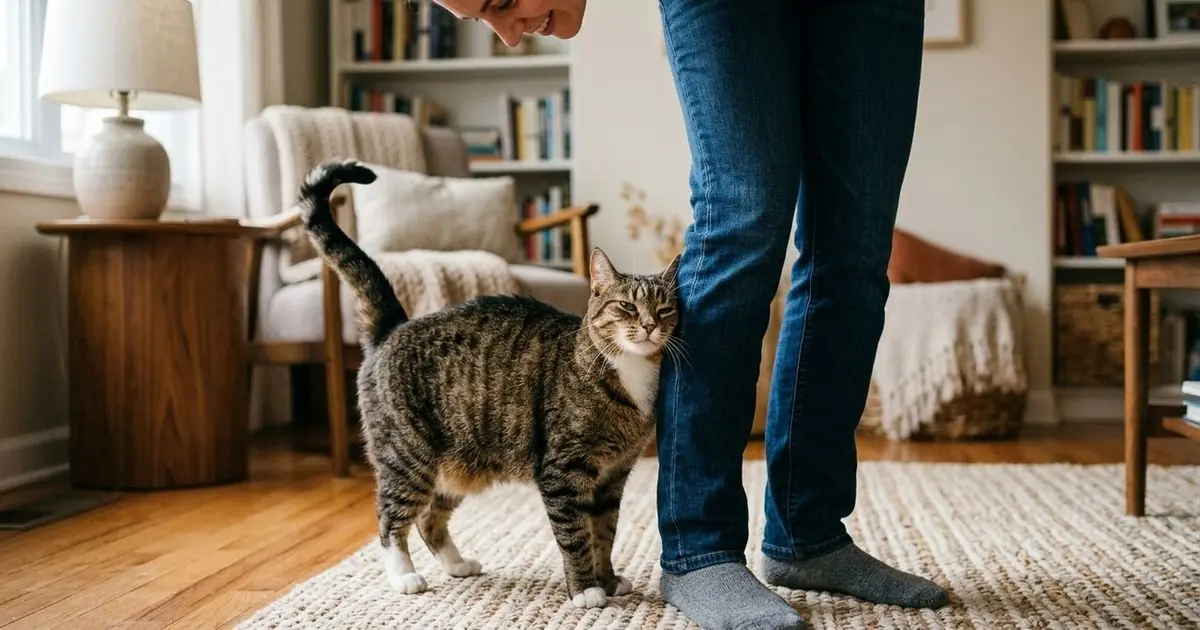
Chapter 1: The Little Gesture That Says More Than It Seems
The scene in the photograph is familiar to anyone who lives with a cat: an animal approaches a person's legs and presses its head and body against them. The cat does not need to meow loudly or jump onto a table to attract attention. A gentle touch is enough to make its presence known.
This behavior is commonly called rubbing or bunting, particularly when the cat uses its forehead, cheeks, or head to make contact. It is a normal part of feline social behavior. Cats may rub against people, other animals, furniture, doorways, and objects in their environment.
To a human observer, the action may look like an uncomplicated display of affection. Often, it is friendly. A cat that approaches with a relaxed body, upright tail, and soft expression is generally showing that it feels comfortable enough to initiate contact.
However, rubbing is not a single-purpose signal. It can serve several functions at once.
A cat may be greeting you while also transferring its scent. It may be seeking a reassuring interaction while asking you to notice that it is hungry. It may simply be repeating a familiar routine that has become part of its relationship with you.
The context matters. What happened immediately before the rubbing? Has the cat just seen you after several hours apart? Is it approaching its food area? Does it continue rubbing when you begin stroking it? Does it seem relaxed, or is it restless and uncomfortable?
These details help explain the behavior more accurately than the movement alone.
Why the greeting can happen so quickly
Cats are observant animals. They learn household routines and can recognize familiar people through a combination of visual, auditory, and scent-related information.
Your footsteps, the sound of a key, the movement of a door, or the familiar rhythm of your arrival may signal that you are home. Some cats appear near the entrance before their owners have even stepped inside.
Once the cat recognizes you, rubbing can become part of its greeting ritual. It approaches, makes contact, and leaves its scent on a familiar person. The interaction may be accompanied by purring, a raised tail, a small meow, or a gentle head movement.
The behavior is especially noticeable after a period of separation. A cat may rub against your legs when you return from work, wake up in the morning, or come back into a room after being away.
That does not mean every cat will greet its owner this way. Some are more physically affectionate, while others prefer to sit nearby, blink slowly, or simply observe. Individual temperament and past experiences influence how cats express social comfort.
A greeting in the cat's own language
It is tempting to translate every feline action directly into a human emotion. A cat rubbing against you may indeed be expressing a friendly relationship, but it is more accurate to understand the behavior as a form of feline communication.
Cats use touch and scent together. The physical contact allows them to exchange information through scent glands located in different parts of the body.
In other words, your cat is not simply touching you. It is interacting with you in a way that makes sense within its own sensory world.
That is what makes the gesture so interesting: an action that seems ordinary to us can carry several layers of information for the animal performing it.
Chapter 2: The Hidden Role of Scent and Why Your Cat Rubs Its Cheeks Against You
One of the most important explanations for rubbing lies in a cat's extraordinary reliance on smell.
Humans tend to understand the world mainly through sight and sound. Cats use those senses too, but scent plays a particularly important role in how they investigate their surroundings, recognize familiar individuals, and establish a sense of familiarity.
A cat's face contains several scent-producing areas. Glands are found around the cheeks, lips, chin, and other parts of the head. When a cat presses or slides these areas against a person or an object, it can deposit scent signals.
These chemical signals are often discussed in connection with pheromones. Pheromones are substances that animals release and other members of the same species can detect. They provide information that humans may not be able to smell or interpret.
What happens when a cat rubs its face on your leg?
Imagine your cat approaching your trousers and pushing the side of its face against the fabric. It may then turn its head, rub the other cheek, and continue along your leg.
This repeated movement brings scent-producing areas into contact with the surface. The cat is effectively adding its own familiar scent to an object or individual in its environment.
To us, nothing appears to change. Your trousers look exactly the same, and you may not notice any smell at all. But scent is a major part of the way cats organize their surroundings.
A familiar scent profile can help make an area feel recognizable. Cats may rub against furniture, corners, doorframes, and household objects for similar reasons. They may also rub against other cats with whom they have a friendly relationship.
When they rub against a person, the behavior can contribute to a shared familiar scent between the cat and its social environment.
Is your cat marking you as its property?
People sometimes describe this behavior by saying that a cat is "claiming" its owner. The phrase is understandable, but it can be misleading if taken too literally.
A cat rubbing against your leg is not necessarily displaying possessiveness in the human sense. Scent marking is a normal communication behavior. It can help a cat identify familiar individuals and make its surroundings feel more recognizable.
The behavior is better understood as a combination of scent communication and social familiarity rather than an attempt to control a person.
This distinction matters because cats use scent marking in many everyday situations. They may rub against a chair after waking up, press their cheeks against a new piece of furniture, or brush against a familiar person after that person returns home.