The common thread is not ownership as humans understand it. It is the importance of familiar scent in the cat's environment.
Why the face is often the first part to make contact
When cats greet one another, they may approach and make contact around the head and face. A domestic cat may use a person's lower leg as the point of contact because it is conveniently positioned.
The cat can reach the person's trousers or shoes without jumping or stretching. It can then move along the leg and sometimes wrap its tail around it.
The sequence may look like a small greeting ceremony: approach, sniff, cheek rub, body rub, and perhaps a pause for petting.
Some cats repeat the sequence several times. Others make one brief contact and move away.
Both can be normal. The amount of rubbing varies with the individual cat, the situation, and the relationship it has developed with the person.
Why familiar smells can make a cat feel more comfortable
A home contains many different scents. New furniture, visitors, cleaning products, outdoor smells brought in on shoes, and unfamiliar objects can all change the sensory environment.
Cats often investigate these changes by sniffing and rubbing. A cat may rub against a familiar chair after a new object has been placed nearby, or it may revisit a doorway after someone has entered the house.
The act of depositing familiar scent may help maintain a recognizable scent environment. This is one reason feline behavior specialists emphasize the importance of scent when considering a cat's comfort.
It also explains why strong, unfamiliar smells can sometimes disturb cats. A heavily scented cleaning product or a sudden change in the household environment may be more noticeable to a cat than its owner expects.
A cat that rubs against you may therefore be doing something that is both social and sensory: greeting a familiar person while reinforcing the familiar scent landscape around it.
Chapter 3: Is It a Sign of Affection? What the Behavior Can Tell You About Your Bond
For many owners, the most reassuring interpretation is also one of the most likely: a cat that approaches and rubs against a familiar person is often showing friendly social behavior.
Cats do not necessarily seek physical contact with everyone they encounter. Some are cautious around strangers and take time to approach unfamiliar people. When a cat voluntarily moves toward someone and initiates gentle contact, it can be a sign that the interaction feels safe and familiar.
Still, it is important to read the whole body rather than relying on one movement.
The raised tail: a useful part of the picture
A cat that approaches with its tail held upright is often displaying a friendly or confident social posture. The tail may be straight, slightly curved at the tip, or gently moving as the cat approaches.
When this posture appears together with relaxed movement and gentle rubbing, it often indicates a positive interaction.
The tail alone, however, does not provide a complete explanation. A cat's emotional state is expressed through a combination of posture, ears, eyes, facial tension, movement, and vocalization.
For example, a cat with a raised tail may still be excited, impatient, or seeking something specific. The surrounding behavior helps distinguish these possibilities.
Purring can accompany rubbing
Some cats purr while rubbing against a person's legs. The sound can make the moment seem especially affectionate.
Purring is commonly associated with contentment, but it does not always mean a cat is happy. Cats may also purr in other circumstances, including when seeking comfort or experiencing stress.
For that reason, purring should be interpreted alongside the cat's posture and behavior.
A relaxed cat that approaches voluntarily, rubs gently, keeps its body loose, and remains comfortable when touched is more likely to be enjoying the interaction than a cat that appears tense or tries to escape.
The importance of voluntary contact
One of the clearest signs of a comfortable relationship is that the cat chooses to approach.
A cat that initiates rubbing is controlling the beginning of the interaction. It can move closer, make contact, pause, and leave whenever it wants.
Respecting that choice helps maintain trust. Rather than immediately picking the cat up or holding it in place, allow it to decide how much contact it wants.
Some cats enjoy a gentle stroke along the cheeks or under the chin after rubbing. Others prefer to make contact and then walk away.
Both responses should be respected.
Why some cats are more affectionate than others
Not all cats express social attachment in the same way. Some regularly weave around their owner's legs, sit on their lap, and rub their faces against hands. Others show their comfort by staying in the same room, sleeping nearby, or following their owner from a distance.
Personality, early social experiences, age, health, and the environment can all influence how a cat interacts with people.
A naturally cautious cat may need more time before initiating contact. A confident and highly social cat may greet visitors as enthusiastically as it greets its owner.
It is not useful to judge the strength of a bond only by how often a cat rubs against someone. A quieter cat can still be strongly attached to its household.
The most meaningful sign is the overall pattern of relaxed, voluntary interaction.
Chapter 4: Why Your Cat May Be Asking for Attention
Although scent communication and greeting are important explanations, rubbing can also be a practical way for a cat to get a person's attention.
Cats learn quickly which behaviors produce a response. If rubbing your leg leads to petting, conversation, food, or play, the cat may repeat the behavior because it has learned that it works.
This does not make the gesture insincere. It simply means that social communication and learned behavior can operate together.
The familiar greeting that becomes a request
Consider what happens when you enter the kitchen. Your cat may approach, rub against your leg, and then walk toward its food bowl.
The first part of the behavior may be a greeting, while the movement toward the bowl gives you another clue. The cat may be asking for food or reminding you that it is time for a familiar routine.
Some cats repeat this pattern at predictable times. They may rub against their owner shortly before breakfast, when a treat cupboard opens, or when the person sits down in a favorite chair.
The timing can reveal what the cat expects.
Rubbing before mealtime
Food is a common reason cats seek attention. A cat may rub against your ankles, meow, look toward its bowl, or walk between your feet when it expects to be fed.
If the behavior occurs at roughly the same time each day, the cat may have learned the household feeding schedule.
It is useful to consider the entire sequence. Does the cat rub, then look toward the kitchen? Does it lead you to the feeding area? Does it become more vocal when you approach the cupboard?
These actions may suggest that the cat is requesting food rather than simply greeting you.
However, an increase in hunger or unusually persistent food-seeking can sometimes be related to a health issue. If your cat's appetite changes noticeably, especially alongside weight loss, increased thirst, or other symptoms, consult a veterinarian rather than assuming it is only asking for extra meals.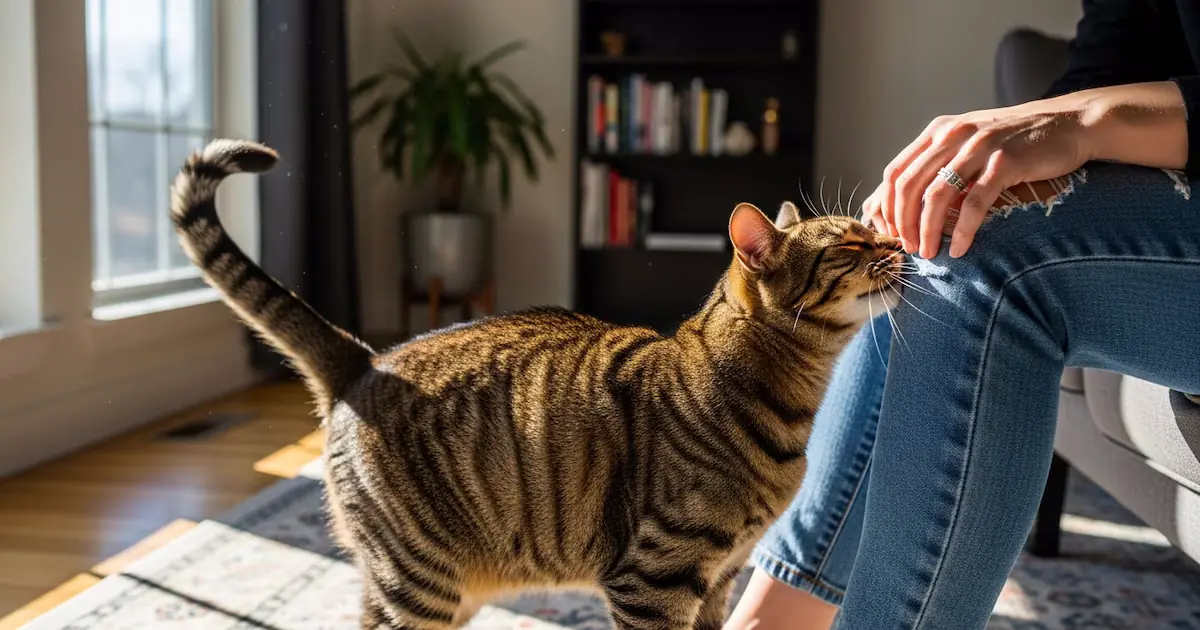
Rubbing when you sit down
Some cats become especially interested when their owner sits on a sofa or at a desk. They may rub against the person's legs, push their head into a hand, or climb onto the lap.