Do not confuse this symptom with the familiar cheek rub shown in the photograph.
Sudden changes in social behavior
A cat that suddenly becomes unusually clingy, restless, withdrawn, or aggressive may be responding to a change in its physical condition or environment.
Pain and illness can alter behavior. Stressful changes at home may also influence how a cat interacts with people.
If the change is marked, persistent, or accompanied by other symptoms, a veterinary examination is the safest way to understand what is happening.
Chapter 11: How to Respond When Your Cat Rubs Against You
Once you understand that rubbing can be a greeting, a scent signal, and a request for attention, the next question is simple: what should you do when your cat approaches?
In most cases, the best response is to allow the cat to lead the interaction.
Let your cat choose the amount of contact
If your cat approaches and rubs against your leg, pause for a moment rather than immediately bending down to pick it up.
Some cats enjoy a gentle stroke along the cheek or under the chin. Others prefer to rub once and continue walking.
Offer your hand calmly and see how the cat responds. If it leans toward your hand, it may welcome contact. If it turns away or walks off, let it go.
This approach gives the cat control over the interaction and helps prevent unwanted handling.
Where do many cats enjoy being touched?
Individual preferences vary, but many cats enjoy gentle contact around the cheeks, chin, and sides of the face. These are also areas where scent glands are located.
Some enjoy being stroked along the back, while others dislike having their stomach, paws, or tail touched.
Watch for signs that the cat wants you to stop. These may include:
-
Turning the head away repeatedly.
-
Flattening or rotating the ears.
-
Flicking the tail sharply.
-
Tensing the body.
-
Moving away or attempting to escape.
-
Swatting, growling, or biting.
These signals should be respected. A cat that has initiated rubbing is not automatically agreeing to every kind of physical contact.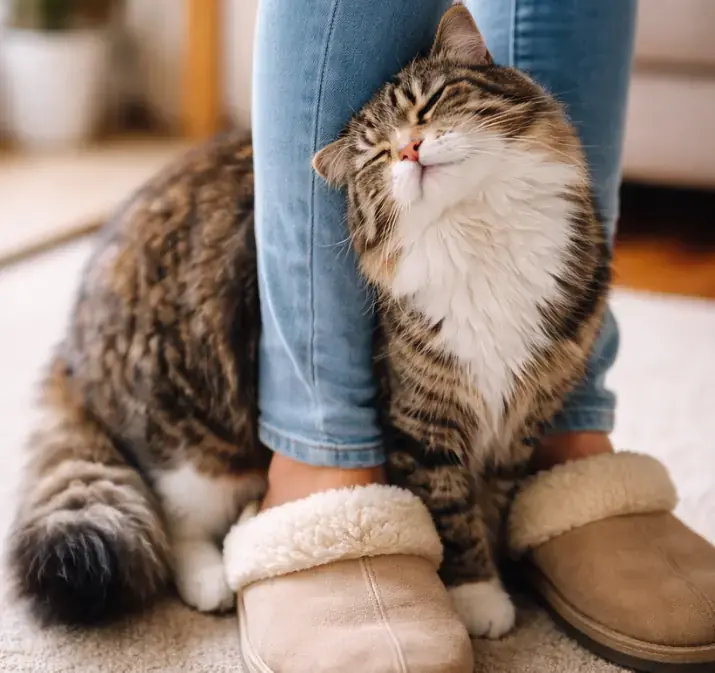
Avoid picking the cat up without warning
A cat may enjoy rubbing against your ankles but dislike being lifted.
The two actions require different levels of physical contact. When a cat is picked up, it loses some control over where it can move, which may make it uncomfortable.
If your cat enjoys being carried, approach gently and support its body properly. If it struggles, let it down safely.
Make greetings part of a predictable routine
Many cats appreciate familiar routines. When you return home, you can greet your cat calmly, allow it to rub against you, and then provide a short period of attention.
If the cat is hungry, follow its normal feeding schedule rather than automatically giving extra food every time it rubs.
If it appears energetic, a brief play session may be more appropriate.
The important point is to respond to the cat's actual needs rather than assuming that every greeting means the same thing.
Chapter 12: How to Build a Stronger Relationship Through Everyday Communication
A good relationship with a cat is built through many small interactions, not only through moments of physical affection.
Rubbing is one of the signals that can help owners understand when their cats feel comfortable approaching them. But trust also develops when people respect a cat's boundaries, provide a predictable environment, and respond consistently to its needs.
Pay attention to patterns
Notice when your cat usually rubs against you.
Does it happen when you arrive home? Before meals? When you sit down? When you enter a particular room?
The timing may reveal whether the behavior is primarily a greeting, an attention-seeking action, or part of a learned routine.
Over time, you may recognize small differences in the way your cat approaches.
For example, a greeting may involve a relaxed tail and a brief cheek rub. A request for food may include repeated vocalizations and movement toward the bowl.
These patterns are not universal, but observing them helps you understand your own cat.
Provide opportunities for play
Some cats seek attention because they have energy that needs an appropriate outlet.
Interactive play using a wand toy or another safe toy can help satisfy natural chasing and pouncing behaviors.
Short, regular play sessions are often more useful than waiting until a cat becomes restless.
Avoid using hands or feet as toys. Encouraging a cat to bite or chase human body parts can create habits that become painful as the animal grows older.
Give your cat safe places to rest
Cats benefit from having comfortable places where they can retreat and rest without interruption.
A quiet bed, elevated perch, scratching post, or hiding space can help a cat feel secure.
Not every moment of social contact needs to become a petting session. Sometimes the best way to strengthen a relationship is to let the cat relax near you without demanding interaction.
Respect scent and familiar surroundings
Because cats rely heavily on scent, sudden changes to their environment may affect how comfortable they feel.
When possible, introduce new furniture, objects, or household changes gradually. Keep familiar resting areas available and avoid using strongly scented products around places where the cat sleeps or eats.
In multi-cat homes, scent can be especially important. Cats may rub against one another and shared objects as part of maintaining a familiar group scent.
Changes in that scent environment can sometimes contribute to tension, so gradual introductions and adequate resources are helpful.
Remember that every cat is an individual
There is no single correct way for a cat to show affection.
One may greet you at the door every day. Another may quietly sit beside you. A third may prefer to follow you around without being touched.
Rather than comparing your cat with other people's pets, learn the behavior of the animal in front of you.
A relationship becomes stronger when the cat can approach, communicate, and move away without being forced into contact.
Chapter 13: The Real Meaning Behind That Gentle Rub
So, what does it mean when a cat rubs against you after noticing that you are home?
The most accurate answer is that it is usually a form of friendly social communication, often combined with scent marking. Your cat may be greeting you, reinforcing a familiar scent connection, seeking attention, or expressing that it feels comfortable approaching you.
The behavior is especially meaningful because cats use scent so extensively. When your cat presses its cheek against your leg, it is interacting with you through a sensory system that humans cannot fully experience.
That does not mean the gesture has one fixed translation. The same cat may rub against you for different reasons at different times.
It may greet you in the morning, ask for dinner in the evening, and seek a little attention when you sit down. The movement may look almost identical, but the context changes what the cat is likely communicating.
The best way to understand the message is to observe the entire interaction: the tail, ears, eyes, posture, vocalizations, and what the cat does immediately afterward.
Most importantly, remember that ordinary social rubbing should be distinguished from unusual or compulsive behavior. If your cat suddenly begins rubbing excessively, appears uncomfortable, develops skin irritation, or displays unusual head pressing, consult a veterinarian.
For the everyday greeting, however, there is usually no reason to worry. When your feline companion approaches, raises its tail, and gently brushes its face against your leg, it is using one of its natural ways to connect with the familiar world around it.
A small gesture, perhaps—but one that reveals just how much communication can take place without a single word.