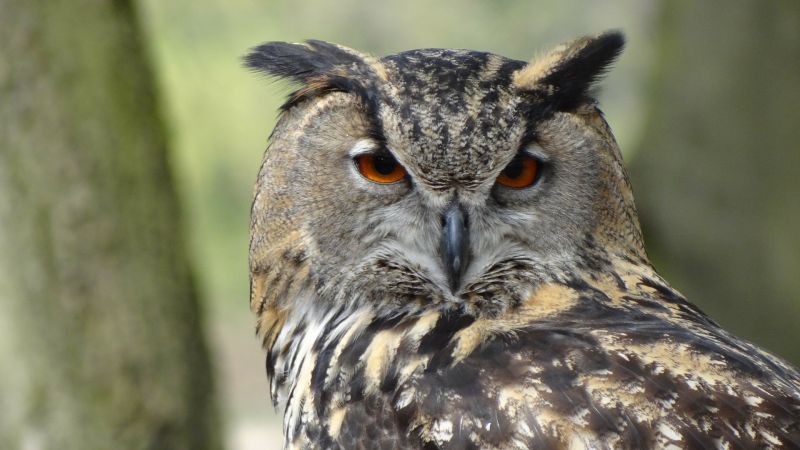
Depending on the species, an owl may occupy a relatively small area or use a much larger landscape. The size of its territory can depend on food availability, habitat quality, competition, and whether the bird is breeding.
If an owl frequently appears near your house, it may be moving through a familiar territory.
You might notice it calling from a tree on several consecutive nights. You may hear another owl responding from farther away, creating a conversation of hoots across the neighborhood.
These calls can serve several purposes.
They may help owls communicate with their mates, advertise their presence, maintain contact, or warn other owls to keep their distance.
The exact meaning depends on the species and the circumstances.
For example, a territorial call can help a resident owl signal that a particular area is already occupied. Another owl hearing the call may respond, move away, or continue calling from a different location.
To people unfamiliar with owl behavior, these sounds can seem eerie.
A deep hoot echoing through a quiet neighborhood may feel as though something unusual is happening. In reality, the owl may simply be communicating with another member of its species.
Different owls produce different sounds. Some have familiar hooting calls, while others make screeches, whistles, trills, or harsh cries.
If you hear repeated calls around your home, the sound alone does not indicate danger or an approaching event.
It is more likely that you are witnessing ordinary animal communication.
And once you begin recognizing these calls, the nighttime environment can become much more interesting.
4. You May Be Living Near a Breeding or Nesting Site
Another possible reason for repeated owl sightings is that the bird is nesting nearby.
During the breeding season, some owls become especially active around suitable nesting locations. Depending on the species, they may use natural tree cavities, old nests built by other birds, rocky ledges, nest boxes, or sheltered structures.
A mature tree with a suitable cavity can be particularly valuable because it offers protection for eggs and young birds.
If your property contains such a tree, it may provide exactly the kind of shelter a nesting owl needs.
You might notice an adult owl returning to the same general area at dusk. You may hear calls more frequently than usual, or observe an adult carrying prey toward a particular tree or structure.
These behaviors can sometimes indicate that young owls are present.
However, an owl appearing regularly in a tree does not automatically mean it has a nest there. It may simply be using the location for resting or hunting.
If you suspect nesting activity, avoid climbing the tree, looking inside a cavity, or approaching the suspected nest.
Disturbing nesting birds can cause stress and may interfere with their ability to care for their young. Depending on where you live and the species involved, disturbing or removing a nest may also violate wildlife protection laws.
If you discover a young owl on the ground, do not immediately assume it has been abandoned. Some young owls leave the nest before they are capable of sustained flight and continue receiving care from their parents.
Keep pets and children away, observe from a safe distance, and contact a qualified wildlife rehabilitator if the bird appears injured or is in immediate danger.
The presence of nesting owls can be an extraordinary opportunity to observe nature, but it should always be approached with patience and respect.
5. Owls Can Help Control Rodent Populations Naturally
One of the most useful benefits of having owls in the surrounding environment is their role in controlling certain pest populations.
Rodents can cause considerable problems around homes, farms, gardens, and storage buildings. They may damage electrical wiring, contaminate stored food, chew through materials, and spread pathogens.
Many owl species prey on mice, voles, rats, and other small mammals.
Barn owls, in particular, are well known for consuming substantial numbers of small rodents when those animals are available. Other species also contribute to natural pest control, although their diets vary.
This means that an owl hunting near your house may be performing an ecological service.
Rather than relying entirely on chemical rodenticides, property owners can support a healthier environment by maintaining suitable habitat for native predators and reducing the conditions that attract rodents in the first place.
That does not mean an owl will eliminate every mouse on your property.
The effect depends on the owl species, local prey populations, habitat, and many other factors.
Nevertheless, owls are valuable components of natural ecosystems, and their presence can be a positive sign that wildlife is using the landscape around your home.
If you want to encourage a wildlife-friendly yard, consider maintaining mature trees where appropriate, reducing unnecessary pesticide use, and avoiding rodent poisons that could harm predators.
Rodenticides can sometimes cause secondary poisoning when a predator eats contaminated prey. Owls and other wildlife may therefore be harmed by attempts to control rodents chemically.
It is also wise to store food securely, clean up spilled birdseed, and keep compost and rubbish properly contained.
These measures help reduce rodent problems while allowing wildlife to exist safely nearby.
In other words, the most effective way to appreciate an owl is not necessarily to feed it or attract it directly. It is to create an environment where wildlife can survive without becoming dependent on people.