Did You Know? When a Lizard Visits Your House, It May Be a Sign of Something More Than You Think
Have you ever walked into a room, looked up at the wall, and suddenly noticed a small lizard watching you? Perhaps it was resting near the ceiling, hiding behind a picture frame, or moving quietly across the wall before disappearing into a corner. For some people, the unexpected visitor is nothing unusual. For others, seeing a lizard inside the house immediately raises questions: Is it a good sign? Does it bring luck? Is there a hidden meaning behind its appearance?
Across different cultures, the arrival of a small lizard in a home has inspired numerous beliefs and interpretations. Some traditions associate it with good fortune, protection, prosperity, or an approaching change. Others consider the animal a reminder to pay attention to the surroundings and the small details of everyday life. In certain households, even the place where a lizard appears is believed to carry a particular meaning.
But there is another side to this curious visitor that is just as interesting.
Behind the traditional beliefs lies a fascinating little animal with an important role in the natural environment. The small house lizards commonly seen on walls and ceilings are often geckos, creatures that have adapted remarkably well to living close to humans. They can enter homes in search of food, shelter, warmth, and suitable places to hide.
Their presence may reveal something about the environment around a house, including the availability of insects, small openings in walls, and nearby vegetation.
So, when a lizard suddenly visits your home, should you consider it a lucky sign, a warning, or simply an ordinary encounter with nature?
The answer is more interesting than many people expect. Traditional beliefs offer one perspective, while biology provides another. Understanding both can help explain why these little creatures have attracted so much attention throughout history.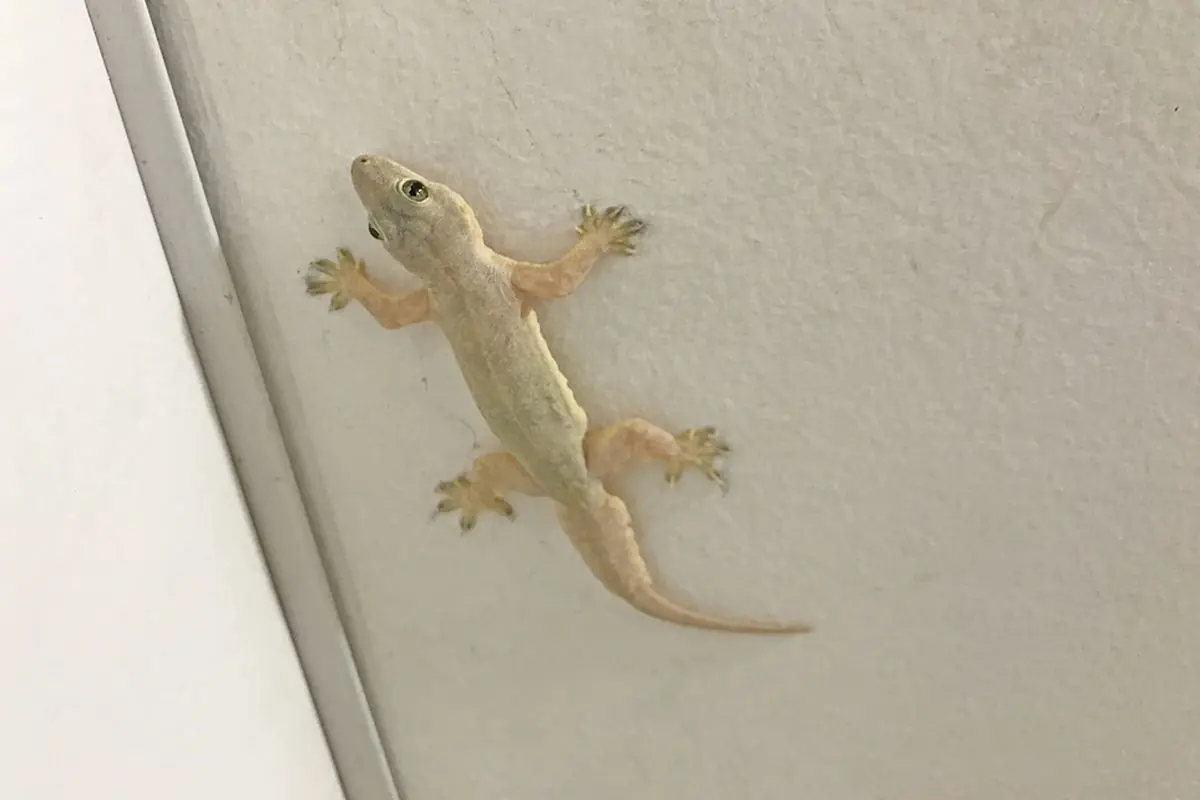
Why Does a Lizard Suddenly Appear Inside Your House?
A small lizard appearing inside a home can seem surprising, especially when the doors and windows appear to have remained closed.
However, these animals are remarkably good at finding their way into buildings.
The small creatures commonly seen climbing indoor walls are often house geckos. They belong to a group of reptiles that have developed special adaptations allowing them to live in a wide variety of environments, including houses, gardens, sheds, and other human-made structures.
Unlike larger reptiles that generally prefer outdoor habitats, some gecko species have become comfortable living close to people.
They do not necessarily enter because something unusual is happening inside the home. In most cases, they are following basic survival needs.
1. Your House May Offer an Abundant Food Supply
One of the main reasons geckos enter homes is the availability of insects.
Small flying insects, mosquitoes, moths, flies, and other invertebrates may gather around indoor lights, windows, and outdoor entrances.
For a gecko, these locations can become convenient hunting grounds.
At night, artificial lighting attracts many insects. A gecko resting near a lamp may simply be waiting for an opportunity to catch its next meal.
This explains why people often notice small lizards near ceilings, balconies, windows, and outdoor lights.
The animal is not necessarily interested in the people living inside. It may be more interested in the insects moving around them.
In fact, geckos can help reduce the number of certain insects around a house.
Their presence may therefore indicate that the surrounding environment provides enough food for a small predator to survive.
2. Small Openings Make It Easy to Enter
Many homeowners assume that a lizard cannot enter unless a door or window has been left open.
However, small gaps around window frames, ventilation openings, roof edges, pipes, and doors may provide access.
Geckos have flexible bodies and can move through surprisingly narrow spaces.
Some species are also excellent climbers.
Their specialized toe pads allow them to move across vertical surfaces and even upside down along ceilings.
A small opening that seems insignificant to a person may be enough for a gecko to enter.
This is especially common in houses surrounded by gardens, trees, shrubs, or other areas where small reptiles naturally live.
3. The House Provides a Safe Place to Hide
A home can offer many hiding places.
Behind cabinets, beneath furniture, around wall decorations, inside storage spaces, and near ceiling corners, a small lizard may find shelter from predators and unfavorable weather.
Geckos are generally cautious animals.
When they detect movement, they may freeze, hide, or quickly escape.
This behavior can make them appear mysterious.
One moment, a lizard may be clearly visible on a wall. A few seconds later, it may disappear into a small opening that is difficult to notice.
The animal is usually responding to its surroundings rather than deliberately approaching people.
4. Warmth and Weather Can Influence Their Movement
Temperature is another important factor.
Like other reptiles, geckos are ectothermic animals. Their body temperature is influenced by the surrounding environment.
They may move between sheltered and exposed locations to find suitable conditions.
During periods of changing weather, heavy rain, or temperature fluctuations, a house may offer a more protected environment than the outdoors.
Some geckos may also become more noticeable when insect activity increases.
Consequently, seeing a lizard indoors does not automatically indicate that the house has a special meaning.
It may simply be an animal responding to food availability, shelter, and temperature.
2. What Does It Mean When a Lizard Visits Your House According to Traditional Beliefs?
The appearance of a lizard inside a home has been interpreted in many different ways throughout history.
In some communities, people see these small reptiles as ordinary creatures that share the same environment as humans. In others, their unexpected arrival has become connected with traditional stories, family customs, spiritual beliefs, and ideas about luck.
These interpretations are especially interesting because they often differ from one region to another.
A lizard appearing on a wall may be considered a positive sign in one household, while another family may interpret the same encounter as a reminder to be careful or pay attention to upcoming events.
There is no universal interpretation, but several recurring themes appear in traditional beliefs.
The Belief That a Lizard Can Represent Good Fortune
One popular interpretation associates the appearance of a lizard inside a home with good fortune.
In some traditional households, small animals entering the home are viewed as symbols of nature bringing a message from the outside world.
A lizard may therefore be interpreted as a positive visitor rather than an unwanted intruder.
Some people associate its presence with opportunities, unexpected good news, or a period of greater harmony within the household.
The idea is often connected with the animal's ability to survive in different environments.
Geckos are adaptable creatures. They can live close to humans, find food in small spaces, and move across walls and ceilings with remarkable ease.
In symbolic interpretations, these characteristics may represent flexibility, resilience, and the ability to overcome difficulties.
However, these meanings belong to folklore and personal belief. There is no scientific evidence that a lizard entering a house predicts financial success, good news, or a particular future event.
Still, the positive interpretation helps explain why some people prefer to leave these little visitors alone rather than immediately remove them.
A Symbol of Protection and Balance
Another traditional interpretation connects the lizard with protection.
Because geckos feed on insects, their presence can be viewed as beneficial to the household.
Long before modern pest-control products became widely available, people observed that certain animals helped reduce the number of unwanted insects around their homes.