Chapter 3 — How to Eat Chicken Liver More Safely
The question is not whether chicken liver is healthy, but how often it belongs on the menu
Chicken liver does not need to be treated as a forbidden food by every adult. It can provide useful nutrients, and many people enjoy it as part of traditional meals. The important point is to avoid making it a frequent, large portion of the diet.
The NHS notes that liver is particularly rich in vitamin A and that eating it more than once a week may put a person at risk of consuming too much. This is general guidance, not a personalized serving prescription for every individual.
For someone who eats chicken liver occasionally, the overall diet may remain balanced. For someone who eats it several times every week, takes a multivitamin containing retinol, and also uses cod liver oil, the combined intake deserves more attention.
There is no single portion size that can guarantee safety for every person. Vitamin A content varies between foods and preparations, and individual needs differ with age, pregnancy, health conditions, and supplement use.
A sensible approach is to think about liver as an occasional nutrient-rich food rather than an everyday protein source. People who are pregnant should follow the stricter guidance to avoid liver and liver products.
Read supplement labels before combining products
One of the easiest ways to overlook excessive vitamin A intake is to use several products without checking their ingredients.
A multivitamin may contain vitamin A. A separate supplement for skin or hair may contain it too. Cod liver oil can also be a source. If a person eats chicken liver regularly, these sources can add up.
When reading labels, look for terms such as:
-
Retinol
-
Retinyl palmitate
-
Retinyl acetate
-
Vitamin A
-
Beta-carotene
The first three are forms of preformed vitamin A. Beta-carotene is a provitamin A carotenoid that the body can convert into vitamin A. The NIH explains that the upper limit for preformed vitamin A does not apply to beta-carotene in the same way.
It is also worth checking whether a supplement contains vitamin A in more than one form. Some products provide a mixture of retinol and beta-carotene.
People should avoid taking multiple supplements that overlap unless there is a clear reason and a healthcare professional has advised them to do so. More supplements do not necessarily mean better nutrition.
Do not use chicken liver as a treatment for tiredness
Because chicken liver contains iron and vitamin B12, some people may assume that eating it regularly is an easy way to treat fatigue.
That is not always appropriate.
Fatigue can be caused by many conditions, including anemia, sleep problems, thyroid disorders, infections, medication effects, stress, and other health issues. Iron deficiency is one possible cause, but it should not be assumed without proper assessment.
Chicken liver contains iron, but eating it does not replace a medical evaluation when symptoms are persistent. A clinician may recommend blood tests to check hemoglobin, iron status, vitamin B12, or other markers depending on the person's symptoms and medical history.
Taking iron supplements without a demonstrated need can also be inappropriate for some people. A nutrient-rich food can contribute to a balanced diet, but it should not become a substitute for diagnosis and treatment.
Cook chicken liver thoroughly
Vitamin A is not the only safety issue associated with chicken liver. Like other poultry products, raw or undercooked liver can carry harmful bacteria, including Campylobacter.
The bacteria may be present inside the liver as well as on its surface. This means that simply browning the outside does not guarantee that the center has reached a safe temperature.
New Zealand Food Safety advises cooking chicken livers to an internal temperature of 75°C for at least 30 seconds to kill harmful bacteria.
This is especially important because some recipes traditionally serve liver with a pink or lightly cooked center. A dish can look appetizing while still being inadequately cooked.
To reduce food-safety risks:
-
Keep raw chicken liver separate from ready-to-eat foods.
-
Wash hands and utensils after handling raw liver.
-
Avoid using the same cutting board for raw liver and salad ingredients without washing and sanitizing it.
-
Cook the liver thoroughly, checking the thickest pieces.
-
Refrigerate leftovers promptly and reheat them safely.
-
Do not rely on color alone to determine whether the liver is safe.
Thorough cooking helps reduce bacterial risks. It does not remove the vitamin A concentration, so it does not make frequent large portions a solution to the retinol issue.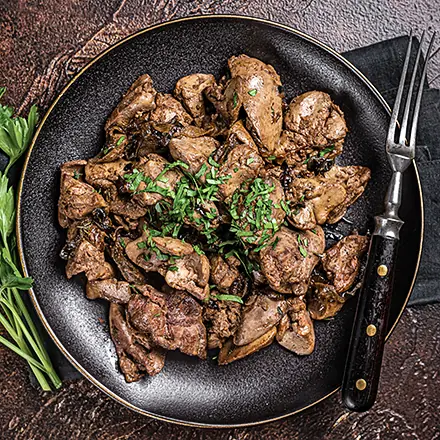
Choose a balanced meal rather than adding more liver
A meal containing chicken liver can be balanced with vegetables, whole grains, and other foods that provide fiber and a wider range of nutrients.
For example, a small occasional liver dish can be served with leafy vegetables, rice, potatoes, or other side dishes. This helps make the meal part of a varied eating pattern rather than turning liver into the main source of several nutrients.
Vegetables and fruits can also provide provitamin A carotenoids, including beta-carotene. These are found in foods such as carrots, pumpkin, sweet potatoes, and dark leafy greens. The body converts some of these compounds into vitamin A.
The conversion process is regulated differently from the absorption of preformed retinol. This is one reason plant sources of provitamin A are not treated the same way as high-retinol foods when setting the upper limit for vitamin A.
A varied diet is generally a better approach than relying heavily on one concentrated food. It allows people to obtain different nutrients from different sources without repeatedly consuming very high amounts of a single nutrient.
What can you eat instead if you want iron and vitamin B12?
People who enjoy chicken liver often value it for its iron, vitamin B12, folate, and protein. Fortunately, these nutrients are available from other foods too.
For vitamin B12: Fish, shellfish, meat, eggs, milk, and some fortified foods can provide vitamin B12. People following vegan diets may need fortified foods or a suitable supplement.
For iron: Lean meat, poultry, seafood, beans, lentils, tofu, and some fortified cereals can contribute iron. Plant-based iron is absorbed differently from the iron in animal foods, and eating vitamin C-rich foods alongside plant sources can help absorption.
For folate: Dark green vegetables, beans, peas, citrus fruits, and fortified grains can provide folate.
For protein: Fish, eggs, poultry, dairy products, beans, lentils, nuts, and tofu offer a range of protein options.
No single alternative has exactly the same nutrient profile as chicken liver. The goal is not to find one food that replaces every nutrient in liver. It is to build a varied diet in which different foods contribute different nutrients.