Eating Just One Bite Could Expose You to Dangerous Parasites: The Hidden Risks of Raw Water Caltrops
A strange-looking freshwater fruit has been enjoyed for generations, but few people realize that the conditions in which it grows may determine whether it is safe to eat. Known as the water caltrop, this dark, horn-shaped fruit contains a white, starchy interior that many people consider a delicious traditional snack. Some eat it freshly harvested, while others boil or roast it before serving.
But there is an important detail that deserves attention: aquatic plants can become contaminated by microscopic parasites when they grow in freshwater environments affected by human or animal waste. These organisms are too small to see with the naked eye, and an apparently fresh fruit does not necessarily reveal whether it has been exposed to them.
One particularly concerning organism is Fasciolopsis buski, commonly known as the giant intestinal fluke. It can infect humans who consume aquatic vegetation carrying its infective stage. Once inside the digestive system, the parasite can develop into an adult worm and cause abdominal discomfort, diarrhea, and other digestive complications. Heavy infections may become much more serious.
Social media posts sometimes claim that eating just one bite of a water caltrop introduces tens of thousands of parasites into the body. Such numerical claims should not be accepted as scientific facts. Not every fruit is contaminated, and there is no reliable basis for claiming that every bite contains a particular number of parasites.
Nevertheless, the underlying food-safety concern is real.
The more important questions are where these fruits come from, how parasites reach aquatic plants, what happens after contaminated food is consumed, and whether ordinary washing is enough to make them safe.
Understanding those details can help people enjoy traditional freshwater foods without unnecessary fear or avoidable health risks.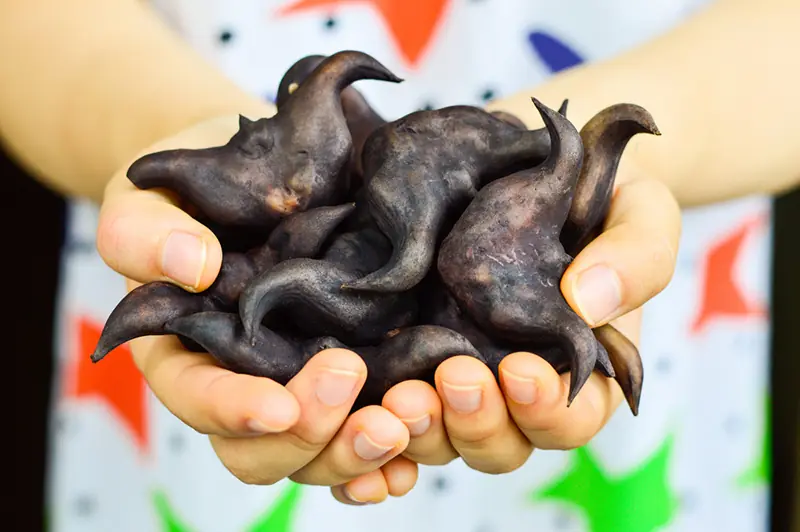
What Exactly Is the Water Caltrop?
The fruit commonly described in the original article is a water caltrop, an aquatic fruit produced by plants belonging to the genus Trapa.
It is sometimes called a horned water chestnut, buffalo nut, bat nut, or singhara, depending on the country and local tradition.
Despite the similarities in their common names, water caltrops should not be confused with Chinese water chestnuts. Chinese water chestnuts belong to a different plant group and have a different appearance and growing structure.
Water caltrops are particularly recognizable because of their unusual shape. Their outer shells are generally dark brown, reddish-brown, or nearly black. Some varieties have two prominent horns, while others develop additional pointed projections.
Inside the hard shell is a pale, starchy kernel.
This edible portion has a mild flavor and a firm texture, which makes it suitable for several traditional preparations. In parts of Asia, water caltrops are sold in markets during particular seasons and are enjoyed as snacks or incorporated into cooked dishes.
The plant itself grows in freshwater environments such as ponds, lakes, and slow-moving waterways. Its leaves float on the surface, while its roots remain anchored in the mud beneath the water.
The fruit develops underwater and eventually becomes hard as it matures.
This growing environment is central to understanding the potential health risks. Freshwater ecosystems can contain many organisms, some harmless and others capable of causing infections in humans.
The fact that a fruit grows naturally in water does not automatically make it unsafe. However, the quality of that water matters enormously.
A water caltrop cultivated in a properly managed environment may have a very different contamination risk from one collected from a pond affected by untreated wastewater or animal waste.
The outside appearance alone cannot establish the safety of either fruit.
Why Have Water Caltrops Been Eaten for Generations?
Water caltrops have a long history as a traditional food in several Asian communities.
For many families, they are associated with seasonal markets, childhood memories, local food traditions, and familiar household recipes.
Their popularity comes partly from their distinctive texture and relatively mild taste.
Unlike strongly flavored fruits, water caltrops have a neutral, starchy quality that allows them to be prepared in several ways.
Some people boil the entire fruit and remove the shell after cooking. Others roast it until the interior becomes tender. The cooked kernel can also be added to soups, desserts, and other traditional meals.
In certain regions, dried water caltrop kernels are processed into flour and used in traditional recipes.
Their nutritional composition is also one reason they attract attention. The edible portion contains carbohydrates and provides some dietary fiber and minerals, although its precise nutritional value varies with the species and preparation method.
For people who have grown up eating water caltrops, the fruit may seem completely ordinary.
However, traditional consumption does not eliminate the importance of modern food-safety practices.
A food that has been eaten for generations can still become contaminated when environmental conditions change.
Population growth, poor sanitation, polluted waterways, and unsafe harvesting practices can all influence the safety of freshwater produce.
The important distinction is not between traditional food and modern food. It is between produce harvested and prepared under safe conditions and produce whose contamination risks are unknown.
How the Giant Intestinal Fluke Reaches the Human Body
The parasite associated with water caltrop contamination is not an ordinary intestinal worm. It has a complex life cycle that depends on freshwater conditions and the presence of suitable intermediate hosts.