There are few everyday body changes more startling than looking down at your hands and suddenly noticing that your fingers have turned unusually white, blue, or red.
For some people, the change may happen after stepping outside on a cold morning. For others, it can occur while holding a chilled drink, reaching into a freezer, or even during a stressful moment. The fingers may feel cold, numb, painful, or strangely tingly at the same time.
Although the appearance can be alarming, there is an important reason these dramatic changes can happen: temporary changes in blood flow.
One possible explanation is Raynaud’s phenomenon, a condition in which the small blood vessels supplying the fingers or other affected areas temporarily narrow. When that happens, less blood reaches the area for a period of time, which can produce noticeable changes in both color and sensation.
Raynaud’s is not the only possible explanation for unusual finger discoloration, and a photograph alone cannot establish a diagnosis. Still, recognizing the pattern can help you understand when the change may simply be a response to cold and when recurring episodes deserve medical attention.
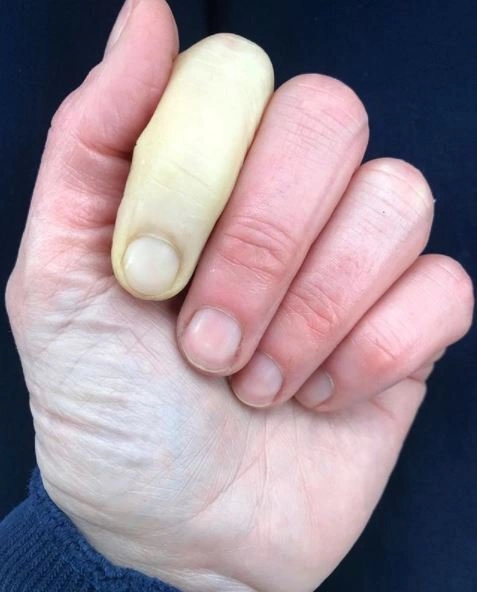
Why Can Fingers Suddenly Change Color?
The skin on your fingers can appear pink or reddish under normal conditions because blood is continuously circulating through tiny vessels near the surface.
When those blood vessels narrow, the amount of blood reaching the fingertips can decrease. The fingers may then become noticeably pale or white.
In some episodes, the color can progress further.
A typical sequence may look something like this:
White or pale → blue or bluish → red
The exact appearance can vary from person to person, and not everyone experiences every stage.
The important point is that these colors can reflect changing blood flow rather than something happening only at the surface of the skin.
The experience can feel just as dramatic as it looks. Some people notice coldness first. Others experience numbness, pins-and-needles sensations, discomfort, or pain. As circulation returns, the fingers may become red and may feel warm, throbbing, prickly, or uncomfortable for a short time.
These episodes can be particularly noticeable because they involve both visible changes and unusual physical sensations.
Raynaud’s Phenomenon: A Possible Explanation
Raynaud’s phenomenon is one condition associated with temporary narrowing of small blood vessels.
The response is often triggered by exposure to cold. The body naturally tries to protect its core temperature by changing blood flow to the extremities. In people with Raynaud’s, this response can be particularly pronounced, causing the fingers or toes to change color and sensation.
Cold weather is an obvious trigger, but a person does not always have to be outside in freezing conditions.
For example, an episode might begin while:
- Holding a cold beverage
- Taking food from a freezer
- Washing hands in cold water
- Moving suddenly between warm and cold environments
- Spending time in an air-conditioned room
Emotional stress may also trigger an episode in some people. The body’s response to stress can affect blood vessels, and in susceptible individuals this may contribute to an attack.
That means an episode does not necessarily indicate that the person has been exposed to extremely cold temperatures.
What Does a Raynaud’s Episode Feel Like?
The visual change may be the first thing people notice, but the sensations can be equally important.
During an episode, the fingers may feel:
Cold: The affected fingertips can feel significantly colder than the rest of the hand.
Numb: Sensation may temporarily decrease.
Tingly: Some people describe pins-and-needles sensations as circulation changes.
Painful: Discomfort can become more noticeable, particularly as blood flow returns.
Sensitive: The affected fingers may feel unusually uncomfortable during the transition back to normal circulation.
The intensity can differ significantly from one person to another.
One person may experience mild episodes only occasionally, perhaps several times a year. Another may have repeated attacks that interfere with work, household tasks, exercise, or daily routines.
Because of that variation, there is no single pattern that applies equally to everyone.
Primary vs. Secondary Raynaud’s
Healthcare professionals generally distinguish between primary Raynaud’s and secondary Raynaud’s.
This distinction matters because the two situations are not necessarily associated with the same underlying concerns.
Primary Raynaud’s
Primary Raynaud’s occurs on its own rather than as a result of another identified medical condition.
It is often less serious and can be manageable with practical measures and, when necessary, medical treatment.