Many people with primary Raynaud’s learn to recognize their triggers and take steps to reduce the frequency or severity of episodes.
Secondary Raynaud’s
Secondary Raynaud’s occurs in association with another condition.
According to the information provided, possible associations include autoimmune diseases, connective-tissue disorders, and vascular problems.
That is one reason repeated or unusually severe episodes should not automatically be dismissed as “just cold hands.”
The color change itself does not tell you which type is present.
Determining whether an underlying problem exists requires consideration of the person’s overall health, symptoms, medical history, and examination.
In other words, the fingers may provide an important clue, but they cannot provide the entire diagnosis.
When Should Finger Color Changes Be Taken Seriously?
Occasional cold hands are common.
Not every temporary change in skin color means that a person has Raynaud’s or another medical disorder.
What deserves more attention is a repeated, pronounced, or worsening pattern.
It is particularly worth discussing with a healthcare professional when the episodes are:
Frequent
If the fingers are repeatedly changing color, keeping track of the episodes can help determine whether there is a recognizable pattern.
Painful
Significant pain is more important than mild temporary discomfort.
Increasing in severity
A change that becomes more intense or starts happening more often deserves attention.
Limited to one side
Repeated changes affecting only one hand or one side may warrant further evaluation rather than simple assumptions.
Associated with sores or wounds
Persistent reductions in blood flow can become more serious in severe cases and may contribute to tissue damage.
These signs do not automatically mean that something dangerous is happening, but they are reasons to seek professional assessment.
Why Prolonged Reduced Blood Flow Matters
Most cases of Raynaud’s can be managed.
However, prolonged or severe reductions in blood flow can become more concerning.
When tissues repeatedly receive less blood than they need, the consequences can become more significant. In severe cases, sores or tissue damage may develop.
This is one reason it is important not to focus only on the color itself.
A brief episode that resolves after warming the hands is different from persistent discoloration accompanied by pain, wounds, or other concerning symptoms.
The duration and severity matter.
So does the overall pattern.
Someone who occasionally notices pale fingertips after touching something cold may have a very different situation from someone whose fingers repeatedly become intensely discolored, painful, and difficult to use.
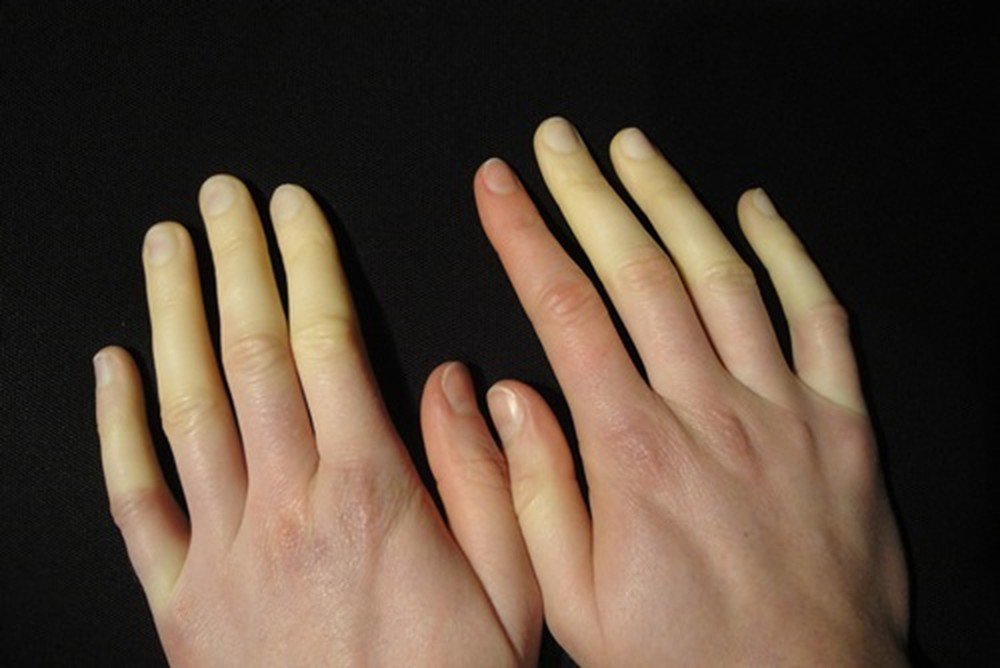
Cold Is One of the Most Common Triggers
If cold exposure repeatedly brings on symptoms, one of the simplest practical strategies is to reduce that exposure.
Keeping the hands warm can help.
That may mean wearing gloves outdoors, but warmth can matter indoors as well.
Someone who experiences symptoms while handling frozen food may find that gloves provide useful protection.
Sudden temperature changes may also be relevant.
For example, moving rapidly from a warm environment into a cold one can sometimes trigger symptoms more easily than a gradual change.
Paying attention to these patterns can be surprisingly useful.