Red fingers do not automatically prove that blood flow has been severely compromised.
Symptoms have context.
A healthcare professional may need to consider medical history, other symptoms, possible underlying conditions, medication use, and the precise pattern of the episodes.
That is particularly important when secondary Raynaud’s is a possibility.
The most responsible response is therefore neither panic nor dismissal.
It is observation followed by appropriate evaluation.
Simple Ways to Reduce the Chance of an Episode
For people who repeatedly experience these symptoms, several practical habits may help.
Keeping the hands warm is one of the most straightforward measures.
Gloves can be useful outdoors and during activities such as handling frozen foods.
Avoiding sudden exposure to very cold temperatures may also reduce episodes for some individuals.
Paying attention to stress may be useful when emotional triggers appear to be involved.
Avoiding smoking is another important consideration because smoking can further narrow blood vessels.
And for people who have already received medical advice or treatment, following that individualized plan remains important.
There is no single strategy that works for everyone.
The underlying cause and severity matter.
A Medical Image Can Be Startling — But the Pattern Matters More
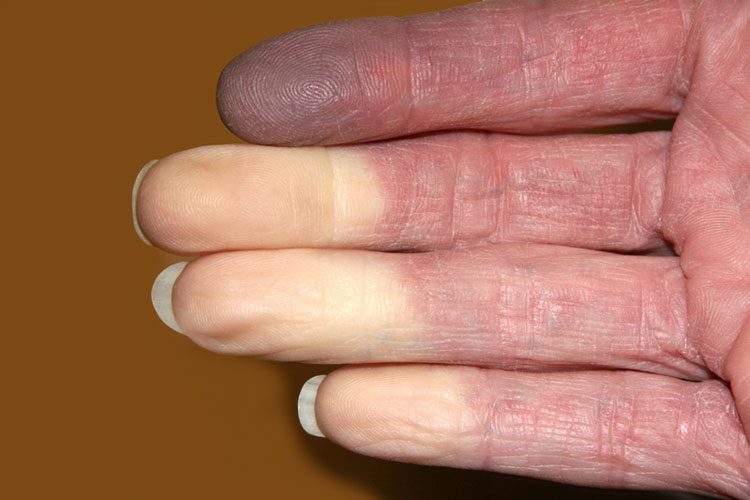
A photograph of fingers turning white, blue, and red can be shocking.
It is easy to look at such an image and immediately imagine that something is seriously wrong.
Sometimes the appearance reflects a temporary change in circulation, such as the blood-vessel narrowing seen with Raynaud’s phenomenon.
But an image by itself cannot distinguish between primary Raynaud’s, secondary Raynaud’s, or another circulation-related condition.
That distinction matters.
Rather than focusing only on how dramatic the fingers look, pay attention to the broader pattern.
When does it happen?
What triggers it?
How long does it last?
Does it affect both hands?
Is it painful?
Are there any sores or wounds?
Does it seem to be getting worse?
These questions may be far more informative than the color alone.
The Bottom Line
Sudden changes in finger color can be unsettling, especially when the fingers move from white to blue to red within a short period.
One possible explanation is Raynaud’s phenomenon, in which small blood vessels temporarily narrow and reduce blood flow to affected areas.
Cold is a common trigger, but emotional stress can also play a role. Episodes may be mild and occasional for some people, while others experience frequent or more severe symptoms.
Healthcare professionals distinguish between primary Raynaud’s, which occurs on its own, and secondary Raynaud’s, which may be associated with another medical condition.
For that reason, recurring, painful, worsening, one-sided symptoms or episodes accompanied by sores or tissue changes should not simply be dismissed as “cold hands.”
Keeping the hands warm, avoiding known triggers, avoiding smoking, and tracking the pattern of episodes may all be useful. Just as importantly, persistent or concerning symptoms deserve professional evaluation.
The most helpful lesson is simple: when your fingers repeatedly turn white, blue, or red, pay attention to the pattern rather than relying on appearance alone.
A dramatic color change may be temporary, but repeated symptoms can provide valuable information about what is happening with circulation and recognizing that pattern early can help ensure the right questions are asked and the appropriate care is considered.