The investigators would need to establish whether the bag had remained in one place.
They could look for signs of abrasion on the fabric, marks on the straps, and traces of material from the surrounding rocks.
They could also examine whether the bag contained anything that appeared to have been added after the original disappearance.
A later addition would not necessarily indicate a crime.
It could simply mean that someone had found the bag and placed an object inside it.
But if the map contained a mark that could be dated to a later period, investigators would need to understand how it had been made.
The captain considered the possibility that a witness might come forward after hearing about the discovery.
Perhaps someone remembered seeing a backpack in the area.
Perhaps a hiker had noticed a person moving away from the main route in 2020.
Perhaps someone had encountered an unusual object during a later visit but had not reported it.
A small detail could become important when compared with the physical evidence.
For now, however, the investigators had no confirmed witness who could explain the backpack’s journey into the crevice.
The mountain had preserved the object.
It had not preserved the identity of the person who might have moved it.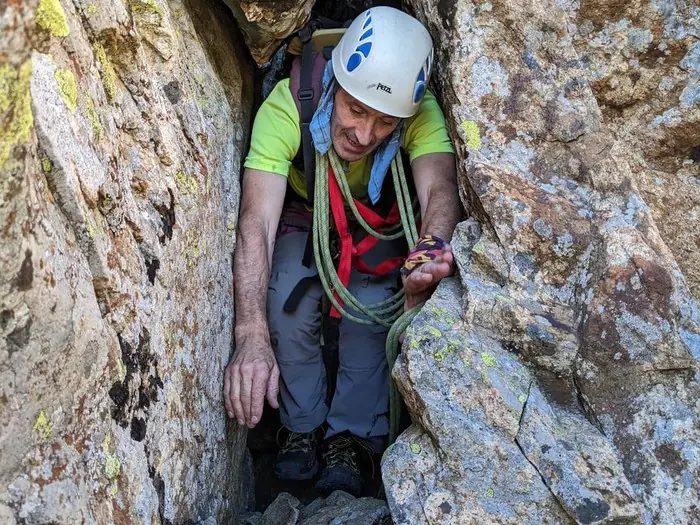
What the Notebook Might Reveal
The blue notebook offered another possible route toward understanding the disappearance.
If its pages could be recovered, they might provide a more detailed account of the outing than the map alone.
Clara might have written the name of a landmark.
She might have recorded the time they stopped for a break.
She might have drawn a place that her father had shown her.
The notebook could also contain information about their plans.
Perhaps they intended to follow a particular trail but changed direction after seeing something interesting. Perhaps they had planned to return by a different route.
Even a simple drawing could help investigators compare the notebook with the landscape.
But the notebook might not contain a clear answer.
A child’s notes are not necessarily written for someone else to understand. Clara may have used abbreviations, symbols, or drawings that made sense only to her.
The pages could also have been written at different times.
A drawing made before the hike might represent a planned destination. A note written later could describe something they had already seen.
Investigators would therefore need to establish the order of the entries.
They could compare the handwriting and ink, examine the paper for damage, and determine whether the pages had been rearranged.
The notebook might reveal a sequence.
It might also reveal a contradiction.
If the final entry suggested that the pair had reached a location far from the backpack, investigators would need to explain how the bag ended up in the crevice.
If the notebook indicated that they were still following the familiar route, the map might have been drawn earlier than expected.
And if the final pages contained no writing at all, the absence of an entry would not necessarily mean that something had happened at that exact moment.
A notebook can stop for many reasons.
Clara might have put it away.
The weather might have changed.
She might simply have become distracted by the journey.
The investigators would need to avoid turning every blank page into a mystery.
The notebook was valuable because it belonged to Clara and could help reconstruct her movements—not because it was guaranteed to contain a hidden message.
The Mountain Keeps Its Own Time
The passage of five years had changed the investigation.
The original search had focused on finding two missing people as quickly as possible. The renewed investigation focused on understanding an object that had survived in a remote location.
The difference was significant.
In 2020, searchers had to make decisions with limited information. They needed to identify the most likely routes and examine the areas where the pair might have gone.
Five years later, investigators had a physical clue.
But the clue had also been exposed to years of environmental change.
The mountain could have altered the position of the backpack. Rain might have washed away traces of its original location. Snow could have covered it, and later melting might have revealed it again.
The crevice itself could have changed.
Small rocks might have fallen into the opening. Larger stones could have shifted slightly. The backpack might have been trapped more tightly over time.
These possibilities made the exact location important.
The investigators would need to document the surrounding terrain before removing anything else. Photographs, measurements, and careful mapping could help them understand the relationship between the backpack and the rocks.
They would also need to distinguish between the condition of the bag when it was found and the condition it might have had when it first arrived.
That distinction could influence the entire investigation.
A strap damaged by years of pressure might look different from one torn during a sudden fall. A bottle dented by a rock could provide a clue about the direction of impact, but only if the investigators could establish when the damage occurred.
The mountain had not simply hidden the backpack.
It had changed it.
And every change had to be considered before the evidence could be interpreted.
The Question That Remains
The discovery of the backpack gave the fictional investigation a new direction, but it did not provide a final answer.
Julián and Clara were still missing.
The map suggested a possible route. The notebook connected the discovery to the child. The bottle and food packaging provided additional objects for examination.
Yet none of these items alone could establish what happened during the final hours of the hike.
The investigators still needed to determine whether the backpack had fallen from above, been moved by another person, or remained hidden in the crevice since the original disappearance.
They needed to understand the unusual mark on the map.
They needed to examine the route and identify whether other objects could be found nearby.
And they needed to establish whether the backpack’s location could explain why the original search had failed.
For the family, the discovery was both painful and meaningful.
It brought back memories they had spent years trying to manage. It offered a new possibility of understanding what had happened, but it also reminded them that the mountain had kept the answers beyond their reach for so long.
The most important clue was not necessarily the backpack itself.
It was the fact that the backpack had been found in a place that raised new questions.
If Julián and Clara had reached the crevice, why had they gone there?
If the bag had fallen from a higher point, what route had they followed?
And if the mark on the map had been added later, who had seen the backpack before the hikers discovered it?
The fictional case remains unresolved.
The blue notebook, the damaged map, and the narrow rock opening offer possible clues, but they do not prove what happened to the father and daughter.
The mountains may eventually reveal more.
Until then, the discovery stands as a reminder that a missing person’s belongings can sometimes reappear long after a search has ended—bringing hope, grief, and a new set of questions with them.