Jeremy Meeks at 42: What the “World’s Hottest Felon” Looks Like Today — From Viral Mugshot to Model Citizen
A single booking photograph changed Jeremy Meeks’s life in a way few people could have imagined. In 2014, his piercing blue eyes, sharply defined features, and intense expression spread across the internet after the Stockton Police Department shared his mugshot. Almost overnight, a man who had been arrested on felony weapons charges became an international talking point, with strangers calling him the “World’s Hottest Felon.”
But the photograph was only the beginning. Behind the viral attention was a complicated personal history, a prison sentence, a family, and a future that looked very different from the one he had known before. After his release, Meeks entered the fashion industry, appeared at major events, explored acting, and gradually built a public identity beyond the image that first made him famous.
The question today is not simply whether he still looks like the man in that famous photograph. It is how much his life has changed since the world first noticed him — and what happened after a moment of internet fame opened a door that had once seemed impossible to reach.
One important date correction: Jeremy Meeks was born on February 7, 1984. That means he turned 42 in February 2026, rather than 41 as stated in the screenshot. The article below follows the supplied story while correcting that age detail.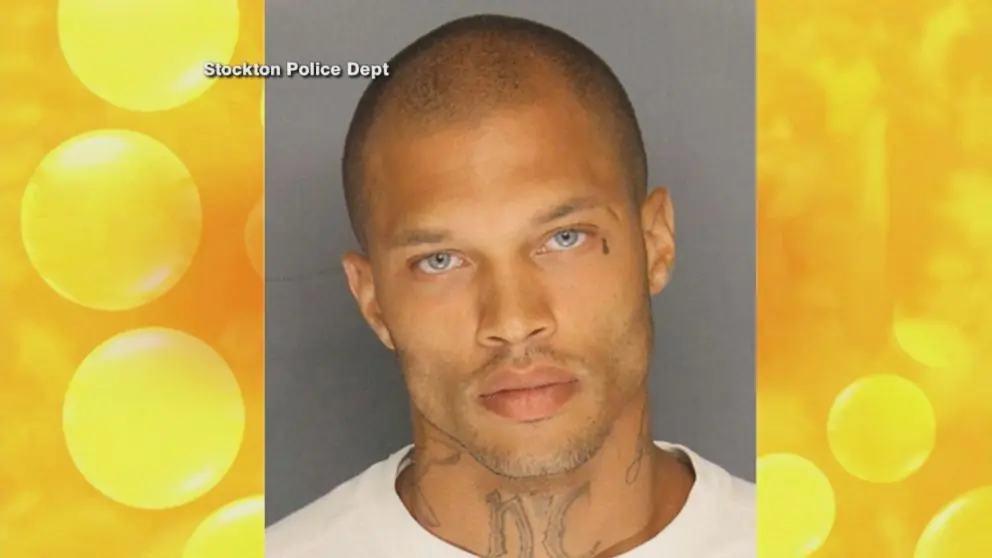
The Photograph That Turned an Arrest into a Global Story
In 2014, Jeremy Meeks was not a fashion celebrity, a familiar face on international runways, or a name regularly discussed in entertainment news. He was a man from Stockton, California, whose life was already shaped by difficult circumstances and encounters with the criminal justice system.
Then came the photograph.
After Meeks was arrested in connection with felony weapons charges, the Stockton Police Department published his booking photograph on Facebook. The image showed a young man looking directly at the camera. His blue eyes, strong facial structure, defined cheekbones, and serious expression immediately attracted attention.
The response was extraordinary. People began sharing the photograph, leaving comments, and discussing his appearance. The image traveled far beyond the local community where the arrest had taken place. It became a viral sensation, and the nickname “World’s Hottest Felon” soon followed.
For many people, the photograph was an unexpected internet curiosity. For Meeks, it became the starting point of a dramatic change in public perception.
The contrast was difficult to ignore. A booking photograph, normally associated with an arrest and a police record, was being discussed in the same way people might discuss a celebrity portrait or a fashion campaign. Instead of focusing only on the circumstances behind the arrest, online audiences began asking who the man in the picture was and what he might look like outside the setting of a police booking room.
Yet the image did not tell the whole story. It showed a face, not a life. It revealed nothing about the challenges he had experienced, the people close to him, or the decisions that had brought him to that point.
And while the internet was fascinated by his appearance, Meeks still had to face the legal consequences of the case.
A Difficult Childhood Behind the Famous Face
The story behind Meeks’s rise cannot be understood through the mugshot alone. His autobiography, Model Citizen: The Autobiography of Jeremy Meeks, offers a more personal account of the circumstances that shaped his early years.
According to the book’s publisher and published reviews, Meeks was born in 1984 in Washington State. His childhood was unsettled, and his parents struggled with heroin addiction. His mother eventually escaped an abusive relationship, but the instability of his early environment had already affected him. He has described growing up with anger, insecurity, and a sense that violence was an ordinary part of life.
For a child growing up in such circumstances, stability can be difficult to find. Home may not always feel safe, and the adults who should provide guidance may be dealing with problems of their own. Meeks’s account describes a childhood marked by movement between places, family difficulties, and exposure to an environment where crime and violence were never far away.
As he entered his teenage years, those experiences continued to influence his choices. He became involved in gang life and spent time in juvenile detention. Rather than following a conventional path through school and into employment, he became increasingly familiar with the criminal justice system.
In his 2025 interview with The Jamaica Gleaner, Meeks spoke candidly about how deeply that environment had shaped him. He said that he had spent years moving in and out of prison, sometimes returning within days of being released. He also described how difficult it was to adjust to ordinary life outside institutions because he had spent so much of his youth in custody.
That admission offers a different perspective on the man seen in the viral photograph. The image made his appearance the center of attention, but it did not reveal the years of instability that preceded it. It could not explain why he had struggled to imagine a future outside the world he knew.
His story is not a simple tale of someone who made one mistake and immediately became famous. It is a longer account of difficult circumstances, repeated setbacks, and a life that had become familiar with incarceration.
That context matters because the public often sees a transformation only after it has happened. A person appears in a new setting, wearing different clothes, surrounded by cameras, and the audience assumes that the change was sudden. In reality, rebuilding a life can involve years of decisions, uncertainty, and effort that are invisible to everyone watching from outside.
The 2014 Arrest That Changed Everything
The event that brought Meeks worldwide attention took place in June 2014, when he was arrested in Stockton, California. The case involved a firearm and a felony weapons charge. The police department published his booking photograph, and the image quickly spread across social media.
The internet reacted in a way few could have predicted.
Booking photographs are usually published as part of routine police communications. They are not intended to introduce someone to the fashion industry or turn them into a celebrity. But Meeks’s photograph attracted a wave of attention because viewers focused on his appearance rather than the circumstances of the arrest.
His light blue eyes were particularly noticeable. His expression was serious, his features sharply defined, and his tattoos gave the photograph a distinctive look. Within a short time, people were sharing the image far beyond Stockton.
The nickname “World’s Hottest Felon” became attached to him. It was a phrase that captured the internet’s fascination but also reduced a complicated person to a catchy label.
The speed of the reaction was remarkable. A local arrest had become an international online story. People who had never heard of Stockton suddenly knew the name Jeremy Meeks. News outlets covered the unusual viral phenomenon, and the photograph became one of the most recognizable booking images of the social-media era.
But the attention created a strange contradiction. Meeks was still dealing with a criminal case, yet his face was being discussed as if he had just appeared in a modeling campaign. The internet was already imagining a different future for him before he had finished dealing with the consequences of his arrest.