Advice about refrigerating raw potatoes varies by region and intended use.
Some food-storage guidance now accepts refrigeration as an option when a household has no suitably cool pantry. Other agricultural and culinary guidance warns that very cold storage can increase the sugar content of potatoes, which may lead to darker browning when they are fried or roasted.
This process is sometimes called cold-induced sweetening.
For potatoes intended for chips, fries, or other high-temperature cooking, excessive cold storage can affect colour and flavour. If the only available option is a refrigerator, follow local food-safety guidance and consider how the potatoes will be cooked.
A cool pantry is often a practical first choice when one is available.
Avoid temperature fluctuations
Repeated changes in temperature can shorten storage quality.
For example, moving potatoes between a warm kitchen and a cold outdoor area may create condensation on the skin. Moisture can encourage decay.
A consistent storage location is preferable.
Keep potatoes away from direct light
Even if the room is cool, a clear container placed beside a window is not ideal.
Use an opaque bag or a covered basket. Do not rely on a transparent plastic bag simply because it is easy to see the potatoes inside.
The goal is to keep them out of the light while still allowing ventilation.
Chapter 4: Five Storage Mistakes That Make Potatoes Sprout Faster
Sometimes the problem is not the potatoes themselves but the way they are stored after being brought home. A few small mistakes can shorten their useful life considerably.
Mistake 1: Washing potatoes before storing them
It is tempting to wash potatoes as soon as they arrive from the market. Clean potatoes look more attractive and seem easier to organize.
However, washing adds moisture to the skin. If the potatoes are placed in a bag or container before they are completely dry, that moisture can encourage mould and decay.
For ordinary household storage, it is generally better to brush away loose soil and wash the potatoes shortly before cooking.
If potatoes have already been washed, allow them to dry completely before storing them. Do not put wet potatoes into a sealed bag.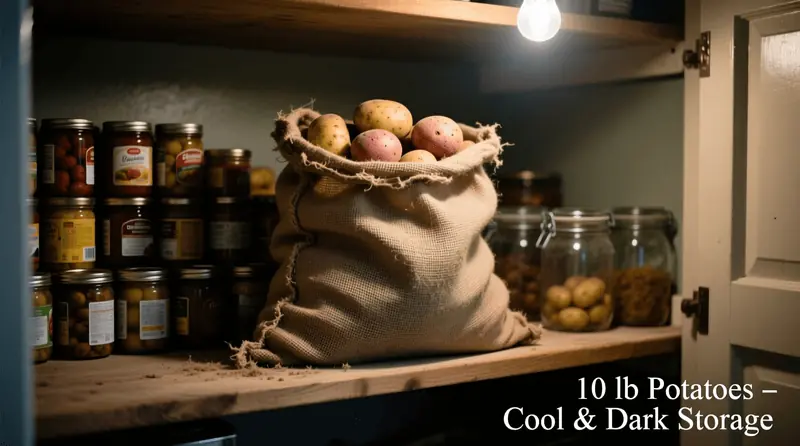
Mistake 2: Leaving them in a bright kitchen
Potatoes displayed in an attractive bowl may be easy to reach, but a bright kitchen can expose them to light for much of the day.
Light encourages greening and can contribute to changes associated with higher glycoalkaloid levels.
A dark cupboard is a better choice. If the potatoes must be kept on an open shelf, use an opaque, breathable container.
Mistake 3: Keeping them in a tightly sealed bag
A sealed bag can trap moisture and limit airflow.
When potatoes are stored in a humid environment, condensation may form. This can contribute to decay, especially if some potatoes already have damaged skin.
Use packaging that allows air exchange. If the original bag is plastic, check whether it has ventilation holes. If it does not, transferring the potatoes to a more breathable container may be helpful.
Mistake 4: Ignoring one rotten potato
A single soft or leaking potato can create a problem for the rest of the batch.
Rotting tubers may release moisture and encourage deterioration nearby. If one potato develops a bad smell, wet patches, or visible mould, remove it promptly.
Do not simply turn the bag over and hope the problem disappears.
Inspect the remaining potatoes, clean the storage container if necessary, and allow everything to dry before returning sound potatoes to storage.
Mistake 5: Buying more than the household can use
Even under good conditions, potatoes have a limited storage life.
A large bag may appear economical, but the saving disappears if much of it sprouts, shrivels, or rots before it is used.
Consider how frequently potatoes appear in your meals. A household that cooks with them several times a week may use a large bag comfortably. A household that eats them occasionally may be better off buying smaller quantities.
Buying less at a time can be the simplest way to reduce waste.
Chapter 5: How to Choose Potatoes That Will Last Longer
Storage begins before the potatoes reach the cupboard.
The condition of the potatoes at the time of purchase has a major influence on how long they remain in good condition.
Look for firm potatoes
Choose potatoes that feel firm and have relatively smooth, intact skins.
Avoid tubers with extensive bruising, deep cuts, wet patches, or obvious decay.
A few superficial marks do not necessarily make a potato unusable, but damaged potatoes should generally be used sooner rather than placed in long-term storage.
Check for existing sprouts
If a potato already has several shoots, it may be further along in its natural growth cycle.
A small shoot does not automatically mean the potato is spoiled, but it suggests that the tuber may not remain dormant for much longer.
Choose potatoes with fewer signs of growth when buying for storage.
Avoid extensive greening
Green areas should be treated carefully because they may indicate increased glycoalkaloid levels.
A potato with extensive greening is not a good choice for ordinary cooking. It is safer to discard it rather than attempt to remove a large amount of green tissue.
Check for softness and wrinkling
A potato that feels soft or has deeply wrinkled skin may have lost considerable moisture.
Some minor wrinkling may simply reflect age, but severe shrivelling suggests declining quality.
If a potato is also sprouting heavily, it is usually better to discard it.
Choose varieties suited to storage
Different potato varieties have different storage characteristics.
Some varieties have relatively short dormancy periods, while others are naturally better suited to longer storage. Mature, thick-skinned varieties often keep longer than delicate early potatoes.
If you grow your own potatoes, check the recommended storage characteristics of the variety you planted.
For supermarket shoppers, the variety name may be available on the packaging. It can be useful to compare varieties if long-term storage is a priority.
Chapter 6: What to Do When Potatoes Have Already Sprouted
Finding sprouts does not automatically mean that every potato in the bag must be thrown away.
The important thing is to assess the whole potato rather than looking only at the shoots.
Small sprouts on a firm potato
If a potato is still firm, has no extensive green areas, and shows only a few small sprouts, some food-safety guidance allows the sprouts to be removed before preparation.