It is one of fifteen developments that form the country's NEOM project - which also includes an industrial city, ports and tourism developments - that have been gradually announced by the kingdom since 2021.
But The Line was the jewel in Crown Prince Mohammed bin Salman's 'Vision 2030' project, which was set in motion to diversify his country's oil dependent economy, as well as its society and culture, and improve the image it projects on the world stage.
The Kingdom said the project, which is expected to cost $1.5 trillion, would be an 'unprecedented living experience' that preserves 'surrounding nature'.
The megacity was to feature two parallel skyscrapers extending across a swathe of desert and mountain terrain, with mirrored facades on the outside.
Saudi officials said it would be built in stages, and would eventually cover a 106-mile stretch of desert along the coast in the western Tabuk province - with its Western tip pointing out over the Red Sea towards Egypt.
However, Bloomberg reports that these plans have now been dramatically scaled back - with the 106 mile structure being reduced to just 1.5 miles - a more than 98 percent decrease in size.
It is not clear whether The Line will still feature its twin skyscrapers seen in the concept imagery, or if the whole project will have to be reconsidered, now that its size has been reduced.
Citing its sources, Bloomberg reports that Saudi Arabia has not yet approved NEOM's 2024 budget, and that its vast expenditure is beginning to concern officials.
Some projects outlined in the Vision 2030 are already expected to be delayed past the end of the decade, with Finance Minister Mohammed Al Jadaan saying in December that longer is needed to build 'factories' and 'sufficient human resources.'
'The delay or rather the extension of some projects will serve the economy,' he said.
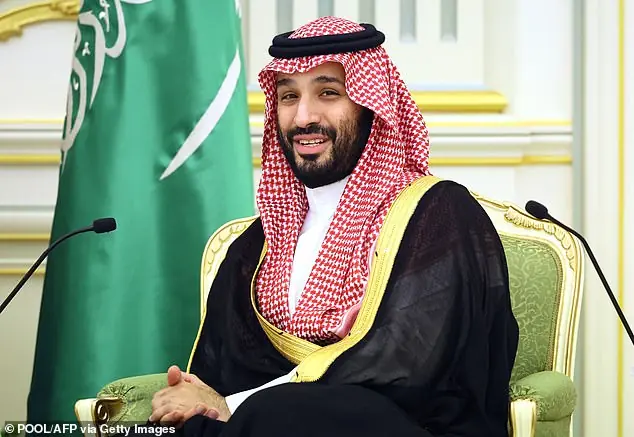
NEOM was first announced in 2017, with Crown Prince Mohammed bin Salman (pictured) delivering a presentation on The Line in July 2022
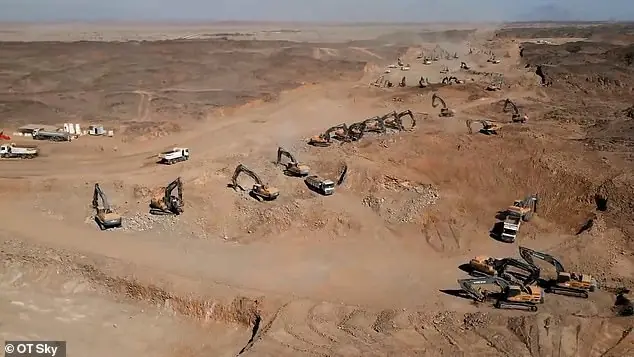
Pictured: Construction workers are seen operating excavators in drone footage captured in 2022 when The Line project began
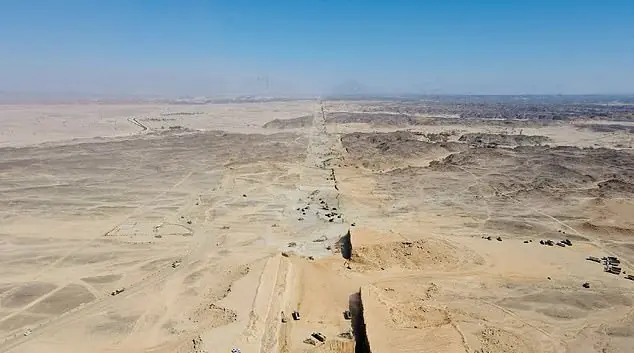
The huge trench can be seen going into the distance as foundations for the incredible megacity are dug out in footage from 2022
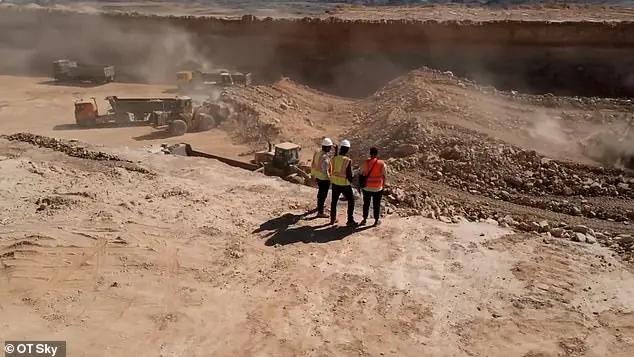
Construction workers stand on the edge of a vast trench being dug for The Line megacity
NEOM was first announced in 2017, with Crown Prince Mohammed bin Salman delivering a presentation on The Line in July 2021 - capturing the attention of both city planner, architects and the general public around the world.
In its original design, if built in the UK, The Line would have been able to stretch between London to Birmingham, or even from London into France.
In US-terms, it was longer than the distance between New York and Philadelphia.
However, unlike city sprawls we are accustomed to today, the vast metropolis would have been contained in two mirrored structures - each rising 500 feet above sea level, taller than the Empire State building - that would stretch out across the desert.
At just 200 yards wide, The Line was intended to be Saudi Arabia's answer to unchecked and wasteful urban sprawl, layering homes, schools and parks on top of each other in what planners term 'Zero Gravity Urbanism'.
Promotional material says residents will have 'all daily needs' reachable within a five-minute walk, while also having access to other perks like outdoor skiing facilities and 'a high-speed rail with an end-to-end transit of 20 minutes'.
For a train to travel 106 miles in 20 minutes, it would need to be able to travel at 318 miles per hour - 16 miles per hour faster than the Beijing to Shanghai speed line, one of the fastest railway lines in the world.
In his presentation, Prince Mohammed sketched out an even more ambitious vision, describing a car-free utopia that would become the planet's most liveable city.
Analysts noted at the time, though, that plans for NEOM have changed course over the years, fuelling doubts about whether The Line will ever become reality.
It was once touted as a regional 'Silicon Valley', a biotech and digital hub spread over 10,000 square miles.
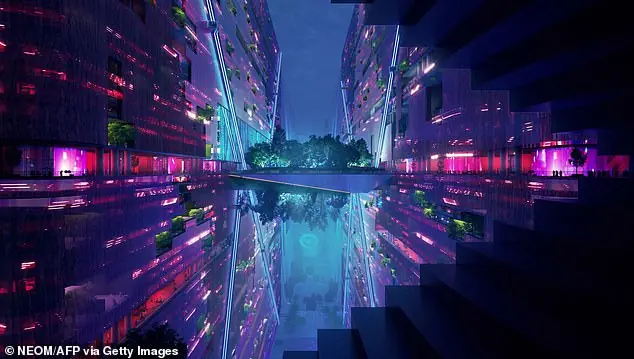
Pictured: Concept art showing the inside of Saudi Arabia's The Line megacity
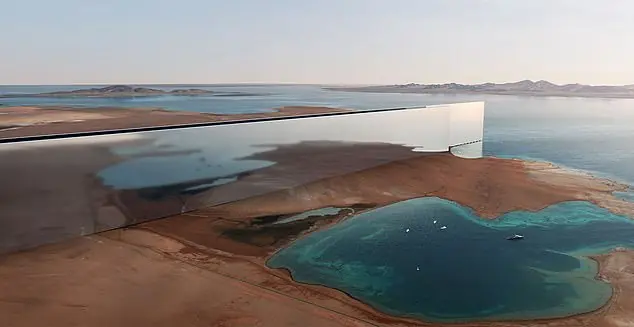
At just 200 yards wide, The Line is intended to be Saudi Arabia's answer to unchecked and wasteful urban sprawl, layering homes, schools and parks on top of each other in what planners term 'Zero Gravity Urbanism'
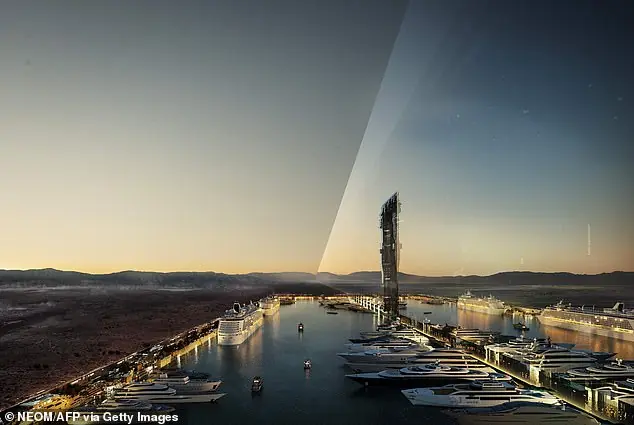
The Line's vast construction was set to extend from the heart of another planned Red Sea megacity, a plank of Crown Prince Mohammed bin Salman's bid to diversify the Gulf state's oil-dependent economy - to the ocean
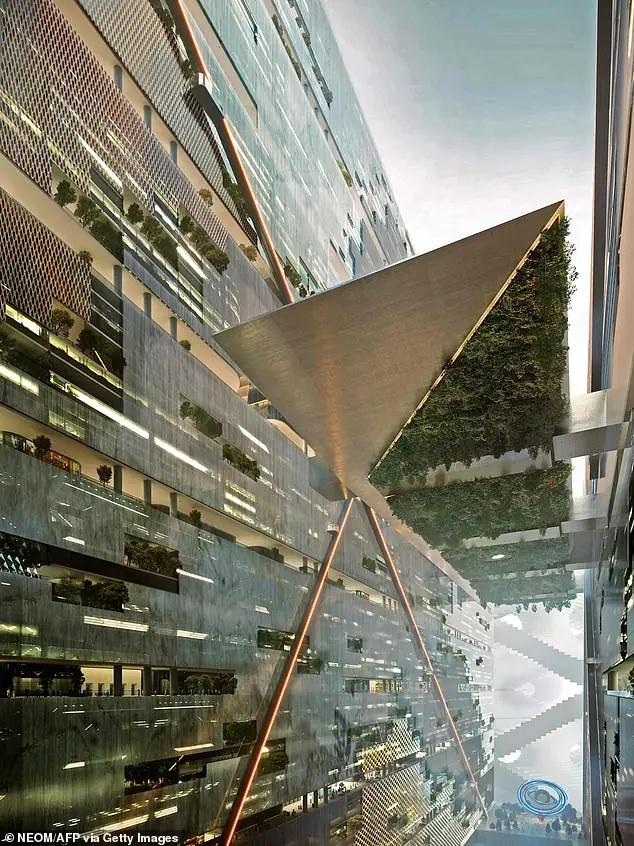
The futuristic megacity in Saudi Arabia was set to feature two massive, mirror-encased skyscrapers that extend over desert and mountain terrain
But it was also a vehicle for reimagining urban life on a footprint of just 34 square kilometres, and addressing what Prince Mohammed describes as 'liveability and environmental crises'.
The site will be powered by 100 percent renewable energy and feature 'a year-round temperate micro-climate with natural ventilation', the promotional video said - something that would be a necessity considering temperatures in Saudi Arabia can range from 27 degrees to 43 degrees.