I head up NASA's asteroid warning division. This is how we'd alert the public if the world was about to end
If you're reading this, an asteroid has probably not wiped out life on Earth yet.
But in the event that our planet is in imminent danger of a world-ending strike, NASA has a special team tasked with warning everyone about the impending disaster.
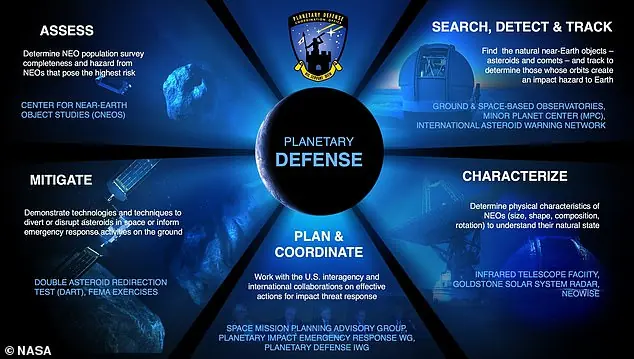
Lindley Johnson is lead program executive for NASA's Planetary Defense Coordination Office, which tracks near-Earth objects (NEOs).
He is in charge of warning the people of Earth about a potential asteroid or comet strike, as well as coordinating the response with the White House.
Johnson, who is so dedicated to tracking asteroids that there is one named after him, has revealed his agency's step-by-step plan to notify the public of a looming threat and stop it from happening.
Keeping an eye on the sky
The Planetary Defense Coordination Office classifies an NEO as any object that comes within 30 million miles of Earth, about one-third of the distance from the Earth to the sun.
More than 34,000 near-Earth asteroids of all sizes have been detected since NASA started tracking them more than three decades ago, according to the Planetary Defense Coordination Office.
Seven of those occurred in January of this year, and 100 more were detected since January 2023.
Needless to say, the Planetary Defense Coordination Office does not raise the alarm every single time it spots a NEO.
But it does keep track of every NEO it finds, according to Johnson.
'We definitely want to find all those before they find us,' he told Business Insider.
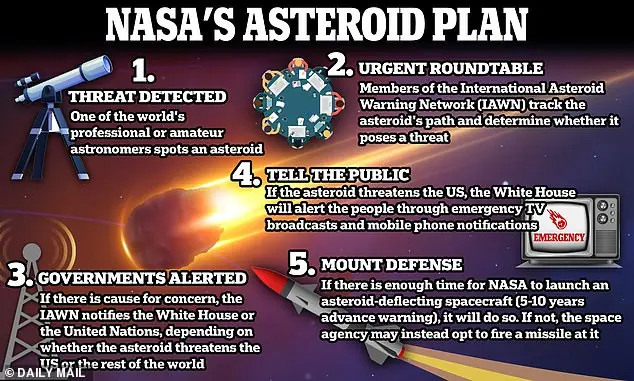
Here's the sequence of events that would happen if Johnson and his team needed to warn people about a NEO posing a serious threat to inhabitants of Earth:
Astronomers spot the world-killing rock
For planetary defense, NASA partners with the International Asteroid Warning Network (IAWN), a global network of astronomers tasked with sounding the alarm.
If a member of the IAWN spots a dangerous NEO, they share the finding across the network so other scientists can confirm that it is accurate and decide whether it poses a danger.
'I don't have a red phone on my desk or anything,' Johnson told BI. 'But we do have formal procedures by which notification of a serious impact would be provided.'
If the IAWN's members agree that the NEO actually does threaten humanity, NASA will put out the warning call in a number of ways - depending on where it is predicted to strike.