Air Canada Pilot’s Heroic Final Move ‘At Last Second’ May Have Saved 74 Lives
The screenshot describes a terrifying runway collision at LaGuardia, a desperate attempt by the pilots to slow the aircraft, and a tragedy that claimed both pilots’ lives. But the headline’s most important claim—that a final-second action may have saved 74 people—needs to be examined carefully against the confirmed details of the incident.
The most striking part of this account is not simply that an aircraft collision occurred. It is the possibility that, in the few seconds between an unexpected danger and impact, the pilots may have taken action that changed what happened to everyone on board. To understand why that possibility matters, we need to look beyond the dramatic headline: at the sequence described by passengers, the aircraft’s movement on the ground, the role of air traffic control, and the difficult questions investigators must answer.
The incident can be identified as Air Canada Express Flight 8646, operated by Jazz Aviation. It collided with an airport firefighting vehicle while landing on Runway 4 at LaGuardia Airport on March 22, 2026. The U.S. National Transportation Safety Board (NTSB) says the aircraft carried 72 passengers and two flight attendants, in addition to the two pilots. Both pilots died; 39 people were taken to hospitals. This means the “74 lives” in the headline refers to the other people aboard—not to 74 people whose survival has been conclusively attributed to one maneuver.
There is also an important distinction between the passenger account and the official findings. A passenger reportedly believed the pilot tried to use reverse thrust in the final seconds. The NTSB’s preliminary information, however, describes the aircraft’s rudder turning left just before impact, consistent with an attempted evasive maneuver. It has not established that reverse thrust saved the passengers. The article below keeps that uncertainty clear while explaining why the pilots’ final actions have drawn so much attention.
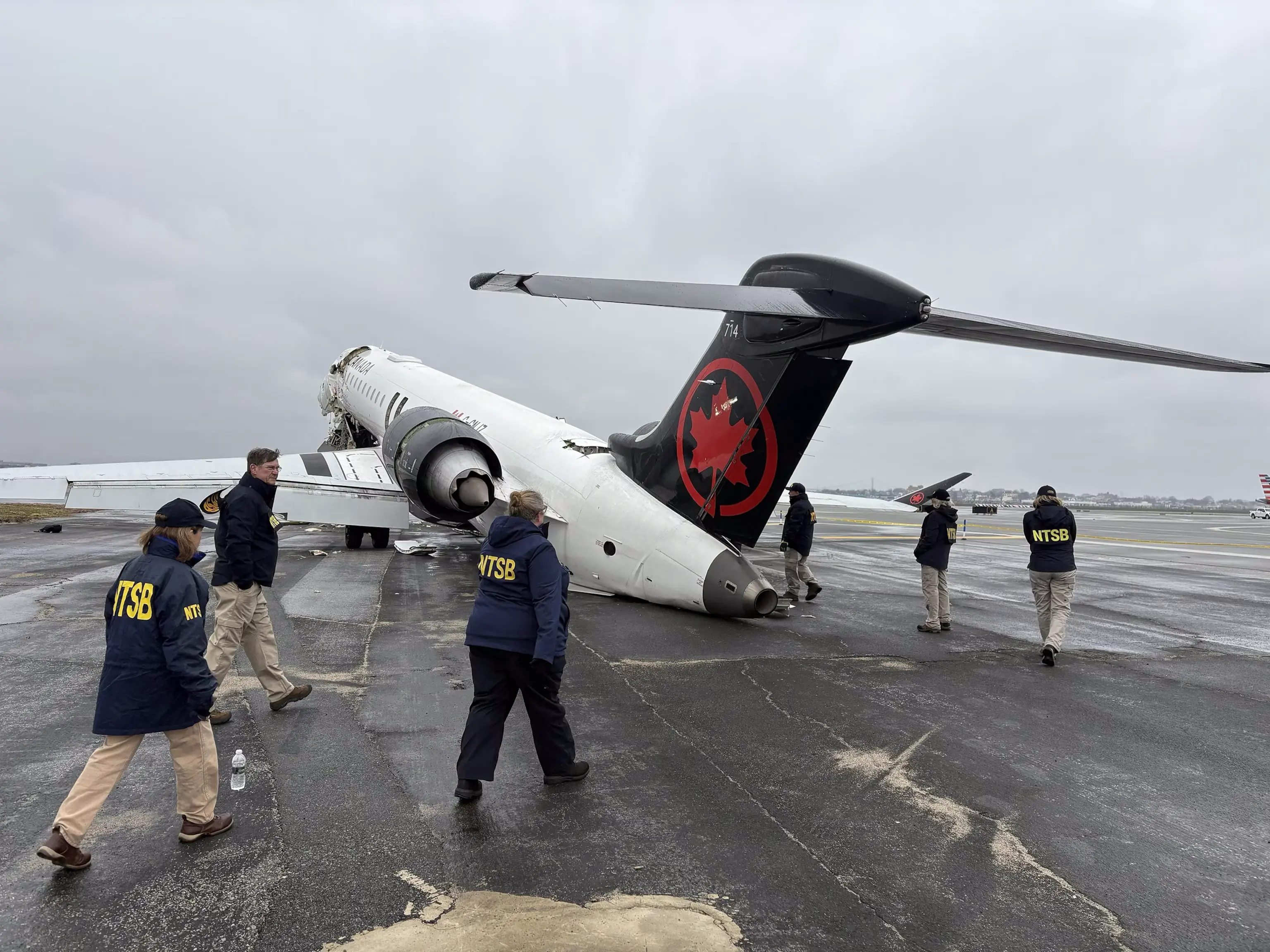
Air Canada Pilot’s Heroic Final Move ‘At Last Second’ May Have Saved 74 Lives
In the final seconds of a routine landing at LaGuardia, an Air Canada Express jet struck an airport fire truck. Both pilots were lost, but the actions taken in the cockpit—and the people who survived—have left a powerful question about what happened in those last moments.
A passenger aircraft landing at a major airport should be entering one of the most predictable parts of its journey. The runway is in sight. The wheels meet the ground. The engines are brought back, the aircraft slows, and passengers begin to relax as the flight transitions from the air to the terminal. For the people aboard Air Canada Express Flight 8646, however, that familiar sequence turned into a disaster within seconds.
The aircraft had arrived at New York’s LaGuardia Airport after a flight from Montreal. It had touched down on the runway and was moving along the ground when it collided with an airport firefighting vehicle. The impact was devastating. The front section of the regional jet suffered catastrophic damage, the cockpit was destroyed, and the two pilots did not survive.
Yet the story did not end with the collision. Most of the people aboard the aircraft lived. Passengers and crew members were injured, some seriously, but dozens survived an event that could have become even more deadly. In the hours and days that followed, accounts from people on board began to draw attention to the pilots’ response in the final moments.
One passenger described a sudden jolt, a loud bang and the sensation of the aircraft sliding sideways. Another detail circulated online: the belief that the pilot had attempted to slow the aircraft with reverse thrust at the last possible moment. To that passenger, the action may have reduced the force of the impact and helped save lives.
It is an emotional explanation, and it is easy to understand why it resonated with survivors. When people escape a frightening event, they naturally look for the moments that might have made the difference between survival and a worse outcome. A pilot’s final actions can become a powerful symbol of courage, particularly when the pilots themselves are no longer alive to explain what they did.
But there is a difference between a passenger’s impression and a conclusion established by investigators. The NTSB’s preliminary findings describe a complex collision involving a landing aircraft, a firefighting vehicle crossing the runway, urgent radio warnings, and last-second movements by both the vehicle and the aircraft. The report does not establish that reverse thrust was the action that saved the people aboard.
What it does show is that the crew faced an extraordinary situation at a moment when the aircraft was already on the ground and moving at high speed. The available time to understand the danger and react was extremely limited. The aircraft’s rudder moved to the left just before impact, indicating that the pilots attempted to steer away from the vehicle.
That detail matters. It offers a documented glimpse into the final seconds without requiring anyone to invent what the pilots were thinking or claim certainty about an unproven maneuver. It also brings the human meaning of the tragedy into sharper focus: while the collision was unfolding, the flight crew was still responding to an emergency.
The headline’s reference to 74 lives points to the 72 passengers and two flight attendants who were aboard with the pilots. The pilots died, while the other 74 people on the aircraft survived the collision, although many were hurt. Their survival is remarkable, but the precise contribution of any single cockpit action remains a matter for the investigation.
To understand why the pilots’ final movements have become such an important part of the story, it is necessary to go back to the beginning of the sequence: a separate emergency at LaGuardia, a fire truck that needed to cross the runway, and a landing aircraft approaching the same stretch of pavement.
The Routine Landing That Became a Nightmare
Flight 8646 was operated by Jazz Aviation on behalf of Air Canada Express. It was a regional service traveling from Montréal–Trudeau International Airport to LaGuardia, one of the busiest airports serving New York City. The aircraft was a CRJ-900, a twin-engine regional jet commonly used for short- and medium-distance routes.
The flight had passengers who were expecting an ordinary arrival. Nothing about the basic purpose of the journey suggested that the aircraft would become involved in a collision on the runway. It was not a midair emergency or a crash during takeoff. The danger emerged during the landing sequence, when the aircraft was already close to the ground and preparing to continue toward the airport’s taxiway system.
The collision happened late on March 22, 2026, at approximately 11:37 p.m. Eastern time, according to the NTSB. The aircraft was landing on Runway 4 at LaGuardia when it struck an Oshkosh Striker 1500 aircraft rescue and firefighting vehicle, identified as Rescue 35.
The fire truck was not simply driving across an empty section of airport pavement. It was part of an emergency response involving another aircraft. A United Airlines flight had reported an unusual odor in its cabin and requested assistance. Airport emergency crews were responding to that separate situation when the sequence leading to the collision developed.
This distinction is important because it shows that two operations were taking place at once. One aircraft had an issue that required emergency services. Another aircraft was arriving and had been cleared to land. The fire and rescue vehicle needed to move across the airport surface, but the route it was instructed to take brought it into conflict with the landing aircraft.
Runways are controlled environments. Aircraft and vehicles cannot simply enter them whenever they need to. Every movement must be coordinated, and permission to cross a runway is a safety-critical instruction. A vehicle crossing an active runway must be aware of approaching aircraft, while controllers must maintain a clear picture of where aircraft and ground vehicles are moving.
The collision exposed how quickly that system can break down when multiple operations overlap and communication becomes confused. A vehicle was cleared to cross the runway while the Air Canada jet was approaching. A warning to stop followed, but the warning did not prevent the vehicle from entering the aircraft’s path.
For passengers inside the jet, the situation would have been almost impossible to understand in real time. They were not looking at the tower’s radar displays. They could not hear every radio exchange between the controllers and emergency crews. They were seated inside an aircraft that had just landed, with the expectation that the remaining part of the journey would involve slowing down and turning toward the terminal.
Then came the impact.
The First Moments: A Jolt, a Bang and Sudden Confusion
Passenger accounts help illustrate how disorienting the collision was from inside the cabin. One passenger described feeling a jolt forward, followed by a loud bang and a sensation that the aircraft was sliding sideways. The description captures the abruptness of the event: there was little time for passengers to understand what was happening before the aircraft’s movement changed dramatically.
A landing aircraft normally produces a series of sensations that passengers recognize. There is the initial contact of the landing gear with the runway, the sound of the engines, the deceleration as the aircraft slows, and sometimes a turn toward a taxiway. These sensations are familiar to frequent travelers, even if they do not know the technical details behind them.