A pilot who sees an obstacle ahead must assess the situation almost instantly. Is there enough runway to brake? Is there space to steer? Is the obstacle moving? Is another vehicle or aircraft nearby? Would an evasive movement create a different danger? These decisions are made in a dynamic environment, not in the calm conditions of a simulator exercise.
The aircraft’s rudder movement recorded in the preliminary information suggests that the crew attempted to change direction. The fire truck also turned left. But the vehicles were already close to one another, and the collision occurred before either maneuver could prevent impact.
This is why the phrase “the pilot’s final move” must be handled with care. It is possible to recognize an attempted evasive action without claiming that the pilot had a realistic opportunity to avoid the collision entirely. The evidence shows an attempt to respond; it does not reveal a guaranteed alternative outcome.
The Human Cost Behind the Investigation
Aviation accidents are often discussed through numbers: aircraft speed, runway distance, radio timing, injury counts and system performance. Those details are essential, but they can make it easy to forget the people at the center of the event.
The two pilots who died were not simply names in an accident report. They were professionals responsible for operating the aircraft and protecting the people on board. Their deaths left families, friends and colleagues grieving, while the airline community faced the loss of two members of its workforce.
The cabin crew also faced an extraordinary event. Flight attendants are trained to manage emergencies, but a collision that severely damages the front of an aircraft creates an environment that can be frightening and physically dangerous. They must respond while also dealing with the shock and confusion experienced by passengers.
Passengers who survived may have very different memories of the same event. Some may remember the impact. Others may recall a sudden silence, a loud noise, the movement of people around them, or the first instructions they heard after the aircraft stopped. Those accounts can differ without necessarily contradicting one another.
The two airport emergency workers in the fire truck were also part of the tragedy. They were responding to a separate emergency when their vehicle collided with the aircraft. They were injured, and their experience must be considered alongside the injuries suffered by passengers and crew.
A complete account of the crash must therefore include everyone involved. It should not turn the pilots into symbols while ignoring the fire truck crew, the passengers, the flight attendants, the controllers or the responders who worked at the scene.
The human dimension also explains why survivors may describe the pilots as heroes. When a person believes that the crew continued trying to protect them in the final seconds, gratitude can be profound. Even if the precise technical action is not yet established, the emotional response is real.
It is possible to honor the pilots without overstating what the evidence proves. Their deaths, the circumstances of the collision and the documented attempt to maneuver the aircraft are enough to explain why so many people have focused on their final moments.
The Investigation Must Look Beyond One Last-Second Decision
After a major aviation accident, investigators do not begin by deciding who should be blamed. Their first task is to reconstruct what happened as accurately as possible. That means building a timeline, examining the aircraft and vehicle, reviewing recordings, interviewing witnesses and testing possible explanations against the available evidence.
The NTSB is leading the investigation into Flight 8646. Its work includes examining the aircraft’s cockpit voice recorder and flight data recorder, the airport’s surface surveillance systems, runway warning lights, air traffic control communications and the actions of the people involved.
The cockpit voice recorder can help investigators understand the sounds and conversations in the flight deck. The flight data recorder provides information about aircraft performance and control inputs. Together, these sources can help establish what happened during the final moments of the flight.
But even these recordings must be interpreted in context. A control input recorded by the aircraft does not automatically explain why a pilot made it. Investigators may need to compare the data with the aircraft’s position, speed, visual conditions, radio communications and the movement of the fire truck.
The investigation also needs to examine the airport environment. How were the emergency vehicles dispatched? What route were they instructed to follow? Which controller issued the crossing clearance? How was the stop instruction transmitted? Did the vehicle crew hear the warning clearly? What information was available to the controllers at each moment?
These questions are connected. If a radio call was obscured, investigators need to understand why. If the surface detection system did not generate an alert, they need to determine what data it received and why it did not produce a warning. If a vehicle lacked a transponder, they need to examine whether airport procedures adequately accounted for that limitation.
The purpose of this process is not simply to produce a narrative of the crash. It is to identify safety failures and determine what changes could prevent a similar event. A final report may take many months because the investigators must verify evidence, resolve conflicting accounts and evaluate technical findings.
The preliminary report is important, but it is not the final word. Its findings can be updated as more information becomes available. That is why it would be irresponsible to declare that the pilots’ last-second maneuver definitely saved 74 lives or that one individual alone caused the collision.
Aviation safety depends on learning from the full sequence. A crash may involve a series of small failures, each of which appears manageable in isolation. When those failures occur together, however, the remaining safety margin can disappear.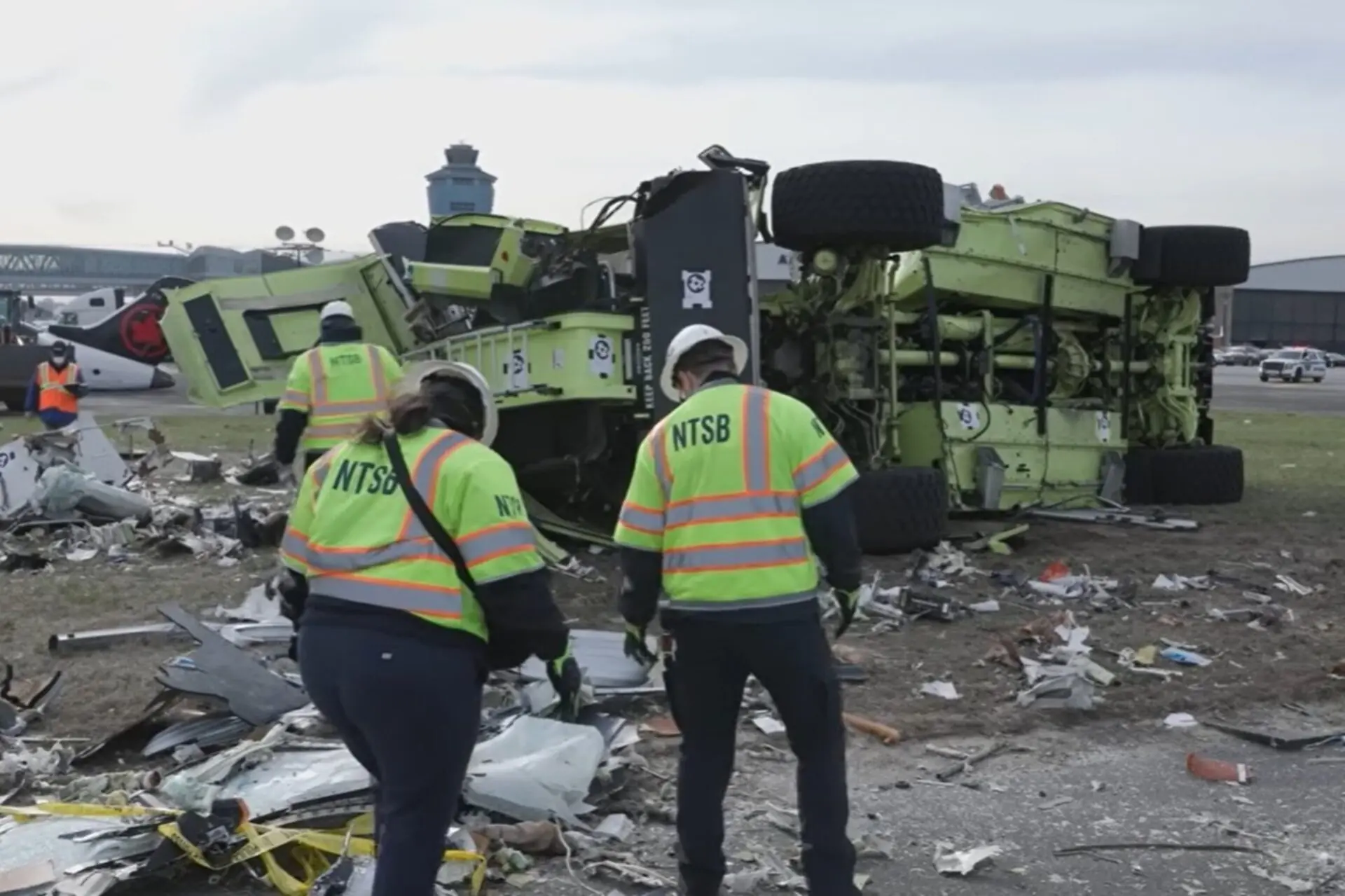
What the Crash Reveals About Airport Safety
The LaGuardia collision has drawn attention to a central challenge facing busy airports: keeping aircraft and ground vehicles separated while many operations are happening at once.
Airports are complex environments. Aircraft arrive and depart, baggage vehicles move between terminals, maintenance crews travel across service roads, fuel trucks approach parked planes, and emergency vehicles respond to incidents. Some of these movements occur close to runways, where even a brief misunderstanding can have serious consequences.
The system depends on strict rules governing who may enter a runway and when. A vehicle operator must know which route is authorized. Controllers must know where aircraft and vehicles are located. Pilots must receive clear instructions and maintain awareness of runway conditions. Technology should help detect conflicts before they become emergencies.
One lesson from the LaGuardia accident is that emergency response operations need to be integrated carefully with active runway movements. A vehicle may have a legitimate reason to move quickly, but urgency cannot replace coordination. The people managing the emergency must still have reliable information about aircraft movements and runway status.
Another lesson concerns equipment. If a ground vehicle is not equipped with a transponder, airport systems may have less information with which to track it. Airports and regulators may need to consider whether emergency vehicles should carry equipment that allows them to be identified reliably by surface surveillance systems.
Communication procedures also deserve attention. When several vehicles are moving together, radio instructions must be unambiguous. A stop command should clearly identify the intended recipient, and the recipient should acknowledge it in a way that confirms understanding. If a message is blocked or unclear, there should be a robust way to resolve the uncertainty before a vehicle enters a runway.
The workload of air traffic controllers is another important subject. Controllers must monitor aircraft, coordinate ground traffic, communicate with pilots and respond to emergencies. When several tasks compete for attention, the risk of confusion can increase. Staffing, training, shift procedures and the design of communication systems all influence how well controllers can manage that workload.
It would be too simple to say that adding more technology will solve every problem. Technology can help identify conflicts, but it depends on accurate information and clear procedures. Likewise, experienced people can make sound decisions, but they need workable systems and sufficient time to act.
The strongest safety approach combines multiple protections. A runway should not depend on a single radio message, one controller’s visual observation or one automated alert. If one layer fails, another should still help prevent a collision.
The final findings from the NTSB may lead to recommendations involving vehicle tracking, runway access procedures, communication protocols, controller workload or other safeguards. Those recommendations will matter far beyond one airport because the same basic challenges exist at busy airports around the world.
Remembering the Pilots Without Turning Speculation Into Fact
The phrase “heroic final move” captures the emotion surrounding the crash, but it also creates a responsibility for anyone reporting the story. The pilots should be remembered with respect, and the experiences of survivors deserve to be heard. At the same time, the technical facts must remain distinct from what people believe may have happened.
The passenger who described the possible use of reverse thrust was expressing gratitude and trying to explain why the aircraft’s occupants survived. That account is meaningful as a personal reaction. It is not, however, a substitute for the aircraft’s recorded data or the conclusions of investigators.
The official preliminary findings provide a concrete detail: the aircraft’s rudder moved to the left just before impact, while the fire truck also turned left. That evidence points to an attempt to maneuver away from the collision. It does not establish that the aircraft avoided a worse outcome because of reverse thrust, nor does it quantify how many lives any one action saved.