After the reduction in Ng, the aircraft reached a maximum speed of approximately 73 knots around two seconds later. At that point, its pitch attitude was about nine degrees, and its altitude was approximately 780 feet above mean sea level.
Afterward, the recorded parameters began to diverge from those of the earlier flights.
The aircraft's speed decreased while its nose-up attitude increased significantly. The roll initially moved toward the right and then toward the left.
The pitch angle reached approximately 19 degrees, while the left bank exceeded 20 degrees and continued to increase. The indicated airspeed had fallen to approximately 55 knots.
Control was lost shortly afterward.
Those figures describe a rapid deterioration in the aircraft's flight condition.
They also explain why the final moments were so critical. The aircraft was still close to the ground, and the pilot had very little altitude available to recover from a developing stall.
Chapter 3: The Aircraft Loses Control — A Chain of Events in Seconds
After the engine parameters changed, the aircraft entered a sequence that ended with a loss of control.
The BEA report describes an increase in pitch attitude, three brief stall-warning activations, a left turn with a high nose-up attitude, and then a continuous stall warning. The aircraft entered an asymmetric stall and struck the ground.
These terms can be difficult for readers who are not familiar with aviation, but they describe a critical situation in which an aircraft can no longer maintain the airflow needed to produce sufficient lift.
What is an aerodynamic stall?
An aerodynamic stall occurs when the wing exceeds its critical angle of attack. In simple terms, the wing is presented to the airflow at an angle that prevents it from producing the lift required for controlled flight.
A stall is not simply an engine stopping. An aircraft can stall even when its engine is operating, because the problem concerns the airflow over the wings.
A stall can occur during different phases of flight, but a stall shortly after take-off is particularly dangerous because the aircraft has limited altitude and little time to recover.
The pilot may need to lower the nose, reduce the angle of attack, manage the aircraft's bank, and regain sufficient airspeed. The available recovery space depends heavily on altitude, aircraft configuration, and the nature of the stall.
In the Tomblaine accident, the aircraft was still climbing at low altitude when its speed began to decrease and its pitch angle increased.
Why the warning sounded three times
The preliminary report states that the stall warning activated briefly on three occasions before becoming continuous.
A stall-warning system is designed to alert the pilot when the aircraft approaches a condition in which the wings may no longer produce sufficient lift.
The warning is not itself the stall. It is an indication that the aircraft is approaching a dangerous aerodynamic condition.
The fact that the warning sounded repeatedly before becoming continuous suggests that the aircraft was moving into an increasingly critical flight state.
The recorded data show that the aircraft's pitch increased while its speed decreased. These changes are consistent with a developing stall situation.
However, the report does not establish why the aircraft entered that condition. Investigators still need to determine how the engine change, the pilot's control inputs, the aircraft's configuration, and any possible technical malfunction interacted.
The left turn and asymmetric stall
The BEA states that the pilot turned left while the aircraft had a high pitch attitude. The stall warning then sounded continuously, and the aircraft entered an asymmetric stall.
An asymmetric stall is a particularly dangerous condition because the two wings do not lose lift in exactly the same way or at the same moment.
One wing may lose lift more severely, causing the aircraft to roll or yaw unexpectedly. The resulting movement can be difficult to control, especially when the aircraft is already close to the ground.
The preliminary report records that the aircraft's roll moved first toward the right and then toward the left, with the left bank increasing beyond 20 degrees.
It is important not to interpret this as proof that one particular control input caused the accident. The data describe the aircraft's movement, but the final explanation requires a detailed reconstruction of the flight and the technical condition of the aircraft.
The impact near the runway
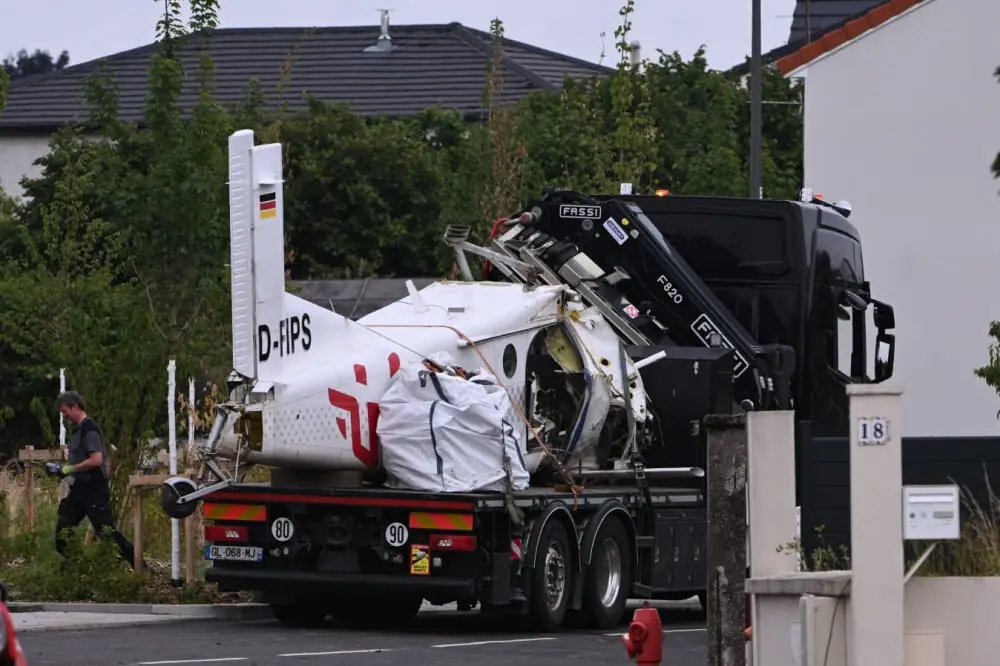
The aircraft struck the ground approximately 200 metres beyond the end of runway 21 and about 150 metres to the left of the runway centreline, according to the BEA report.
The wreckage was found near small bushes and streetlights. Investigators did not observe evidence that the aircraft had collided with those objects before reaching the ground.
The impact trajectory was close to vertical, with a steep nose-down attitude and a left bank.
The wreckage remained largely grouped together, and the flight-control systems were found to have continuity at the time of impact. The aircraft was subsequently transported for further technical examination.
The location of the crash was particularly concerning because it was close to a residential area.
The aircraft came down near homes and public routes. Early reports described how narrowly the accident avoided causing additional casualties on the ground. The 11 people aboard were killed, but no further deaths were reported among residents or passers-by.
A tragedy that could have been even worse
The aircraft's final trajectory brought it down close to a populated area. That fact added another dimension to the tragedy.
A crash involving a small aircraft can endanger not only those aboard but also people living or working nearby. A falling aircraft may strike buildings, vehicles, roads, or public spaces.
In Tomblaine, the crash site was close to residential buildings and a cycle route. The fact that the aircraft did not strike a home or cause additional casualties on the ground was a significant part of the early public discussion.
For the local community, however, the event was still devastating. Emergency services had to secure the site, deal with the wreckage, and support the families and witnesses affected by the accident.
The investigation would have to examine the crash itself while also reconstructing the events that began inside the aircraft during take-off.
Chapter 4: The Technical Clues Found in the Wreckage
The preliminary report does not simply describe the final flight. It also documents the examination of the aircraft and its systems.
This part of the investigation is especially important because some possible explanations can be tested through physical evidence.
Investigators examined the wreckage, dismantled components, inspected systems, and looked for traces that might indicate smoke, overheating, or mechanical failure.
Some findings helped narrow the investigation. Others raised new questions.
The aircraft's maintenance history
The aircraft was a Pilatus PC-6/B2-H4 fitted with a Pratt & Whitney PT6A-27 turboprop engine and a three-blade Hartzell constant-speed propeller.
At the time of the accident, the airframe had accumulated approximately 12,560 flight hours and 22,640 cycles. The engine had recorded approximately 7,540 operating hours, including around 3,785 hours since its last major overhaul.
The last scheduled 100-hour airframe and engine inspection had been completed in April 2026 at a maintenance facility in Switzerland. The aircraft's certificate of airworthiness was valid until July 31, 2026.
These details are relevant because investigators must determine whether the aircraft had any known maintenance issues or defects before the accident.
A valid certificate of airworthiness does not guarantee that a mechanical failure cannot occur. It indicates that the aircraft met the applicable requirements at the time of certification, but a sudden fault may still develop.
The BEA's examination therefore looked beyond the paperwork and focused on the physical condition of the components.
The flaps and flight-control systems
Investigators examined the aircraft's flaps and control systems.
The flaps were present on both wings, and the control linkage was continuous. No anomaly that could have contributed to the accident was identified in the preliminary examination.
Measurements indicated that the flaps were extended symmetrically in an intermediate position. The exact position was still being determined.
The investigators also examined the aircraft's trim systems.
The PC-6 uses a system that allows the horizontal stabilizer and other trim surfaces to be adjusted. These systems help the pilot manage the aircraft's attitude and control forces.
The electric actuator controlling the horizontal stabilizer was found to be installed normally. It showed no anomaly during dismantling or tomography examination. Its recovered position was consistent with the manufacturer's recommended take-off configuration.
The rudder and aileron trim systems were also examined. The preliminary report did not identify an abnormality in their installation or examination, and their measured positions were consistent with the recommended take-off settings.
These findings are significant because investigators were checking whether an abnormal trim setting or a failure in the control system might have contributed to the aircraft's unusual pitch and roll.
At the preliminary stage, the examined trim systems did not provide evidence of such a problem.
Three warning lights found on the aircraft
One of the most important technical discoveries involved the aircraft's warning panel.
The BEA examined the small filament lamps inside the warning indicators using X-ray imaging. The investigators found that three indicators had filaments showing deformation patterns that were consistent with the lamps being illuminated at the time of impact.