Do not attempt to manage suspected severe poisoning at home.
Professional treatment may require specific medical interventions.
Don't Try to "Detox" Yourself
If you suspect that you ate improperly prepared cassava, do not rely on internet detox recipes, supplements, or home remedies.
Cyanide poisoning can progress quickly.
This is not a situation where drinking extra water or taking random supplements is an appropriate substitute for medical care.
If significant symptoms occur, seek emergency medical assistance.
Why the "200 Deaths" Statistic Needs Context
The number makes a powerful headline.
"Over 200 people killed every year."
But statistics need context.
Cassava is eaten by enormous populations.
Hundreds of millions of people depend on it as a staple.
So the headline does not mean that cassava regularly kills ordinary consumers who eat properly prepared food.
The risk is concentrated in situations involving:
-
High-cyanide varieties
-
Inadequate processing
-
Food shortages
-
Drought
-
Poor nutrition
-
Limited food-safety infrastructure
In other words, the danger is highly conditional.
Why This Story Is Bigger Than Cassava
Cassava illustrates an important principle in food science:
Many foods are safe because humans learned how to process them correctly.
Cooking itself is a form of food technology.
Fermentation is food technology.
Drying is food technology.
Salting is food technology.
Canning is food technology.
Processing isn't necessarily something that makes food "bad."
Sometimes processing is precisely what makes a food safe.
Cassava is one of the clearest examples of this principle.
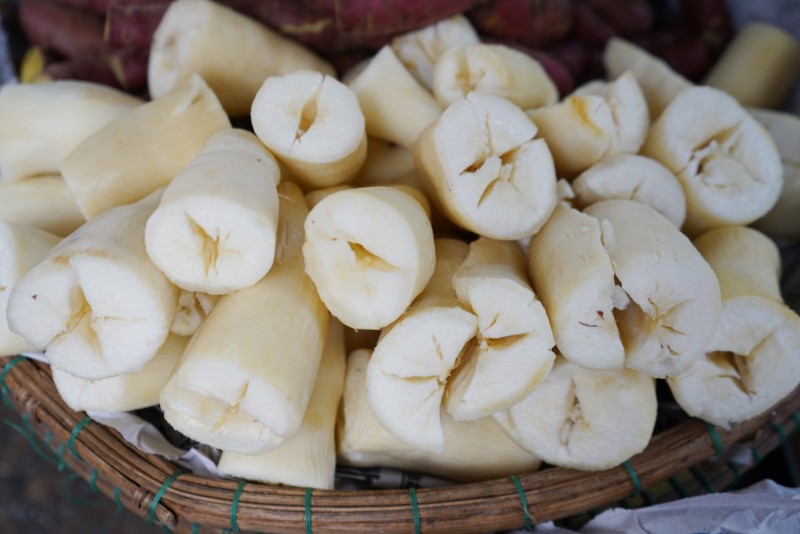
A Food That Can Be Both Dangerous and Essential
This is what makes cassava so fascinating.
The same chemical property that makes it potentially dangerous also exists within a plant that has become enormously important to human survival.
Cassava is drought tolerant.
It is productive.
It can grow in challenging conditions.
It stores energy underground.
It provides carbohydrates.
And it can be processed into numerous foods.
Its natural defense system is simply part of the plant's biology.
Humans learned to work around it.
What You Should Remember
If you remember only a few things about cassava, remember these:
First: Cassava contains naturally occurring cyanogenic compounds.
Second: These compounds can release cyanide when cassava is improperly processed.
Third: Bitter varieties generally present a greater cyanogenic risk than lower-cyanide varieties.
Fourth: Proper processing can substantially reduce the risk.
Fifth: Cassava is a major staple food for hundreds of millions of people.
Sixth: Cassava poisoning can cause severe illness, including acute poisoning and neurological disorders such as konzo.
Seventh: A dramatic nickname like "the world's deadliest food" should not be interpreted to mean that properly prepared cassava is inherently unsafe.
The Bottom Line
Cassava may be one of the most misunderstood foods in the world.
On one hand, it contains naturally occurring compounds capable of producing cyanide.
On the other hand, it is a crucial source of calories for hundreds of millions of people.
That sounds like a contradiction.
But it isn't.
The difference is preparation.
Cassava is not a food that should be eaten casually in its raw or inadequately processed form.
Its cyanogenic compounds make proper preparation essential.
But when appropriately processed, cassava can be transformed into a safe and versatile staple that has supported communities for generations.
That is why the phrase "world's deadliest food" tells only half the story.
The other half is much more interesting.
This is a plant that can potentially poison you if handled incorrectly—but can also feed you when handled correctly.
It is a reminder that food safety isn't always about avoiding a particular ingredient.
Sometimes it's about understanding the ingredient.
Understanding the chemistry.
Respecting traditional preparation.
Using appropriate processing methods.
And knowing that something that looks completely harmless can have a hidden biological defense system.
So the next time you see a cassava root, don't look at it as a mysterious poisonous food.
Look at it as something far more fascinating:
A resilient staple crop with a natural chemical defense that humans learned, over generations, how to safely overcome.
And perhaps that's the real reason nearly half a billion people have continued eating it.
Not because they are ignoring the danger.
But because generations of knowledge have taught them how to make this remarkable root safe.