NOAA says there's a 60% chance a radiation storm could hit Earth this WEEK... here is all YOU need to know
Earth has yet to fully grapple with last week's 'severe' solar storms — but already scientists are warning about a new 'perfect storm' of rare space weather.
The sun has been releasing powerful flares, emissions of electromagnetic radiation, which contain large quantities of charged particles that have accelerated in speed and increased in number due to the intense magnetic activity on the star's surface.
And now the National Oceanic and Atmospheric Administration (NOAA) shows a 60 percent chance of a solar 'radiation storm' starting tomorrow with a lower possibility on Wednesday as well.
The particles can interact with our planet's magnetic field and atmosphere, causing disruptions to satellite communications, as well as radiation hazards for astronauts in space and interference with power grids.
This week's coming solar radiation storm differs from the 'geomagnetic storms' that hit Earth this weekend, which were a direct hit powerful enough to disrupt Earth's protective magnetic field, the magnetosphere.
Much of the coming radiation storm will be absorbed by Earth's magnetic field, but not near the exposed polar regions — where Earth's magnetosphere curves back down and inward toward Earth's core.
NOAA's Space Weather Prediction Center also noted that the past weekend's geomagnetic storms would persist until 5PM ET Monday, with the possibility of further, but weaker 'power grid fluctuations' and impacts on 'satellite operations.'
The storm's ability to push the famous 'Northern Lights' further south would also continue with aurora still likely to be visible along the 'northern tier of the US such as northern Michigan and Maine,' according to the agency's space weather experts.
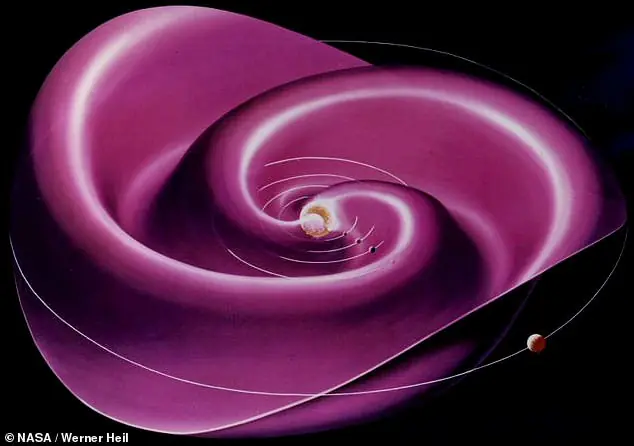
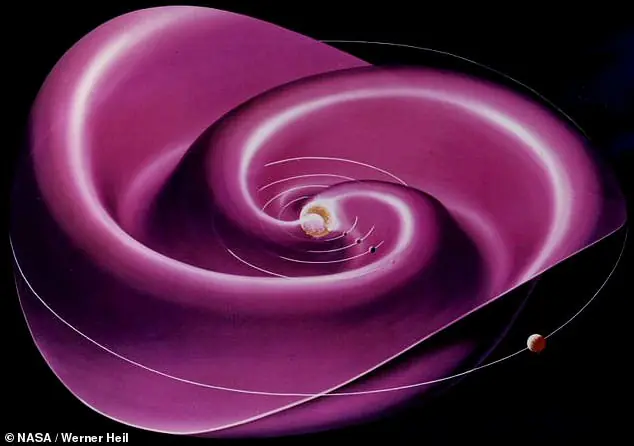
Then, as the week progresses, Sunspot AR3664, the giant 'sunspot' responsible for last weekend's solar storms, is scheduled to pass through a portion of the Parker Spiral, curving its high-speed radiation onto a path intersecting with Earth's orbit.
Sunspot AR3664, a dark patch of the sun's surface with a magnetic field about 2,500 times stronger than Earth's own, is one of the largest sunspots observed in decades.
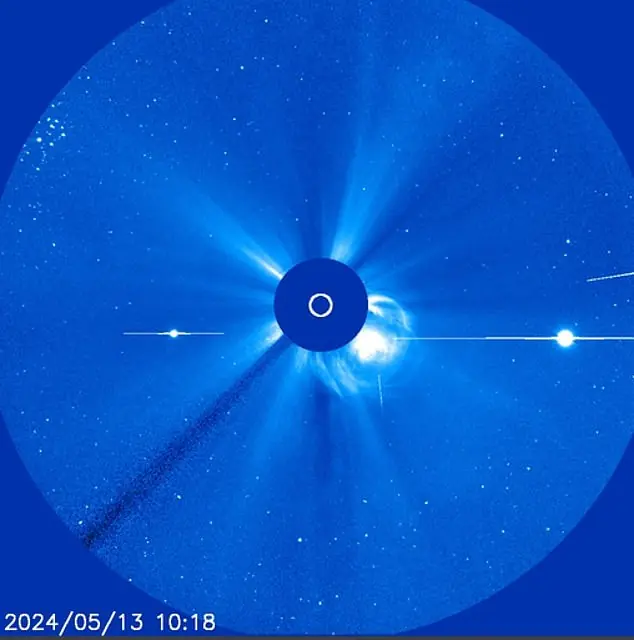
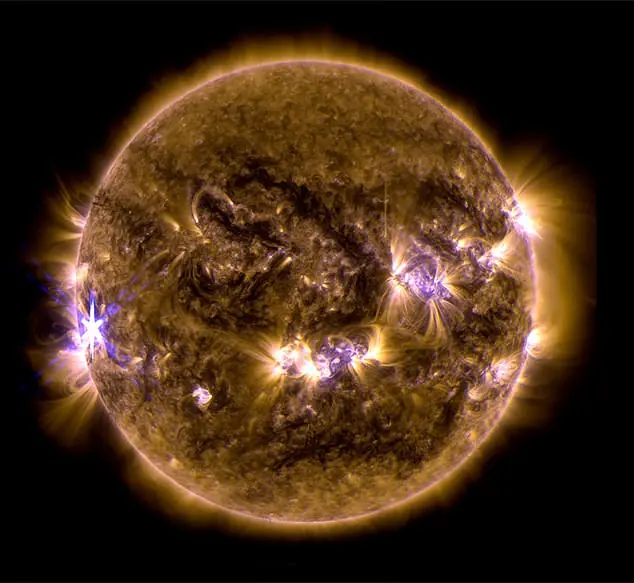
The dense magnetic event is as long as 15 Earths and capable of producing solar storms on par with the 1859 Carrington event, which set telegraph stations and wires on fire, cut communications worldwide, and disrupted ships' compasses.
Because Earth is now mostly out of range from any more direct hits from this roiling sunspot's geomagnetic storms, this week's radiation storms will come from a unique feature of the sun's own rotation.
'[As] the Sun rotates, the Sun's magnetic field expands outwards in a spiral pattern, the Parker Spiral,' according to NASA's Solar Dynamics Observatory team.
When the ejections from a sunspot like AR3664 hits the right portion of the spiral, in the team's words, it leads to 'the charged particles of the solar wind spraying out into the solar system like a garden sprinkler.'
Already, NOAA's space weather observing satellite GOES-18 has detected a surge in subatomic particles, specifically protons, ejected from the sun into Earth's upper atmosphere.
GOES-18's 'proton radiation' readings passed the 'warning threshold' midday Monday, in advance of the predicted 'radiation storm' later this week.
NOAA's team issued a warning that radio communications at Earth's poles could already experience 'fades' at certain frequencies today.