Repeated pauses in breathing, gasping, or choking can be warning signs of obstructive sleep apnea. Do not rely on a sleeping-position change alone; ask about a sleep evaluation.
5. You feel unusually sleepy during the day.
Excessive daytime sleepiness can result from insufficient sleep, medication effects, or sleep disorders. If you regularly feel exhausted despite spending enough time in bed, it is worth investigating.
6. You experience persistent palpitations.
Feeling your heartbeat more strongly when lying down does not automatically indicate heart disease. However, new or recurring palpitations should be assessed, particularly if accompanied by dizziness, faintness, chest discomfort, or breathlessness.
7. You cannot breathe comfortably when lying flat.
This is not a symptom to dismiss as a normal consequence of sleeping position. Difficulty breathing while lying down can be associated with heart or lung conditions and deserves prompt medical attention.
These signs do not prove that sleeping on the right side is responsible. They are reasons to look more carefully at sleep habits, physical support, and possible medical conditions.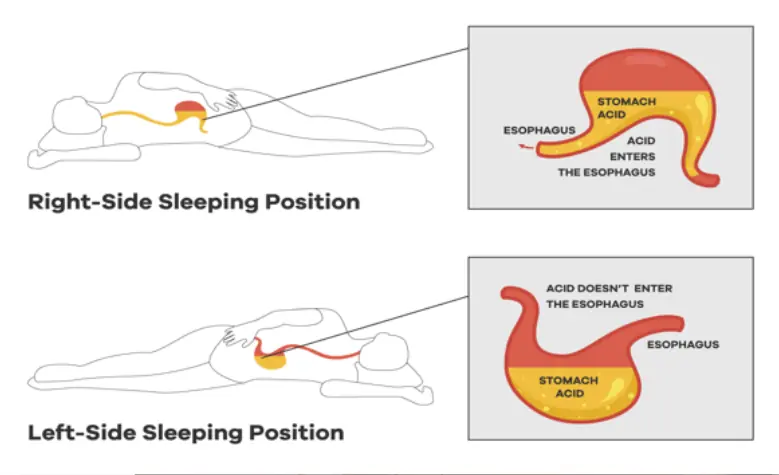
How to make right-side sleeping more comfortable
If you prefer sleeping on your right side and do not experience concerning symptoms, there is generally no reason to force yourself to change.
A few practical adjustments may make the position more comfortable.
Choose a pillow that supports your neck
The pillow should fill the space between your head and the mattress without forcing your neck to bend.
People with broader shoulders may need a higher pillow than people with narrower shoulders. The mattress also matters because a softer mattress allows the shoulder to sink further into the bed.
Keep your spine in a neutral position
Try to keep your head, shoulders, and hips aligned. Avoid twisting the upper body in one direction while the pelvis faces another.
A slightly bent-knee position may feel comfortable, but you do not need to curl into a tight fetal position.
Place a pillow between your knees
A pillow between the knees can help prevent the upper leg from dropping forward and twisting the pelvis.
This adjustment may be particularly helpful for people who experience lower-back or hip discomfort.
Avoid placing your arm underneath your body
Sleeping with an arm trapped under the torso or head can place pressure on the shoulder and may contribute to numbness or discomfort.
Try keeping the lower arm comfortably in front of you or slightly bent, rather than using it as a pillow.
Allow yourself to change sides
There is no requirement to remain on the right side throughout the entire night.
If your shoulder becomes uncomfortable, turn over. If you experience reflux, you may prefer the left side. If you are pregnant, follow the advice from your maternity care team about appropriate sleeping positions.
Changing position naturally is part of normal sleep.
When should you try sleeping on your left side instead?
There are several circumstances in which experimenting with the left side may be worthwhile.
If you have nighttime acid reflux: Research suggests that left-side sleeping can reduce esophageal acid exposure compared with right-side sleeping. It may be a useful adjustment alongside other GERD management measures.
If you are pregnant: After 28 weeks, NHS guidance recommends going to sleep on either side rather than deliberately settling on your back. The right side is acceptable; the left side is not the only option.
If your right shoulder or hip hurts: Moving to the opposite side may reduce pressure on the painful area. However, if the opposite shoulder or hip is also uncomfortable, another position may be more suitable.
If you simply feel more comfortable: There is no need to justify changing sides. Personal comfort is a legitimate reason to adjust your sleeping position.
For people with heart failure or other significant medical conditions, the choice may be more complicated. Follow individualized medical advice rather than assuming that the left side is always healthier.
How to build a healthier nighttime routine
Sleep position is only one part of healthy sleep. Even a perfectly arranged pillow cannot compensate for an irregular schedule, untreated sleep apnea, or habits that repeatedly interrupt rest.
A few consistent habits can help support better sleep.
Keep a regular sleep schedule
Going to bed and waking up at roughly the same times can help regulate the body's internal clock.
This does not mean that every night must be identical. Work schedules, family responsibilities, and social activities sometimes make that impossible. But maintaining a reasonably consistent routine can make it easier to fall asleep and wake up feeling rested.
Give yourself time to wind down
Bright screens, stressful conversations, and demanding work immediately before bed can make it harder for some people to relax.
A quieter routine may help. Reading, taking a warm shower, listening to calm music, or doing gentle stretching can create a transition between daytime activity and sleep.
Be mindful of late meals
Large meals close to bedtime may worsen nighttime reflux for some people.
If you frequently experience heartburn, consider finishing dinner earlier and avoiding lying down immediately after eating. The appropriate timing may vary, but giving the stomach time to settle can be helpful.
Limit alcohol near bedtime
Alcohol may make a person feel sleepy initially, but it can disrupt sleep later in the night. It may also worsen snoring and obstructive sleep apnea in some individuals.
People who have sleep-related breathing problems should discuss alcohol use and other possible triggers with their healthcare professional.
Make the bedroom comfortable
A supportive mattress, suitable pillow, comfortable room temperature, and reduced nighttime noise can all help.
The best setup is not necessarily expensive. A pillow that maintains neck alignment and a mattress that cushions the shoulders and hips may be more useful than a collection of specialized sleep products.
Pay attention to repeated symptoms
If you wake up with headaches, dry mouth, choking sensations, heartburn, or unexplained fatigue, take note of how often these symptoms occur.
A short record of sleep times, symptoms, meals, and sleeping positions may help a clinician understand the pattern.
The purpose is not to monitor every movement obsessively. It is to recognize recurring problems that deserve attention.
The final answer: Is sleeping on your right side bad for you?
For most healthy adults, sleeping on the right side is not inherently dangerous. It does not automatically damage the heart, lungs, stomach, or brain.
In fact, side sleeping can be helpful for people whose snoring or obstructive sleep apnea becomes worse when they lie on their backs. Both the left and right sides may offer that benefit, depending on the individual.
However, the right side may not be the most comfortable choice for everyone.
People with nighttime acid reflux may experience fewer symptoms when sleeping on their left side. Pregnant people in late pregnancy are generally advised to go to sleep on either side rather than on their backs. Someone with a painful right shoulder or hip may benefit from changing sides or adjusting their pillows.
People with heart or lung conditions may have individual preferences that should be discussed with their healthcare team.
The most important point is that sleep position should be considered in context. A position that works well for one person may be uncomfortable or unsuitable for another.
If you have slept on your right side for years and wake feeling rested, breathe comfortably, and have no concerning symptoms, there is usually no reason to panic or make a dramatic change.
But if you regularly wake with heartburn, notice repeated breathing interruptions, experience persistent palpitations, or struggle to breathe when lying flat, do not assume that the answer is simply turning over. Those symptoms deserve appropriate medical attention.
The healthiest sleeping position is not a universal direction on a compass. It is the position that allows your body to rest comfortably while taking account of your individual health needs.