Chapter 1: A Sudden Hailstorm Turns a Quiet Neighborhood Into a Scene of Chaos
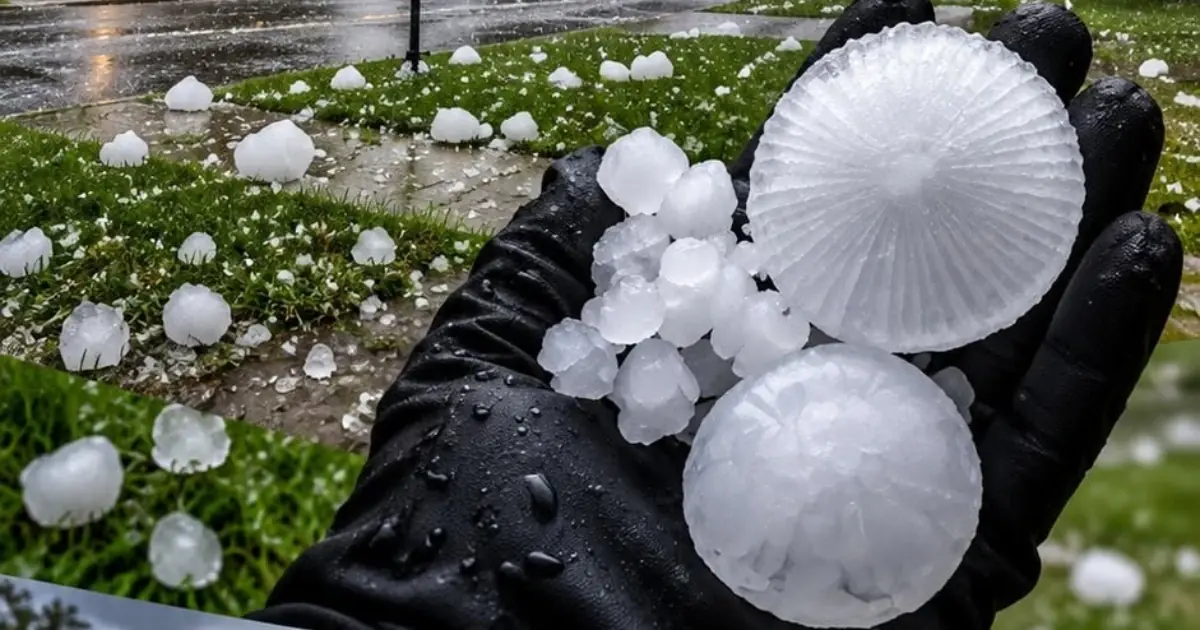
A quiet residential street can change dramatically when a powerful thunderstorm moves overhead. One moment, families may be enjoying an ordinary afternoon. Minutes later, dark clouds gather, rain begins to fall heavily, and large pieces of ice strike rooftops, vehicles, lawns, and sidewalks.
The photograph captures the frightening aftermath of such a storm. Large hailstones are scattered across the grass and roadway, while a person holds several unusually large pieces of ice in a gloved hand. The surrounding neighborhood appears peaceful, yet the damage visible in the lower images suggests that the storm was anything but ordinary.
Hail is a form of solid precipitation that develops inside thunderstorms. Unlike snow, which usually forms as ice crystals, hailstones grow when water droplets are carried upward into freezing parts of a storm cloud. These droplets freeze and accumulate in layers until the hailstone becomes too heavy for the storm's rising air to support.
According to the National Oceanic and Atmospheric Administration, hail can damage homes, vehicles, aircraft, crops, and livestock. Large hail can also injure people who are caught outside during a storm.
The danger becomes especially serious when hailstones reach the size of golf balls or larger. A small hailstone may bounce harmlessly off a lawn, but a large, hard piece of ice can crack glass, dent metal, damage roofing materials, and injure anyone struck by it.
In a severe storm, hail may fall alongside strong winds, lightning, and torrential rain. These hazards can arrive almost simultaneously, leaving little time for people to react. A person who steps outside to inspect the hail may be exposed not only to falling ice but also to lightning or flying debris.
The phrase “red alert” often attracts attention because it suggests an immediate threat. However, weather alerts vary by country and local meteorological agency. Residents should always check official local warnings rather than relying only on dramatic social media captions.
The image does not establish the exact location, date, or official warning level of the event. Nevertheless, the conditions shown illustrate why hailstorms deserve serious attention.
A severe thunderstorm is generally defined by the U.S. National Weather Service as one capable of producing hail at least one inch in diameter, damaging winds of 58 miles per hour or more, or a tornado.
Even when a storm lasts only a short time, its effects can remain visible for hours. Hail may accumulate in gutters, block drainage channels, damage gardens, and leave roads slippery. Broken branches and damaged power lines can create additional hazards after the rain has stopped.
For families living in areas where severe thunderstorms are common, preparation is essential. Knowing where to shelter, keeping vehicles protected when possible, and following official weather updates can reduce the risk of injury and property damage.
The most important lesson from a scene like this is simple: when large hail begins falling, people should not remain outside to take photographs or collect ice. A safe indoor location is far more valuable than a dramatic picture.
Chapter 2: How Giant Hailstones Form Inside Powerful Storm Clouds
Hailstones may look like simple pieces of ice, but their formation involves powerful air currents and rapidly changing temperatures inside a thunderstorm.
When warm, moist air rises from the ground, it can enter a thunderstorm's strong updraft. As the air climbs higher, temperatures become colder. Water droplets carried into these freezing regions may turn into ice.
Some droplets remain liquid even when the surrounding air is below freezing. These are known as supercooled water droplets. When they collide with an existing ice particle, they can freeze onto its surface and increase its size.
The hailstone may travel through different parts of the storm cloud several times. Each journey can add another layer of ice. Some hailstones develop cloudy layers containing trapped air, while others form clearer ice as water freezes more slowly.
The stronger the updraft, the longer a hailstone may remain suspended inside the storm. This gives it more opportunities to grow.
Eventually, the hailstone becomes too heavy for the rising air to support. It then falls toward the ground, sometimes at considerable speed.
The size of hail varies greatly. Some stones are only a few millimeters wide, while others can grow to several centimeters. Extremely powerful thunderstorms can produce hailstones large enough to break windows and cause serious damage to vehicles.
The size of a hailstone is not the only factor that determines how much damage it causes. Its speed, density, shape, and the angle at which it strikes can also matter. A large hailstone hitting a windshield may cause a different type of damage from one striking a roof or a garden plant.
The storm's movement is another important factor. A slow-moving thunderstorm may repeatedly affect the same neighborhood, allowing hail to accumulate on roads and lawns. A fast-moving storm may produce a brief but intense burst of hail over a smaller area.