Her later years were also not entirely free from medical challenges.
As with many people who live into advanced old age, she experienced physical limitations and required assistance with some activities. Yet she remained intellectually engaged and continued to attract attention because of her extraordinary historical experience.
In 1991, she left her Long Island estate and moved to Manhattan.
The city that had once welcomed her as a diplomatic celebrity became her home again.
She was now an elderly woman living far beyond the political world in which she had once exercised influence.
But one extraordinary appearance remained ahead.
In 1995, as the United States marked the fiftieth anniversary of the end of the Second World War, the woman who had addressed Congress in 1943 returned to Washington.
The political figures who welcomed her belonged to a different generation.
Many had not yet been born when she first stood before American lawmakers.
And yet, there she was: a living connection to a world that had almost vanished.
Chapter 5: A Century of Memories and the Final Public Appearance
In 1995, Soong Mei-ling was 97 or 98 years old, depending on the historical birth date used.
Her age alone made her remarkable.
But what made her appearance especially significant was the historical distance she represented.
When she first visited Washington during the Second World War, the United States and China were allies against Japanese expansion. Franklin D. Roosevelt was president. The outcome of the war remained uncertain, and the future of East Asia was still being decided.
By 1995, the international landscape had changed almost beyond recognition.
The Soviet Union had collapsed. The Cold War had ended. China had undergone decades of political and economic transformation. Taiwan had begun moving away from its earlier authoritarian political system.
The woman who had once asked American lawmakers to support China's wartime resistance was now a witness to a completely different world.
Her appearance at the Senate reception commemorating the fiftieth anniversary of Allied victory brought renewed attention to her life.
For many observers, she represented a connection to the generation that had fought the Second World War.
For others, she represented the complicated history of the Nationalist government and its role in twentieth-century China.
Her legacy was never entirely simple.
Supporters remembered her as a determined diplomat who helped secure international support for China during its struggle against Japan. They praised her public speaking, humanitarian activities, and ability to challenge the expectations placed upon women in political life.
Critics, however, viewed her through the history of the Nationalist regime, including its authoritarian practices, political repression, and failures during the Civil War.
Both perspectives are part of the historical record.
Mei-ling had lived at the center of a government whose achievements and mistakes affected enormous numbers of people. Her personal influence cannot be separated completely from the political system she helped represent.
Yet her individual story remained distinctive.
She had entered public life at a time when women were rarely permitted to exercise independent political influence. She used education, family connections, language skills, and personal intelligence to build a position that extended far beyond the conventional role of a political wife.
Her relationship with the United States was especially unusual.
She was not simply a foreign visitor attempting to impress American officials. She had studied in the country, understood its culture, and knew how to communicate with its people.
That familiarity gave her a diplomatic advantage.
Her 1943 speech to Congress remains one of the defining moments of her public life. It demonstrated that international influence could be exercised through language and persuasion as well as through military power.
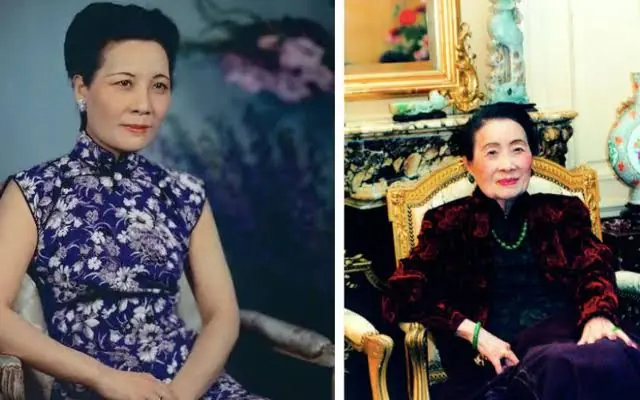
But the woman who returned to Washington in 1995 was very different from the energetic diplomat of the 1940s.
She had survived almost every major figure of her political generation.
Franklin D. Roosevelt had died in 1945. Winston Churchill died in 1965. Mao Zedong died in 1976. Her husband had died in 1975.
The political world that had once surrounded her was disappearing into history.
In private life, she continued to maintain interests that had accompanied her for decades. She read, painted, prayed, and received visitors. Her physical strength was no longer what it had been, but her reputation remained powerful.
She had also outlived the political role that once defined her.
For decades, she had been Madame Chiang Kai-shek. The title connected her to the authority of her husband and the Nationalist government.
In old age, however, she increasingly became a historical figure in her own right.
People were fascinated by the woman who had witnessed so much of the twentieth century and remained alive to see the beginning of the twenty-first.
Her longevity invited questions that were difficult to answer.
Was it genetics? Was it access to medical care? Did her religious faith provide emotional stability? Did her education and lifelong intellectual activity help her remain mentally engaged?
There is no single proven explanation.
Her long life was almost certainly shaped by a combination of biological, medical, social, and personal factors.
But perhaps the most remarkable feature was the extraordinary range of historical events she had experienced.
She had known China before the Second World War, watched it suffer invasion, represented it before Congress, witnessed the collapse of the mainland Nationalist government, and spent decades in exile.
Few people could claim to have lived through such a transformation of national and international history.
As the twentieth century approached its end, Mei-ling became one of the last living links to the political world of Chiang Kai-shek.
But even as she approached her hundredth birthday, her story had not yet reached its final chapter.
The woman who had once been expected to represent a rising republic was now preparing to leave behind an entirely different legacy: that of a person who had outlived the political age that created her.
Chapter 6: The Last Witness to a Vanishing World
On March 4, 1998, Soong Mei-ling reached her hundredth birthday according to the commonly cited birth date of 1898.
It was an extraordinary milestone.