Parenthood is often associated with responsibility, stability, and conventional family roles.
But being a parent does not require abandoning individuality.
A father can be devoted to his children while dressing unconventionally.
He can work in a technical profession while enjoying fashion.
He can value traditional family responsibilities while challenging traditional clothing expectations.
These characteristics do not contradict one another.
In fact, one could argue that showing children that adults can be comfortable with individuality may be valuable.
Children naturally notice social rules.
They observe who wears what, who behaves in which ways, and which differences are celebrated or criticized.
An adult who confidently demonstrates that harmless differences do not need to be feared can provide a useful lesson.
That lesson is not necessarily "everyone should wear skirts."
It is something broader:
People do not have to look identical in order to respect one another.
Why Men Have Fewer Fashion Choices
One of the most overlooked aspects of this conversation is that traditional masculinity can restrict men as well.
The discussion about gender and clothing is often framed as women fighting for the freedom to wear traditionally masculine clothing.
But men can also be limited by gender expectations.
A man who wants to wear bright colors may be told that they are feminine.
A man who enjoys jewelry may be questioned.
A man who likes makeup may face ridicule.
A man who prefers skirts or dresses may encounter even stronger reactions.
The underlying message can be:
There are certain things men are simply not supposed to enjoy.
That can be restrictive.
Fashion should ideally be an area where people have room to explore.
Not everyone will want to do so.
Many men genuinely prefer trousers and conventional shoes.
There is nothing wrong with that.
The point is that preference works both ways.
Freedom means being able to choose conventional clothing without judgment—and unconventional clothing without unnecessary assumptions.
The Internet Changed the Conversation
Bryan's story would likely have been very different several decades ago.
Social media allows people with unconventional lifestyles or fashion choices to find audiences far beyond their immediate communities.
A person can post an outfit in Germany and receive reactions from people around the world within hours.
This has two effects.
The first is positive.
People who once felt isolated can discover others with similar interests.
Someone who has always believed they were "the only person" interested in a particular style may suddenly discover thousands of others.
The second effect is more complicated.
Social media magnifies criticism as well as support.
An unusual image can travel quickly, and people who have never met the individual may feel entitled to make judgments about them.
That can make online visibility both empowering and exhausting.
For Bryan, however, the enormous interest in his wardrobe has transformed what might otherwise be a personal fashion preference into a broader cultural conversation.
Why People Are So Fascinated by "Breaking the Rules"
Human beings are naturally drawn to things that challenge expectations.
A man in a conventional suit is familiar.
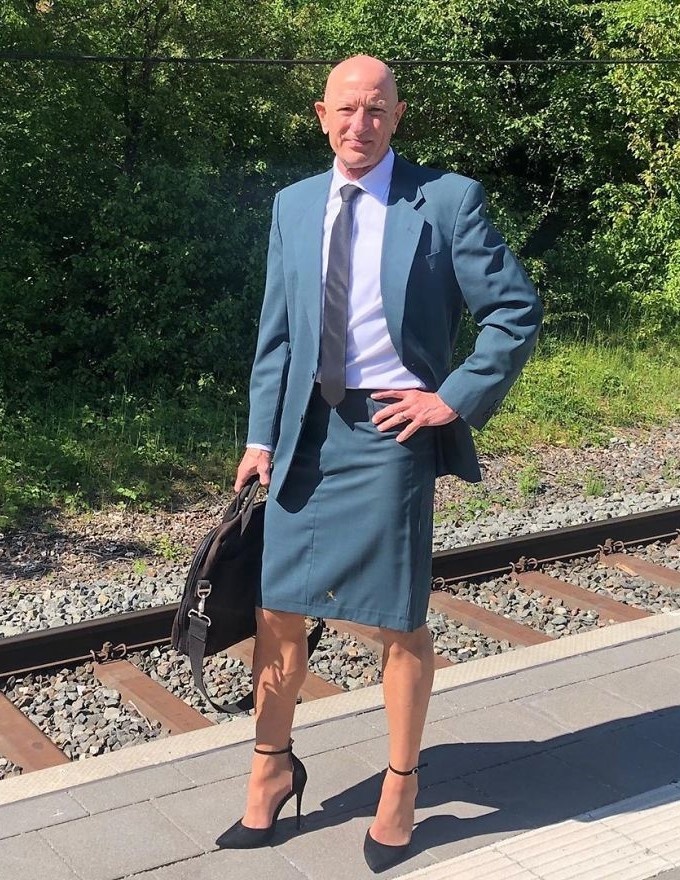
A man wearing a pencil skirt with a blazer and tie is unexpected.
The brain notices the contrast.
That is part of what makes Bryan's photographs visually compelling.
His outfits contain recognizable pieces, but they are combined in an unfamiliar way.
This is a fundamental principle of fashion.
Innovation often occurs when someone takes familiar elements and rearranges them.
The result does not have to be outrageous.
Sometimes a small change is enough to make people look twice.
Is Wearing a Skirt Really "Breaking the Rules"?
That depends on who created the rules.
Most clothing rules are social conventions rather than laws of nature.
There is nothing inherently incompatible between a male body and a skirt.
The fabric does not change.
The garment does not suddenly become physically dangerous because it is worn by a man.
What changes is the social interpretation.
In some cultures, male skirt-like garments are completely normal.
Kilts are perhaps the most familiar Western example. Other cultures have long traditions of men wearing robes, tunics, wraps, sarongs, or skirt-like garments.
This is important because it demonstrates that the idea of "men do not wear skirts" is not universally true.
It is culturally specific.
Bryan's style exists within one particular cultural environment, which is why it generates attention.
Fashion Has Always Borrowed Across Gender Lines
Modern fashion is filled with examples of once-gendered clothing becoming mainstream.
Trousers are perhaps the most obvious example.
There was a time when women wearing trousers could be considered controversial in many Western societies.
Today, they are so ordinary that the historical controversy can be difficult to imagine.
The same process has happened with other garments and accessories.
Women's suits became mainstream.
Men's jewelry has experienced periodic revivals.
Longer hairstyles for men have moved in and out of fashion.
Pink, once strongly associated with boys in certain historical periods, eventually became heavily feminized in Western marketing.
These examples demonstrate that fashion categories are fluid.
What seems shocking today may eventually become ordinary.