Perhaps the healthiest way to understand Bryan's story is to avoid forcing a single explanation onto it.
Fashion can be identity.
Fashion can be art.
Fashion can be comfort.
Fashion can be practicality.
Fashion can be rebellion.
Fashion can simply be fun.
One person may wear a skirt because it represents something deeply meaningful to them.
Another may wear one because they like the silhouette.
Another may enjoy challenging social expectations.
Another may simply prefer skirts to trousers.
All of these motivations are possible.
That is why assumptions can be misleading.
The garment tells us what someone is wearing.
It does not necessarily tell us why.
What Society Can Learn From Men Who Wear Skirts
The broader lesson is not that every man should start wearing skirts.
That would simply replace one form of pressure with another.
The more useful lesson is about personal autonomy.
A society can become more tolerant when it learns to distinguish between behavior that causes genuine harm and behavior that merely looks unfamiliar.
A person wearing an unconventional outfit may challenge our expectations, but that does not mean they are doing something wrong.
Discomfort is not necessarily evidence of danger.
Sometimes discomfort is simply the feeling of encountering something new.
That distinction is important.
If someone is professionally competent, respectful toward others, and appropriately dressed for the practical requirements of their environment, their choice of a skirt does not automatically diminish any of those qualities.
The Question of Respect
There is also an important distinction between personal freedom and social courtesy.
People have the right to express themselves, but workplaces and social environments can still have reasonable expectations.
A hospital, laboratory, factory, or construction site may require specific clothing for safety.
A formal ceremony may have a dress code.
A person may choose to follow those requirements while still expressing themselves within them.
Personal freedom does not mean that context disappears.
But context also does not require people to accept every outdated assumption without question.
The conversation becomes more productive when both sides recognize that distinction.
Why Some People Feel Threatened by Unconventional Masculinity
Another important question is why a man's feminine-coded clothing can provoke stronger reactions than a woman's masculine-coded clothing.
One explanation is that traditional masculinity has often been defined partly through separation from femininity.
Men have historically been encouraged to prove masculinity by demonstrating that they are not feminine.
That creates a rigid boundary.
If a man wears a skirt, that boundary becomes less clear.
For people who strongly identify masculinity with traditional appearance, this can feel threatening—not necessarily because the clothing itself is harmful, but because it challenges the definition they have learned.
But masculinity does not have to disappear simply because its boundaries become broader.
A man can be masculine while wearing a skirt.
He can also be feminine, androgynous, or simply uninterested in categorizing himself.
The important point is that clothing does not need to determine the entire person.
The Quiet Power of Normalizing Difference
Perhaps the most significant effect of people like Bryan is gradual normalization.
The first person to do something unconventional often receives enormous attention.
The hundredth person receives less.
The thousandth may barely be noticed.
This is how social norms evolve.
Visibility gives people an opportunity to become familiar with something they previously considered unusual.
That does not mean everyone will suddenly like it.
It means the emotional reaction may become less intense.
And sometimes that is enough.
Social progress does not always arrive through dramatic political events.
Sometimes it happens through ordinary people living their lives differently and demonstrating that nothing terrible happens as a result.
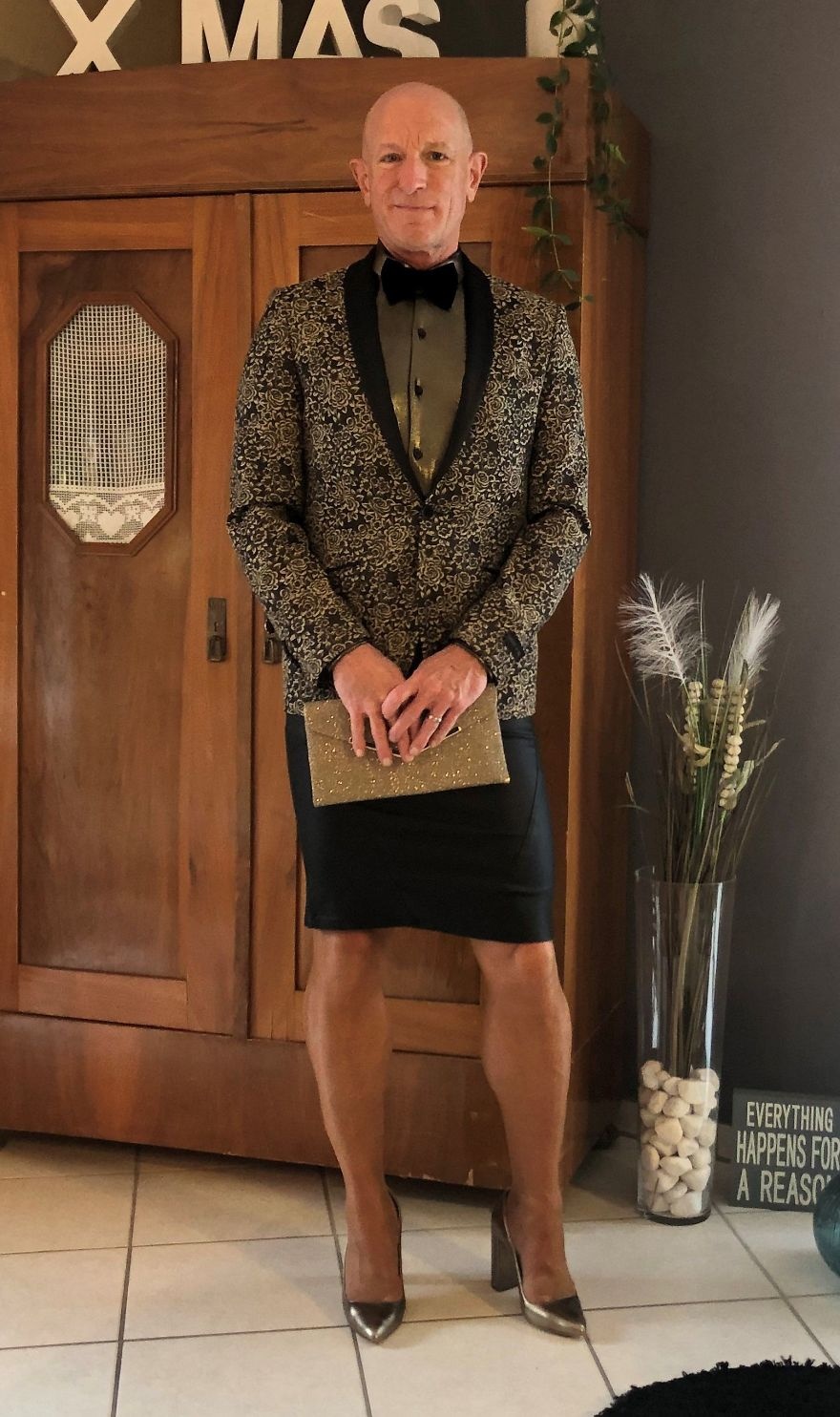
What Makes Bryan's Story So Interesting
The fascinating part of Mark Bryan's story is ultimately not the skirt.
It is the contrast between the expectations people place on him and the reality of his life.
He is described as an engineer.
He is a father.
He is an older man.
He has a professional career.
And he enjoys wearing clothing that society traditionally categorizes as feminine.
Those facts can exist simultaneously.
That may be the most important lesson.
People are rarely as simple as the categories assigned to them.
A person's profession does not determine their wardrobe.
Their age does not determine their personality.
Their gender does not determine every item they are allowed to enjoy.
And clothing does not have to carry the enormous symbolic weight that society sometimes places upon it.
A Different Way of Looking at the Question
Instead of asking:
"Why does a man want to wear a skirt?"
perhaps a better question is:
"Why do we care so much who is allowed to wear one?"
That change in perspective is significant.
It moves the conversation away from treating Bryan as an unusual curiosity and toward examining the social expectations surrounding clothing.