If You See a Purple Butterfly Sticker Near a Newborn, Here’s What It Means – The Heartbreaking Story Behind a Symbol That Has Touched Hospitals Around the World
A tiny purple butterfly on a newborn's incubator may look like a simple decoration. But behind that delicate symbol is a mother's heartbreaking loss, two twin daughters, and a promise that no grieving parent should ever have to explain their pain again.
Imagine walking into a neonatal intensive care unit and seeing a tiny purple butterfly attached to the side of a newborn baby's incubator.
At first glance, it might look like an ordinary sticker. Perhaps someone placed it there to decorate the baby's sleeping space. Perhaps it is simply a colorful symbol chosen by the hospital.
But for families who understand its meaning, that little butterfly represents something much deeper.
It can tell the story of a baby who was born alongside a twin or another sibling, but whose brother or sister did not survive.
It represents a life that was loved, even if that life lasted only a few hours. It also reminds hospital staff and visitors that the parents caring for the surviving newborn may be experiencing two emotions at once: the happiness of having a baby in their arms and the devastating grief of having lost another.
The meaning behind this symbol began with a young British mother named Millie Smith.
In 2016, Millie and her partner, Lewis Cann, were expecting identical twin girls. They had imagined bringing two daughters home, watching them grow together, and experiencing all the ordinary moments that parents of twins look forward to.
But their pregnancy brought news that no expectant parent wants to hear.
One of their daughters, Skye, had been diagnosed with a condition that meant she would not survive for long after birth. Her twin sister, Callie, was still developing, and the family continued the pregnancy knowing that the outcome for the two babies would be very different.
When the girls finally arrived at 30 weeks, Skye lived for just three hours.
Callie survived, but her parents' experience in the neonatal intensive care unit became a painful reminder that the world around them did not always understand what had happened.
Then came an apparently innocent comment from another mother.
She looked at Millie and told her how lucky she was not to have twins.
The words were not intended to hurt. The other woman did not know that Millie had actually given birth to twins, or that one of her daughters had just died.
But the comment broke something inside the grieving mother.
Instead of correcting the stranger, Millie left the room in tears.
And from that deeply painful moment came an idea that would eventually reach neonatal units far beyond her local hospital.
A small purple butterfly.
To understand why hospitals display it, and why this simple symbol has become so meaningful to bereaved families, we need to return to the beginning of Millie's story.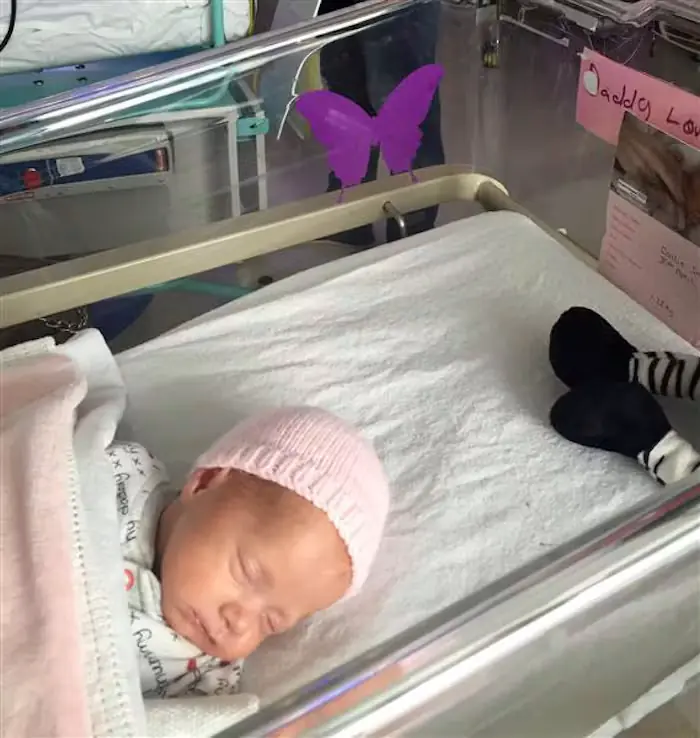
Chapter 1: Two Little Girls, One Pregnancy, and News No Parent Was Prepared to Hear
The Excitement of Discovering Twins
Millie Smith and Lewis Cann were looking forward to becoming parents.
When Millie discovered she was pregnant, she had a strong feeling that there might be more than one baby.
Twins were not entirely unfamiliar in her family. There were several sets of twins among her relatives, so the possibility did not seem impossible.
When the pregnancy scan confirmed that she was expecting identical twin girls, the couple experienced the excitement that many parents feel when they discover they are having more than one child.
They began imagining their future.
Two daughters would arrive together. They would share birthdays, grow up alongside one another and perhaps develop the special relationship often associated with twins.
The couple chose the names Callie and Skye.
Those names would soon become central to a story that reached families across the world.
However, the excitement surrounding the pregnancy did not last without interruption.
During an early scan, the medical team noticed something concerning.
Millie later recalled that the doctor became unusually quiet during the examination. She and Lewis sensed that something was wrong even before the full explanation was given.
The news was devastating.
One of their daughters had a serious condition called anencephaly.
The Diagnosis That Changed Everything
Anencephaly is a severe neural tube defect that occurs when important parts of the brain and skull do not develop properly during early pregnancy.
It is a rare but extremely serious condition.
In babies affected by anencephaly, major portions of the brain and skull may be absent. The condition is not compatible with long-term survival, and there is no treatment that can reverse the underlying developmental problem.
Doctors explained that Skye would not survive for long after birth.
For Millie and Lewis, the diagnosis created a situation that was almost impossible to comprehend.
They were still expecting two daughters.
One baby was developing with a condition that would prevent her from surviving, while the other continued to grow.
The couple had to prepare for two completely different outcomes within the same pregnancy.
There was no simple way to separate the joy of expecting Callie from the grief of knowing that Skye's life would be extremely short.
Every scan became emotionally complicated.
Every new stage of pregnancy carried both hope and fear.
The couple still wanted to celebrate their daughters.
They wanted Skye to have a name, an identity and a place in their family.
They did not want her to become merely a medical diagnosis or a sad detail in the history of the pregnancy.
She was their daughter.
And they wanted the short time they would have with her to matter.
Why They Chose to Continue the Pregnancy
According to accounts shared by Millie and organizations that later documented the family's story, the couple decided to continue the pregnancy despite the serious risks and emotional difficulties involved.
They wanted to give Callie the best possible chance while also allowing Skye to be born and spending time with her.
This decision required considerable emotional preparation.
The family knew that the birth would probably not resemble the experience they had originally imagined.
They would need medical support, specialist care and the opportunity to say goodbye.
The pregnancy was also considered high-risk.
Carrying twins already involves additional medical considerations, and the circumstances surrounding Skye's diagnosis made the situation even more complicated.
The couple had to balance medical advice, the needs of both babies and their own wishes as parents.
For Millie, the decision was rooted in love.
She wanted both girls to be acknowledged.
She wanted to hold Skye, speak to her and make sure that her daughter knew she was wanted.
This is an important part of the story because it explains why the purple butterfly later became so meaningful.
It was never intended to represent only sadness.
It was created to recognize a baby who had been part of a family, even if that baby had not lived long enough to come home.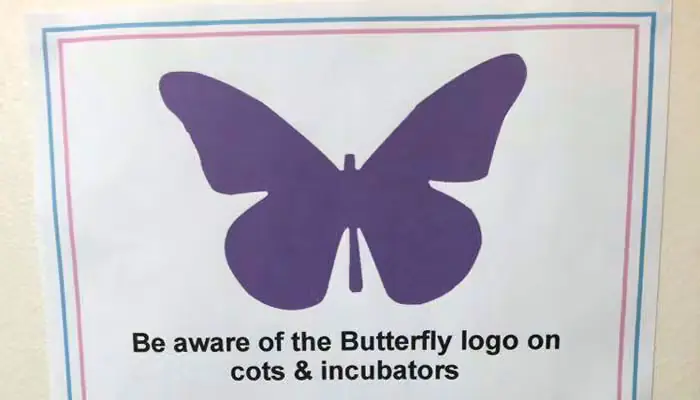
Chapter 2: The Birth of Callie and Skye – Three Hours That Changed Their Family Forever
April 30, 2016: The Day the Twins Arrived
After months of uncertainty, Millie went into premature labour.
The date was April 30, 2016.
She was approximately 30 weeks pregnant, considerably earlier than the usual time for a twin delivery.
The medical team at Kingston Hospital in the United Kingdom prepared for the arrival of both babies.
For Millie and Lewis, this was the moment they had spent months anticipating, but it was also the moment they had feared.
They knew Skye's condition meant that her life would be extremely short.
They also knew Callie had arrived prematurely and would need specialist medical attention.
When the girls were born, both babies cried.
For a brief moment, the sound of two newborns entering the world brought an unexpected feeling of hope.
Skye had arrived.