The wider Neonatal Butterfly Project grew out of research involving bereaved parents and healthcare professionals.
According to neonatal researcher Professor Nick Embleton, the project developed after studies explored the experiences of families who had lost one baby from a multiple pregnancy while another survived.
A parent suggested using a butterfly cot card to acknowledge the baby who had died.
The project began developing in 2015.
Professor Embleton later collaborated with Millie and the Skye High Foundation, helping develop resources, guidance and educational materials for neonatal staff.
This work is related to the same central aim: ensuring that families experiencing multiple-birth loss receive sensitive and appropriate care.
The distinction is useful because the purple butterfly symbol is part of a broader effort to improve how hospitals acknowledge bereavement.
NEONATAL RESEARCH+1
More Than 100 NHS Hospitals and Hundreds Worldwide
The initiative has continued to grow.
The Neonatal Research website reports that the Butterfly Project has been adopted in more than 100 NHS hospitals across the United Kingdom and hundreds of hospitals worldwide.
It also describes educational resources and training designed to help healthcare professionals understand the experiences of bereaved parents.
This is a remarkable development for an idea that began with one mother's painful experience in a hospital room.
The symbol has moved beyond its original setting.
It has become part of a wider conversation about how hospitals can support families after the loss of one or more babies from a multiple pregnancy.
A Purple Butterfly in Hospitals Around the World
Hospitals in different countries have introduced versions of the initiative.
Nationwide Children's Hospital in the United States, for example, has documented its participation in the Purple Butterfly Project.
The hospital explains that a purple butterfly may be placed on the door of a patient who was part of a multiple birth but whose sibling did not survive.
The symbol helps staff and other families recognize the loss while celebrating the life of the surviving baby.
The hospital also describes the story of Millie, Lewis, Callie and Skye as the inspiration behind its participation.
Nationwide Children's Hospital+1
The concept has also reached other countries through neonatal organizations and bereavement-support groups.
In New Zealand, for example, the Neonatal Trust and Multiples New Zealand worked together to introduce the purple butterfly initiative.
These developments show that the emotional challenge faced by Millie and Lewis is not limited to one country.
Parents everywhere can experience the loss of one baby while another child from the same pregnancy survives.
The language, healthcare systems and hospital practices may differ.
But the need for sensitivity is universal.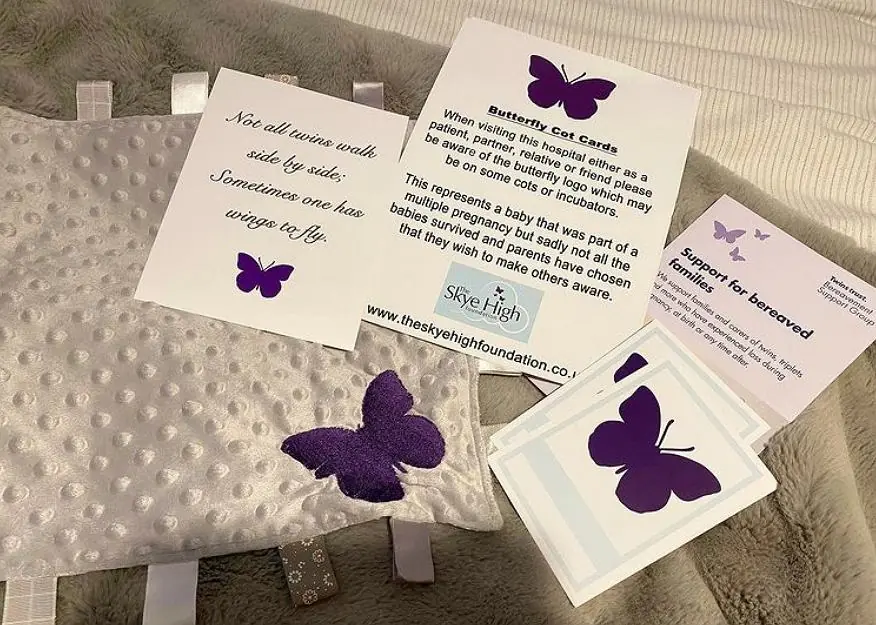
Chapter 5: The Invisible Grief Experienced by Parents of Surviving Twins
One of the most important reasons the purple butterfly matters is that the grief associated with multiple-birth loss can be difficult for other people to recognize.
When a parent loses a baby during pregnancy or shortly after birth, relatives and friends may offer sympathy.
They may send flowers, attend a funeral or ask how the family is coping.
But when another baby survives, the situation can become more complicated.
The family is simultaneously welcoming a child and grieving another.
Happiness and Grief Can Exist Together
Imagine a mother visiting her premature newborn in the NICU.
The baby has gained weight.
The doctors are pleased with the progress.
The mother is relieved.
She smiles when she sees the baby moving in the incubator.
But when she looks at the empty space where the other twin might have been, the happiness becomes mixed with sadness.
She may wonder what the surviving child would have looked like beside their sibling.
She may imagine the two babies growing up together.
She may think about the first birthday they were supposed to celebrate as twins.
A medical improvement can be wonderful news, but it does not remove the grief.
This is why phrases such as "At least you still have one baby" can be so painful.
They may be intended as reassurance, but they can make parents feel that the baby who died is being treated as less important.
The surviving child is not a replacement.
The two babies are separate individuals.
Both were wanted.
Both were part of the family.
The Pressure to Explain the Missing Baby
Another difficulty is that parents may have to explain their loss repeatedly.
A new nurse enters the room.
A relative visits.
Another family begins a conversation.
A hospital worker asks about the pregnancy.
Each interaction may require the parent to decide whether to explain that the surviving baby had a twin who died.
Sometimes parents are comfortable talking about the lost child.
They may want people to know the baby's name.
They may appreciate opportunities to share photographs or memories.
At other times, they may feel too exhausted to repeat the story.
The purple butterfly can help reduce this burden.
It gives the family a way to communicate the situation without having to start the conversation themselves.
The Importance of Remembering Both Babies
A surviving twin may grow up knowing that they had a sibling who died.
Parents may choose to talk about the sibling from an early age.
They may keep photographs, handprints, hospital cards or other keepsakes.
Some families celebrate both babies' birthdays.
Others create a special remembrance day.
There is no single correct way to remember a baby.
Every family has its own beliefs, traditions and emotional needs.
But acknowledging the lost sibling can help the family feel that the baby has not been erased from its history.
The butterfly serves as a visible reminder of that principle.
It tells people that the surviving baby is not the only child in the family's story.
Why Silence Can Sometimes Hurt More Than Words
Many people feel uncomfortable discussing baby loss.
They worry about saying the wrong thing.
They may avoid mentioning the baby who died because they think doing so will make the parents sad.
But for some bereaved parents, silence can feel as though their child has been forgotten.
A name spoken with kindness may be more comforting than pretending nothing happened.
A simple acknowledgment can communicate that the baby mattered.
This does not mean visitors should ask intrusive questions or demand details.
It means allowing parents to decide how much they wish to share.
A purple butterfly can create an opening for a gentle, respectful conversation.
It can also signal that the family may prefer privacy.
Understanding which response is appropriate requires listening rather than making assumptions.
Chapter 6: What Should You Do If You See a Purple Butterfly?
Understanding the meaning of the symbol is important, but knowing how to respond is equally important.
A family caring for a newborn with a purple butterfly on the incubator may be experiencing a situation that is difficult to understand from the outside.
The best response is usually simple: show kindness, respect their privacy and avoid making assumptions.
1. Avoid Asking Whether the Baby Is an Only Child
A question that seems harmless can bring back painful memories.
For example, asking a parent whether they are happy to have only one baby may unintentionally remind them of the sibling who died.
Instead, you can simply acknowledge the newborn.
If the parents want to talk about the baby's sibling, allow them to do so.
2. Do Not Assume the Parents Have Forgotten Their Lost Baby
The surviving newborn may be receiving all the attention from visitors and medical staff.
However, the parents may still be thinking about the baby who died.
They may want that child to be remembered and acknowledged.
A simple expression of sympathy can mean more than an attempt to find the perfect words.
3. Respect Their Privacy
Not every family wants to discuss the circumstances of their loss.
Some parents may openly share their experience.
Others may prefer to keep the details private.
The butterfly is not an invitation to ask personal medical questions.