Chapter 1: The Day the Earth Shook Japan
At 2:46 p.m. on March 11, 2011, a powerful earthquake struck beneath the Pacific Ocean off the northeastern coast of Japan. The shaking was felt across a vast area, including major cities far from the epicenter. Buildings swayed, roads cracked, trains stopped, and people rushed outside as the ground continued to move.
The earthquake became known as the Great East Japan Earthquake, or the Tōhoku earthquake. Its magnitude was ultimately assessed at 9.1 by the United States Geological Survey, making it one of the most powerful earthquakes ever recorded. It was also the largest earthquake ever instrumentally recorded in Japan.
The earthquake was caused by movement along a major boundary between tectonic plates near the Japan Trench. The Pacific Plate moves beneath the plate carrying northeastern Japan. Over long periods, pressure builds where the plates meet. When the accumulated stress is released suddenly, the seafloor can move dramatically, generating powerful seismic waves.
In 2011, the rupture affected an enormous section of the plate boundary. The resulting movement displaced a huge volume of seawater and created a tsunami that raced toward the Japanese coast.
The earthquake itself was devastating, but the tsunami became the greatest source of destruction. Within approximately 30 minutes, the first major tsunami waves had reached parts of the northeastern coastline. Seawalls that had been built to protect coastal communities were overtopped, while water surged through ports, residential neighborhoods, farmland, and industrial areas.
+1
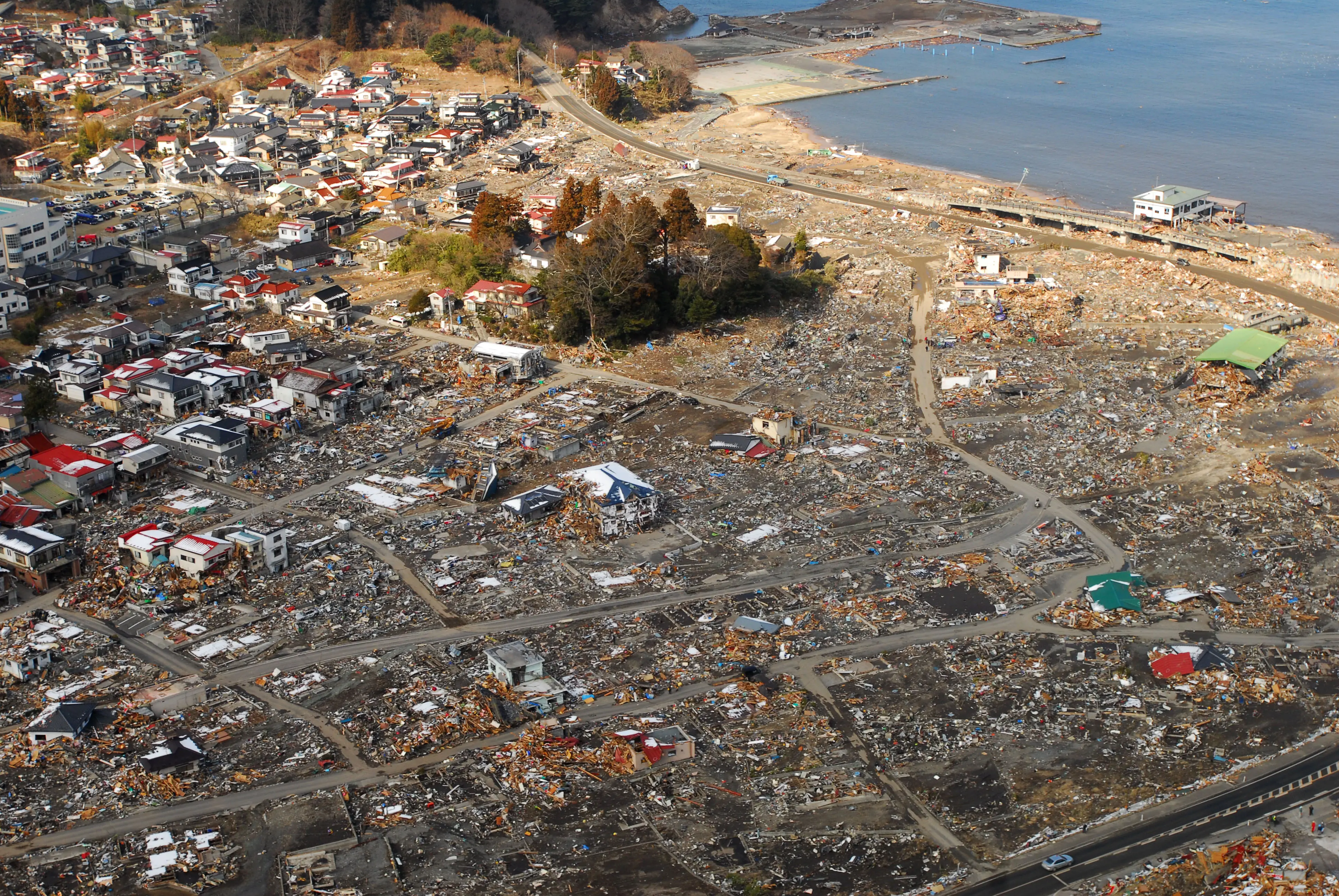
The scale of the disaster was difficult to comprehend. Entire communities were inundated. Houses were swept from their foundations, vehicles were carried away, and fishing boats were pushed inland. Roads and bridges were damaged, making it difficult for emergency services to reach people who needed help.
The tsunami did not strike only one city. It affected a long stretch of Japan's Pacific coastline, with researchers documenting impacts along approximately 2,000 kilometers. Some of the most severe damage occurred in the Tōhoku region, including the prefectures of Iwate, Miyagi, and Fukushima.
+1
That distinction matters because the dramatic image supplied with the headline does not establish a particular city. The 2011 disaster was a regional catastrophe involving numerous coastal communities, not a single town swallowed by one enormous wave.
The earthquake also triggered aftershocks, disrupted transport and communications, and damaged essential infrastructure. People who had escaped the initial shaking faced another immediate danger: the possibility of additional tsunami waves.
For many coastal residents, the safest decision was to move toward higher ground as quickly as possible. Yet evacuation was not always easy. Some people were elderly, disabled, caring for children, or unable to travel quickly. Others were caught in areas where roads had already been damaged.
The disaster demonstrated how quickly an earthquake beneath the ocean can become a national emergency. It also showed that even a country with extensive earthquake engineering and tsunami preparedness can face conditions beyond what its protective systems were designed to withstand.
Chapter 2: When the Ocean Became the Greatest Threat
A tsunami is often imagined as a single towering wall of water approaching the shore. In reality, tsunamis behave differently from ordinary wind-driven waves.
They consist of a series of long waves that can carry enormous energy across the ocean. In deep water, a tsunami may pass beneath a ship without appearing particularly dramatic. As it approaches shallow coastal waters, however, the wave slows down and its height can increase.
The danger is not limited to the first wave. Later waves may arrive after the initial flooding, and the strongest surge does not necessarily occur first. Water can continue moving inland, carrying debris and damaging structures long after the earthquake has stopped.
In the 2011 Tōhoku disaster, the tsunami reached extraordinary heights in some locations. The National Centers for Environmental Information reports a maximum wave height of almost 40 meters in Iwate Prefecture. The waves overwhelmed coastal defenses and travelled far inland in vulnerable areas.
+1
The force of moving water is one of the most dangerous aspects of a tsunami. Even relatively shallow water can exert tremendous pressure when it moves rapidly. Once it begins carrying vehicles, timber, boats, and pieces of buildings, the resulting debris can cause further destruction.
A person caught in such a flow may have little chance of remaining upright, let alone swimming to safety. Buildings that appear solid under ordinary conditions can be undermined by erosion or struck by heavy objects carried by the water.
In coastal towns, the impact extended beyond homes. Fishing harbors, warehouses, shops, schools, roads, electricity networks, and water systems were damaged. Communities that depended on the sea for their livelihoods suddenly found their boats and equipment scattered across streets and fields.
The tsunami also created a dangerous situation for emergency responders. Flooded roads, damaged bridges, unstable buildings, and debris made it difficult to reach affected neighborhoods. Some areas could only be assessed from the air or approached after conditions became safer.
The waves did not stop at Japan. The tsunami travelled across the Pacific and was detected at coastal gauges in more than 25 countries and regions. Although the greatest destruction occurred in Japan, the event demonstrated that a major tsunami can affect coastlines thousands of kilometers from its source.
+1
The international impact was a reminder that tsunami preparedness cannot be limited to countries located near the most active earthquake zones. Ocean-wide warning systems and cooperation between governments are essential.