An inside key may interfere with the operation of some cylinders, but it is not a universal anti-picking device.
A key inserted on the inside does not automatically reinforce the door, strengthen the frame, or make the lock resistant to forced entry.
It also does not necessarily prevent other forms of lock manipulation.
The more reliable approach is to use a properly installed, quality lock that has been designed to resist common attacks.
Police.uk recommends upgrading to suitable security-rated euro cylinder locks and ensuring that doors and windows are properly secured.
A well-designed lock should be considered part of a complete security system rather than a standalone solution.
The door itself matters too. A strong lock installed in a weak door or poorly reinforced frame may still provide limited protection.
For this reason, homeowners should not assume that leaving a key inside makes an ordinary lock equivalent to a high-security lock.
3. Why the Sound of Keys May Help—but Should Not Be Trusted
Another reason given for leaving keys in the door is that they may create a sound when someone tries to manipulate the handle or lock.
The idea is easy to understand.
If several keys are attached to a metal key ring and left in the cylinder, movement of the lock may cause them to rattle. In a quiet house at night, that sound could potentially attract attention.
But this should not be treated as a dependable alarm.
A person may turn a handle very gently. Some locks operate quietly. The keys may not move enough to create a noticeable sound, especially if they are held close to the door or resting against another surface.
In addition, household sounds can easily mask the noise.
A television, air conditioner, fan, running water, or even heavy rain may make a small rattling sound difficult to hear.
The sound of keys also does not identify what is happening outside. It could be caused by a family member, a loose mechanism, or normal movement of the door.
A proper door sensor or alarm is much more reliable for detecting unauthorized opening.
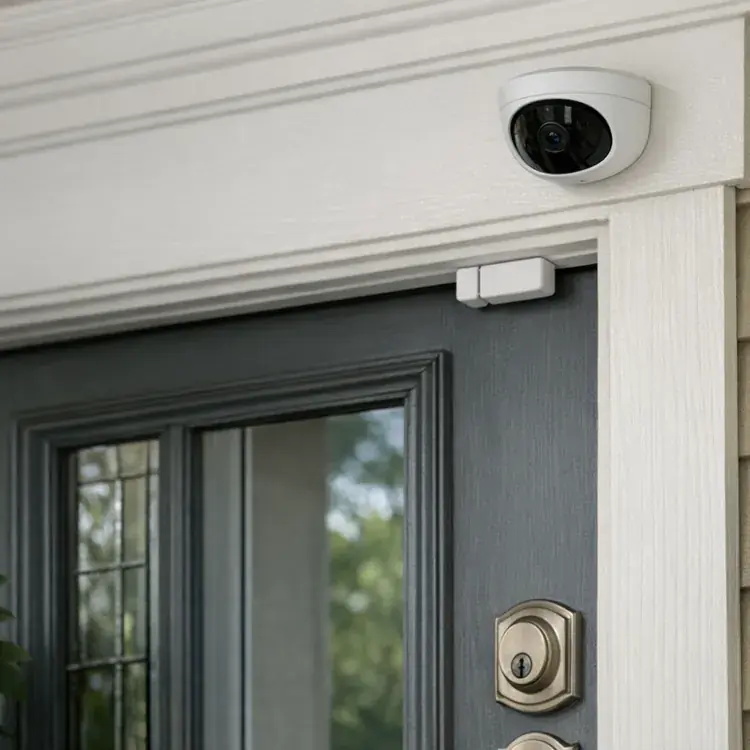
A magnetic contact sensor can be installed on the door and frame. When the door opens, the sensor can trigger an alarm or send a notification, depending on the system.
The key may produce a useful incidental sound, but it should never replace a dedicated security device.
4. The Most Important Benefit: Knowing Exactly Where the Key Is
One of the most practical reasons to prepare the door before going to bed has nothing to do with preventing burglary.
It is about avoiding confusion.
Many households have experienced the frustration of searching for a key at the wrong moment. The key may be left in a handbag, placed on a table, carried into another room, or mixed with several other keys.
During an emergency, this small inconvenience can become much more serious.
Imagine a situation in which a family needs to leave the house quickly because of smoke, an electrical problem, or another urgent danger.
If the key is always kept in a known location, the household can avoid wasting time searching for it.
However, the safest location is not necessarily inside the lock.
For doors that can be unlocked from inside without a key, a fixed key hook near the entrance may be a better choice. The key should be easy for household members to reach but not accessible to someone outside through a letterbox, broken glass, or another opening.
Police.uk warns against keeping keys near exterior doors where someone might reach through a letterbox or other opening to retrieve them.
The important principle is consistency.
Every person in the household should know where the key is kept and how to use it.
5. The Hidden Danger: Could Leaving a Key in the Lock Make Escape Harder?
This is the part of the nighttime key habit that deserves the most attention.
A key left inside the door may be convenient, but certain lock designs can create a serious problem if the household needs to escape quickly.
Some doors require a key to unlock from both sides. These are often called double-cylinder deadbolts.
If a key is inserted on the inside, it may be possible to unlock the door quickly. But if the key is removed, misplaced, or turned into an unexpected position, the door may become difficult to open.
The danger is especially serious when a fire occurs.
Smoke can spread rapidly through a home, reducing visibility and making it difficult to think clearly. A person who normally knows how to operate a lock may struggle when frightened, coughing, or trying to help a child or older family member.
The South Australian Metropolitan Fire Service warns that security devices can prevent occupants from escaping if they cannot find the keys needed to unlock them. It recommends making sure doors and windows can be opened quickly from inside.
This is why fire safety must be considered before adopting any nighttime locking routine.