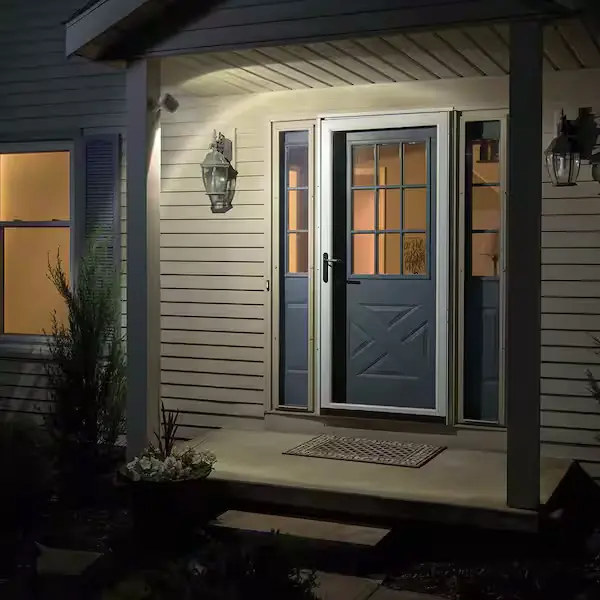
A dark entrance can make it difficult for residents to see what is happening outside.
Motion-sensor lights can improve visibility by switching on when movement is detected near the entrance.
The sudden illumination may also discourage someone who prefers to approach a house without being noticed.
Police guidance recommends outdoor lighting, including motion-activated lights, as one way to reduce opportunities for burglary.
askthe.police.uk
The most useful locations may include:
-
The front door.
-
A side entrance.
-
A garage door.
-
A pathway leading to the house.
-
A poorly lit section of the garden.
The light should be positioned so that it illuminates the approach without shining directly into neighbors' windows.
It is also important to maintain the equipment. A motion sensor that is blocked by plants or aimed incorrectly may fail to detect someone approaching.
A well-lit entrance can help residents identify visitors, find the keyhole, and move safely around the property at night.
11. An Alarm System Can Provide a More Reliable Warning
A home alarm system is designed to detect certain types of activity and alert residents.
Depending on the system, sensors may be installed on doors, windows, or other access points.
Some systems produce a loud local alarm. Others can send notifications to a smartphone or connect to a monitoring service.
A door-opening sensor can provide a more dependable warning than the sound of keys rattling in a lock.
However, alarm systems need to be installed and maintained properly.
A sensor with a depleted battery may fail. A poorly positioned sensor may not detect the activity it was intended to monitor.
Residents should also understand what happens when the alarm is triggered.
Does it simply make a sound? Does it send a notification? Is someone responsible for checking the alert?
Police Scotland explains that home alarm systems may include magnetic door and window sensors, motion sensors, and glass-break sensors.
The right system depends on the property and the household's needs.
12. The Door Itself Must Be Strong Enough
A lock can only provide limited protection if the door and frame are weak.
For example, a high-quality lock installed in a damaged frame may not provide the level of security the homeowner expects.
The door's hinges, strike plate, frame, and surrounding structure all play a role.
A strong exterior door should be properly fitted and maintained. Loose hinges, damaged wood, worn screws, or a poorly aligned latch can reduce its effectiveness.
Police.uk recommends checking the strength of the door and its frame and seeking advice from a qualified locksmith when improvements are needed.
Homeowners should also check whether the lock is appropriate for the type of door.
A lock designed for one door material may not be suitable for another.
If the door has a large glass panel, the security arrangement may need additional consideration.
The goal is to make the entrance secure while preserving a safe and convenient way to leave from inside.
13. A Nighttime Security Routine That Makes Sense
Instead of focusing only on the key, households can develop a short routine before going to bed.
The routine does not need to be complicated.
First, check that the front door is fully closed and locked.
Second, check other exterior doors, including the back door and any door leading to a garage.
Third, make sure accessible windows are closed or secured appropriately.
Fourth, confirm that the key is in its designated location and that everyone knows where it is.
Fifth, check that the door can be unlocked quickly from inside.
Finally, make sure smoke alarms and other essential safety devices are working.
A routine like this helps reduce the chance of forgetting an important security step.
It also avoids relying on a single action—such as inserting a key—as though it could protect the entire home.
The College of Policing identifies physical security measures such as door locks, window locks, deadbolts, and exterior lights as useful elements of burglary prevention.
14. What Families With Children Should Consider
Households with children need to pay special attention to how locks and keys are managed.
A child may not understand how a complicated lock works, particularly during an emergency.
If a door requires a key to open from inside, children should know where the key is kept and how to use it safely.
However, the safest arrangement is usually one that does not require a key for emergency exit.
Children should be taught:
-
Which doors are safe exits.
-
How to open those doors.
-
What to do if they hear a smoke alarm.
-
How to call for help.
-
Why they should never play with locks or keys.
The same principles apply to older adults and people with mobility or cognitive difficulties.
A lock that is easy for one adult to operate may be difficult for another household member.
Before making changes to the locking system, consider whether everyone in the home can use it independently.
15. What to Do if You Hear Something Near the Door at Night
Hearing an unfamiliar sound outside can be frightening.
But it is important not to assume immediately that someone is attempting to break in.