Have you ever noticed how often people cross their legs while sitting?
You may see someone do it during a conversation, at a restaurant, while working at a desk, waiting for an appointment, or simply relaxing at home. It is such a familiar posture that most people rarely stop to ask why they do it.
For women in particular, leg crossing is sometimes treated as a mysterious form of body language. Some people claim it reveals confidence, attraction, nervousness, elegance, or even a person's personality.
The reality is much less dramatic.
There is no single meaning behind crossing your legs. People do it for comfort, habit, posture, personal space, clothing, temperature, social conventions, and sometimes simply because one position feels better than another.
Body language can provide clues about a person's state of mind, but a single gesture should never be treated as a reliable way to determine what someone is thinking or feeling.
So why do women and people in general often cross their legs when sitting?
Let's take a closer look.

1. It May Simply Feel Comfortable
The most obvious explanation is often the one people overlook:
Crossing your legs can feel comfortable.
When sitting for a while, people naturally shift their posture.
You might:
-
Cross your legs
-
Uncross them
-
Move one foot forward
-
Tuck one leg underneath you
-
Lean against the back of the chair
-
Change the position of your hips
-
Shift your weight from one side to the other
These small movements help prevent the body from remaining completely static.
For someone who has developed the habit of crossing their legs, the position may simply feel natural.
There doesn't have to be a hidden psychological message behind it.
2. It's Often a Habit
Posture is strongly influenced by repetition.
If someone has crossed their legs for years, they may do it automatically without consciously deciding to.
The sequence can become almost unconscious:
Sit down.
Get comfortable.
Cross one leg over the other.
Continue the conversation.
In many cases, the person isn't thinking about their legs at all.
This is similar to other everyday habits, such as tapping a foot, folding your arms, resting your chin on your hand, or adjusting your position in a chair.
Once a posture becomes familiar, the brain doesn't need to consciously control every movement.
3. People Naturally Change Position While Sitting
Humans are not designed to remain perfectly still for long periods.
Even when someone appears to be sitting quietly, their muscles are making small adjustments to maintain balance and comfort.
Crossing the legs changes how weight is distributed through the pelvis, hips, thighs, and feet.
After sitting in one position for several minutes, changing the position can feel relieving.
That's why someone may cross their legs, uncross them, and then cross them again a few minutes later.
The movement isn't necessarily meaningful.
It may simply be the body's way of finding a more comfortable position.
4. It Can Be Influenced by Clothing
Clothing can also affect how people sit.
Certain outfits may make a person more conscious of how they position their legs.
For example, someone wearing a skirt or dress may naturally choose a seated position that feels secure and comfortable.
That doesn't mean there is one universal “women's sitting posture.”
People have different preferences, clothing styles, cultural backgrounds, and habits.
But clothing can certainly influence posture.
Someone wearing loose athletic clothing may sit differently from someone wearing formal clothing.
5. It Can Help Someone Feel More Secure or Comfortable in Public
People sometimes change their posture depending on their surroundings.
In an unfamiliar environment, a person may adopt a more contained posture.
Crossing the legs can make the body feel more compact and controlled.
Someone sitting in a crowded waiting room, public transportation, restaurant, or unfamiliar office may unconsciously position their body in a way that feels more comfortable or gives them a sense of personal space.
Again, this doesn't automatically mean the person is anxious or uncomfortable.
Context matters.
6. Social and Cultural Habits Can Play a Role
Posture isn't purely biological.
People learn many aspects of body language from their surroundings.
Children observe how adults sit, stand, greet people, eat, and behave in formal settings.
Over time, these behaviors become familiar.
In some cultures or social environments, certain seated positions may be perceived as more formal, polite, or appropriate than others.
Ideas about “ladylike” posture have also influenced generations of women in some societies.
For example, girls may have been taught from a young age to sit with their knees together or legs crossed.
When a behavior is repeatedly taught and practiced, it can become automatic.
7. It May Be a Way of Managing Personal Space
Personal space varies from person to person.
When sitting next to someone, people constantly make small adjustments to avoid feeling crowded.
Crossing the legs changes the position and shape of the lower body.
Sometimes that can make a seated posture feel more contained.
This can be particularly noticeable when sitting in:
-
Crowded waiting rooms
-
Airplanes
-
Trains
-
Buses
-
Offices
-
Restaurants
-
Classrooms
However, crossing the legs does not necessarily indicate that someone wants to avoid interaction.
It is simply one possible way of arranging the body.
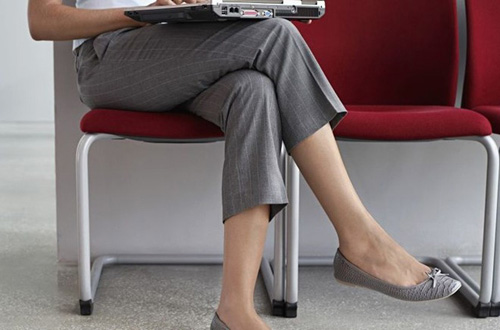
8. Sometimes It Is About Temperature
Temperature can influence posture more than people realize.
When someone feels cold, they may naturally bring their limbs closer to the body.
Crossing the legs can sometimes contribute to a feeling of warmth or simply be part of a more compact posture.
When people are hot, on the other hand, they may spread out, change positions frequently, or seek more airflow.
Our bodies are constantly making small adjustments based on environmental conditions.
9. It Doesn't Automatically Mean Attraction
This is where body-language myths become particularly misleading.
You may have heard that when a woman crosses her legs around someone, it means she is attracted to them.
That conclusion cannot reliably be drawn from the gesture alone.
Someone might cross their legs because:
-
They are comfortable
-
They always sit that way
-
They are cold
-
Their chair is uncomfortable
-
They are wearing certain clothing
-
They are simply changing position
If you're trying to understand someone's feelings, a single posture is far less informative than the broader context of their behavior and communication.
Body language should be interpreted as part of a pattern, not as a secret code.
10. It Doesn't Automatically Mean Nervousness Either
The opposite myth is equally common.
Some people assume that crossed legs indicate nervousness, defensiveness, or insecurity.
Again, there isn't a universal rule.