A person can cross their legs while feeling completely relaxed.
Another person might sit with both feet firmly on the floor while feeling extremely nervous.
Body language varies enormously between individuals.
Someone's usual posture is often more informative than comparing them to an imaginary “normal” posture.
What About Crossing One Leg Over the Other?
There are several different ways people cross their legs.
Someone may place one knee directly over the other.
Another person may cross at the ankles.
Someone else may tuck one foot behind the other.
These positions aren't necessarily associated with different psychological meanings.
The exact posture may depend on:
-
Chair height
-
Leg length
-
Flexibility
-
Clothing
-
Habit
-
Comfort
-
The person's physical condition
Trying to assign a specific personality trait to every variation is likely to create more confusion than useful information.
Does Crossing Your Legs Cause Health Problems?
You've probably heard the claim that crossing your legs is inherently bad for your health.
The reality is more nuanced.
For most healthy people, occasionally crossing the legs is not considered inherently dangerous.
However, staying in the same position for a long time can contribute to discomfort, stiffness, or temporary changes in circulation.
Some people may also experience pins and needles or numbness if a posture puts pressure on a nerve.
If that happens, simply changing position usually relieves the sensation.
The bigger concern isn't necessarily whether your legs are crossed.
It's whether you're sitting in one position for too long.
Long Periods of Sitting Matter More Than One Specific Posture
Modern lifestyles often involve extended periods of sitting.
People may spend hours:
-
Working at a computer
-
Driving
-
Watching television
-
Using a phone
-
Studying
-
Gaming
Remaining sedentary for long periods can have broader health implications.
That's why regularly standing up, walking around, stretching, and changing positions is generally more useful than worrying excessively about whether your legs are crossed.
A simple rule is:
Move regularly rather than trying to find one “perfect” sitting position.
What If Your Leg Goes Numb?
Occasionally, crossing your legs can place pressure on nerves or blood vessels.
You might experience:
-
Tingling
-
Pins and needles
-
Temporary numbness
-
A feeling that your foot has “fallen asleep”
Changing position usually allows the sensation to disappear.
But persistent or recurrent numbness shouldn't automatically be blamed on the way you sit.
If numbness continues after changing position, repeatedly occurs without an obvious reason, or is accompanied by weakness, severe pain, swelling, or other neurological symptoms, medical evaluation may be appropriate.
Is There a “Correct” Way for Women to Sit?
Not really.
There is no single posture that every woman should use.
The ideal seated position depends on the individual and the situation.
A comfortable position generally allows you to:
-
Keep your body reasonably supported
-
Avoid prolonged pressure on one area
-
Change position when necessary
-
Maintain comfortable alignment
-
Get up and move regularly
You don't need to force your legs into a particular position simply because someone says it looks more elegant or healthy.
Comfort and movement are more useful goals than trying to achieve a perfect pose.
Why People Change Their Legs During Conversations
Have you ever noticed someone cross their legs, uncross them, and then switch sides while talking?
This is completely normal.
Sitting still for an extended conversation can become uncomfortable.
The person may simply be shifting their weight.
However, body position can sometimes change with emotional state.
For example, someone may sit differently when they become more relaxed or more engaged in a conversation.
The important point is that you cannot reliably determine the reason from one movement alone.
To interpret nonverbal behavior responsibly, you would need to consider the entire context, the person's normal behavior, their verbal communication, and the situation.
Why the Same Person May Sit Differently Around Different People
Posture can change depending on social setting.
Someone may sit casually at home but adopt a more upright position during a job interview.
They may cross their legs while talking to a close friend but keep both feet on the floor during a formal meeting.
That doesn't necessarily mean their personality has changed.
Different environments create different expectations.
People naturally adjust their behavior to fit the situation.
The Most Common Reason May Be the Simplest One
After all the theories about body language, attraction, confidence, elegance, and personality, the simplest explanation remains the most important:
Sometimes people cross their legs because it feels comfortable.
That's it.
Not every movement has a hidden meaning.
Not every posture is a psychological signal.
And not every gesture should be decoded like a secret message.
Human body language is complicated because human behavior is complicated.
So, Why Do Women Often Cross Their Legs?
There isn't one universal answer.
Women may cross their legs because:
-
It feels comfortable
-
They have developed the habit
-
They want to change position
-
Their clothing influences their posture
-
They are adjusting to the chair
-
They feel cold
-
They are sitting in a crowded space
-
They were taught a particular posture
-
They simply prefer that position
And sometimes, there may be no conscious reason at all.
The same applies to men.
Although social expectations can influence how people sit, the basic human need for comfort, movement, and balance remains the same.
The Bottom Line
Crossing your legs while sitting is one of the most ordinary human postures, yet it has inspired countless theories about personality and body language.
Some interpretations can be interesting, but they shouldn't be treated as universal rules.
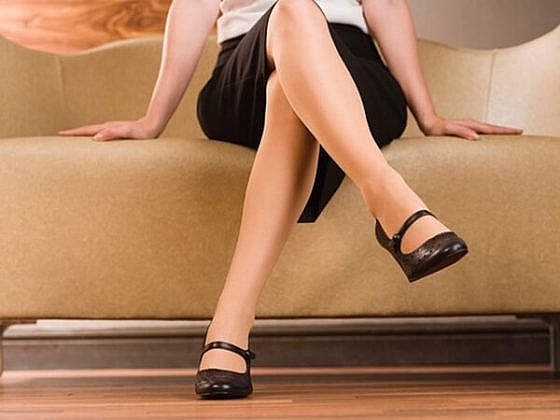
A woman crossing her legs does not automatically mean she is confident, shy, nervous, attracted to someone, uncomfortable, or trying to send a particular message.
Context matters.
Her facial expression, words, overall behavior, environment, and normal habits provide far more information than one isolated movement.
And from a physical standpoint, the most important consideration isn't whether your legs are crossed.
It's whether you're comfortable and whether you're moving regularly rather than remaining in one position for hours.
So the next time you notice someone crossing their legs while sitting, there may be no mysterious explanation at all.
She may simply be getting comfortable.